


 English
 русский
 Español
 عربى


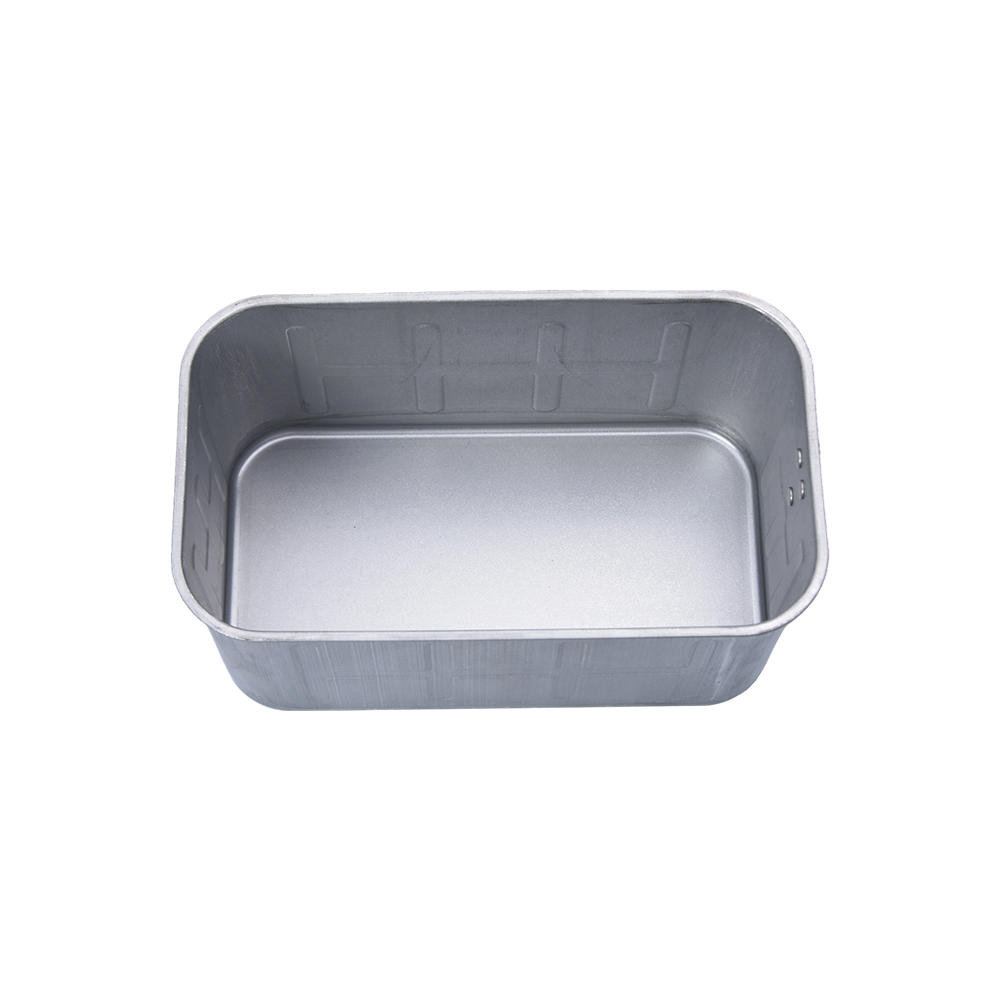
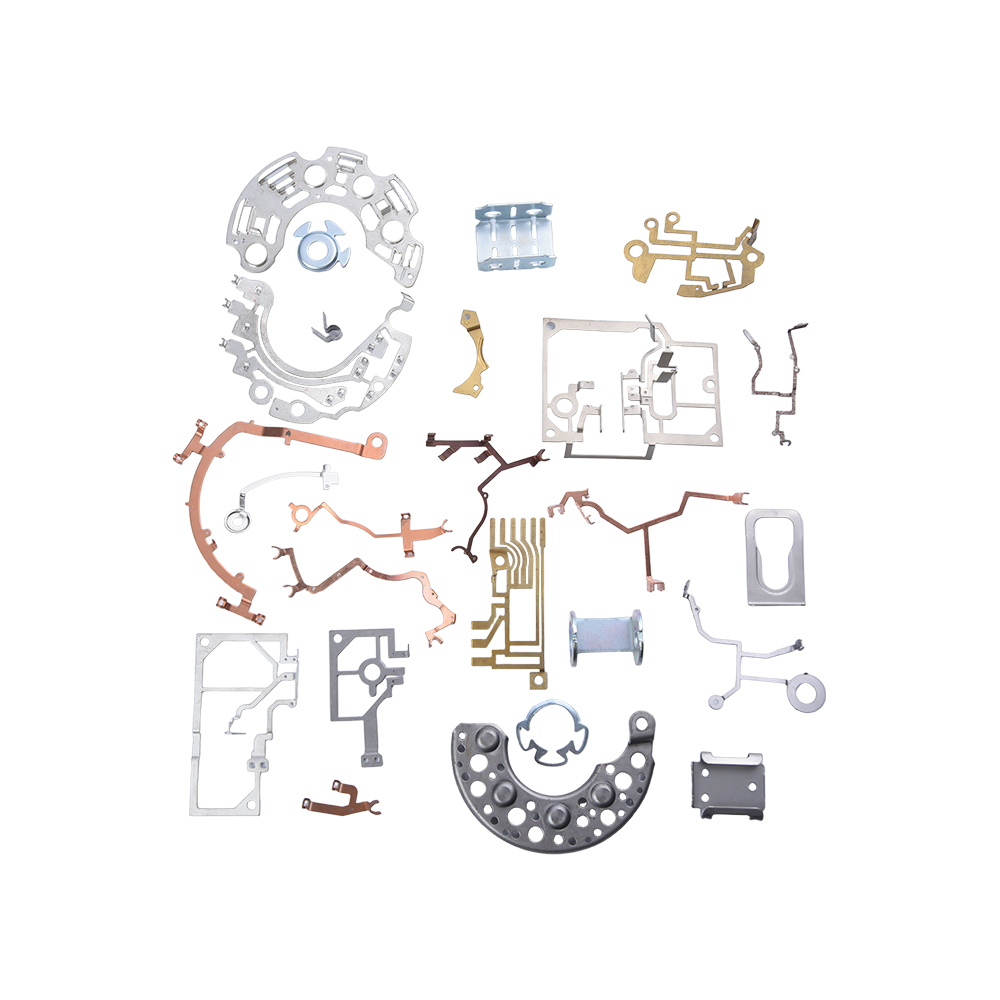
Sheet metal bending is one of the most fundamental processes in metal fabrication. It turns a flat sheet of steel, aluminum, or copper into...
READ MORE

News
Home / Author / Wang Xinyi — Senior After-Sales Coordinator / Air Fryer Baking Tray: Versatile, Durable, and Precision-Made for Modern Cooking
Air Fryer Baking Tray: Versatile, Durable, and Precision-Made for Modern Cooking
2026-10-26
The air fryer baking tray has become an essential accessory for households seeking more flexibility from their kitchen appliances. Designed to support baking, roasting, grilling, reheating, and air frying, this practical component expands the function of an air fryer beyond ordinary frying. Instead of limiting the appliance to chips, nuggets, or small portions of meat, a well-designed baking tray allows users to prepare cakes, cookies, pizzas, vegetables, seafood, and other foods with greater convenience and consistency.
A high-quality air fryer baking tray must do more than simply fit inside an appliance. It must tolerate repeated exposure to high temperatures, promote effective air circulation, resist rust and stains, release food residue easily, and maintain its shape during regular use. It must also be manufactured with accurate dimensions so that it can be installed, removed, and cleaned without difficulty. These requirements make precision metal forming, sheet metal stamping, deep drawing, bending, and strict quality control especially important.
The Air Fryer Baking Tray supplied by Yuyao Hongli Optoelectronics Co., Ltd. is designed around these practical requirements. Produced by an experienced manufacturer of drawn metal products, deep drawn metal parts, precision sheet metal stamping, and kitchen appliance accessories, the tray combines functional design with reliable manufacturing quality. Its heat-conductive metal construction supports even cooking, while its perforated or mesh-style surface assists the circulation of hot air around the food.
For appliance manufacturers, kitchenware distributors, wholesalers, and businesses seeking OEM or ODM products, this type of baking tray offers a balance of performance, durability, production consistency, and customization potential. For end users, it provides a simple way to make an air fryer more versatile and easier to use.
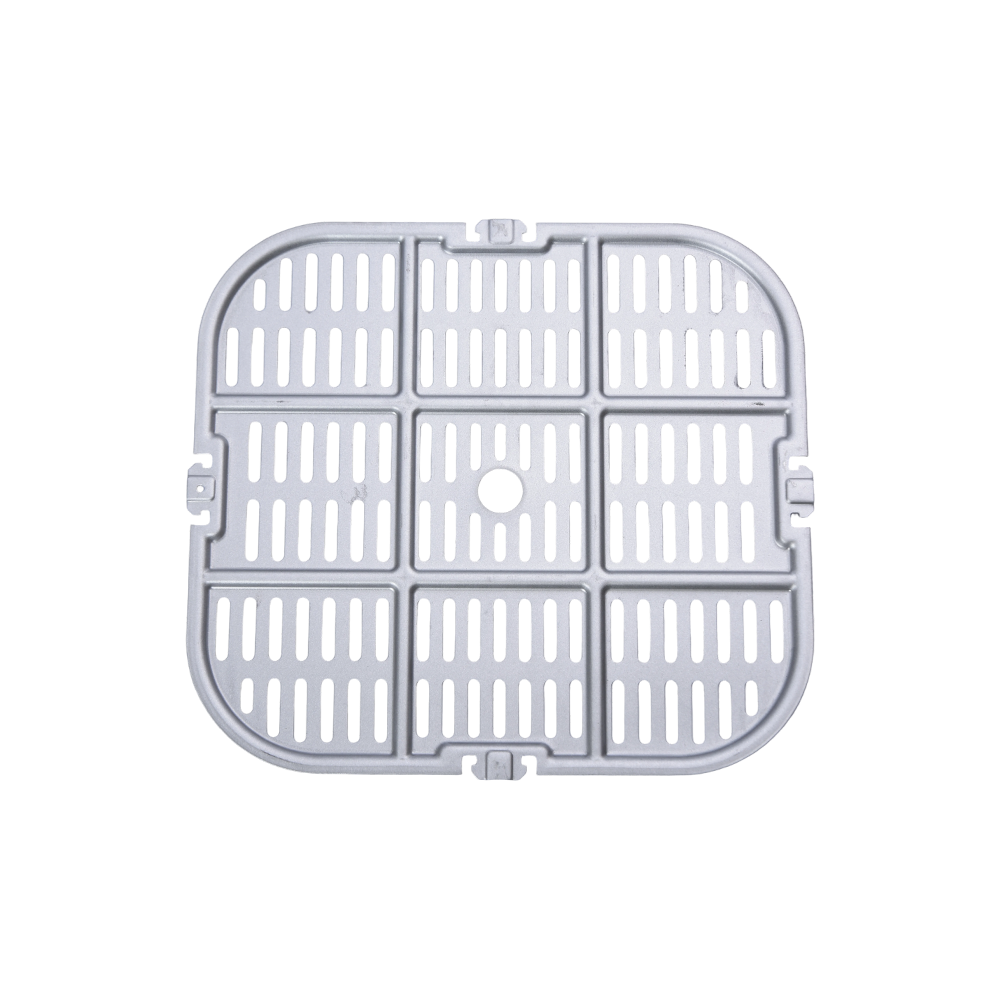
Air fryer baking tray
What Is an Air Fryer Baking Tray?
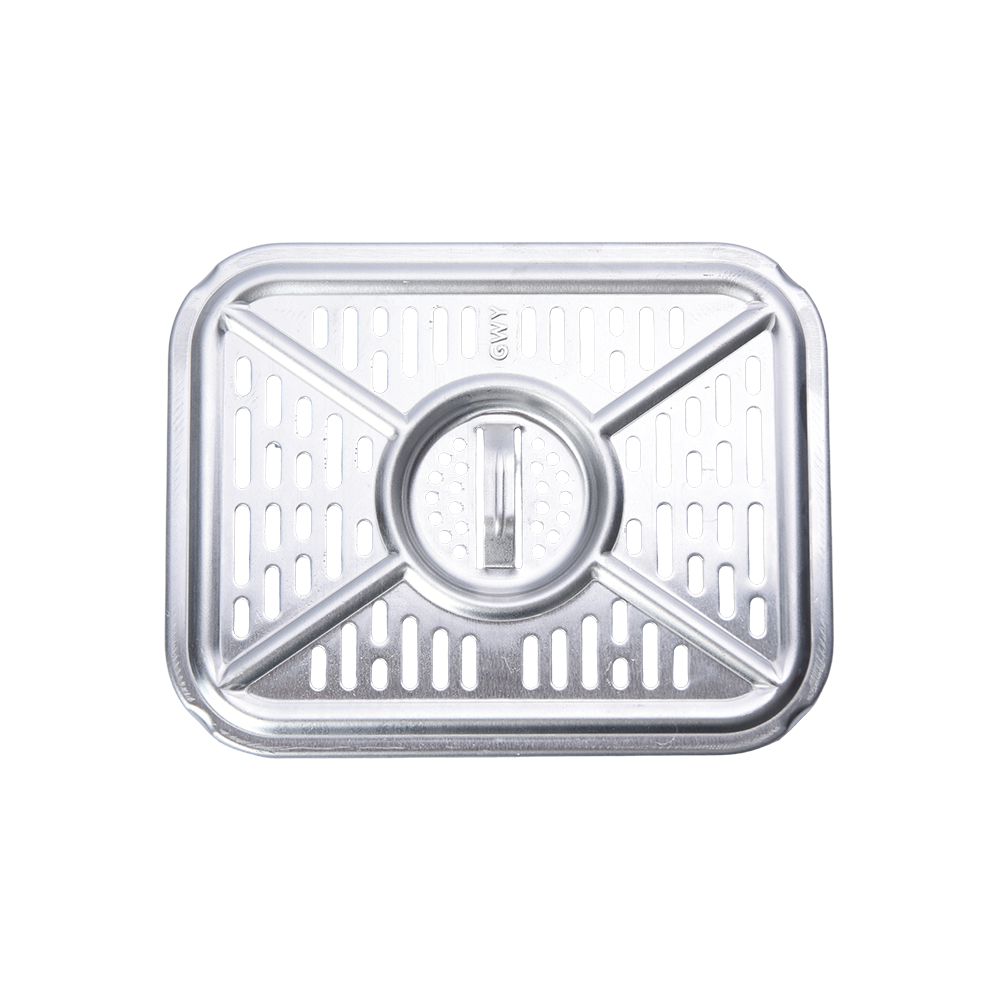
An air fryer baking tray is a shaped metal accessory designed to sit inside an air fryer basket or cooking chamber. Depending on the appliance design, it may be used as a flat tray, raised platform, baking surface, grill plate, or secondary cooking layer. The tray generally includes a smooth or perforated metal body that supports food while allowing hot air to circulate underneath and around it.
Unlike a basic solid container, a perforated air fryer baking tray can help distribute heat more effectively. Openings in the surface allow heated air to contact a larger portion of the food. This is particularly useful when preparing items that benefit from a crisp outer surface, such as vegetables, potatoes, chicken wings, seafood, and breaded foods.
The tray can also provide a more stable and organized cooking surface. Small food pieces are less likely to fall through a large basket opening, while delicate items such as cookies, pastries, or thin slices of vegetables can be arranged more easily. When used for baking, the tray helps contain batter and dough. When used for roasting or grilling, it creates a defined surface that can simplify handling and cleanup.
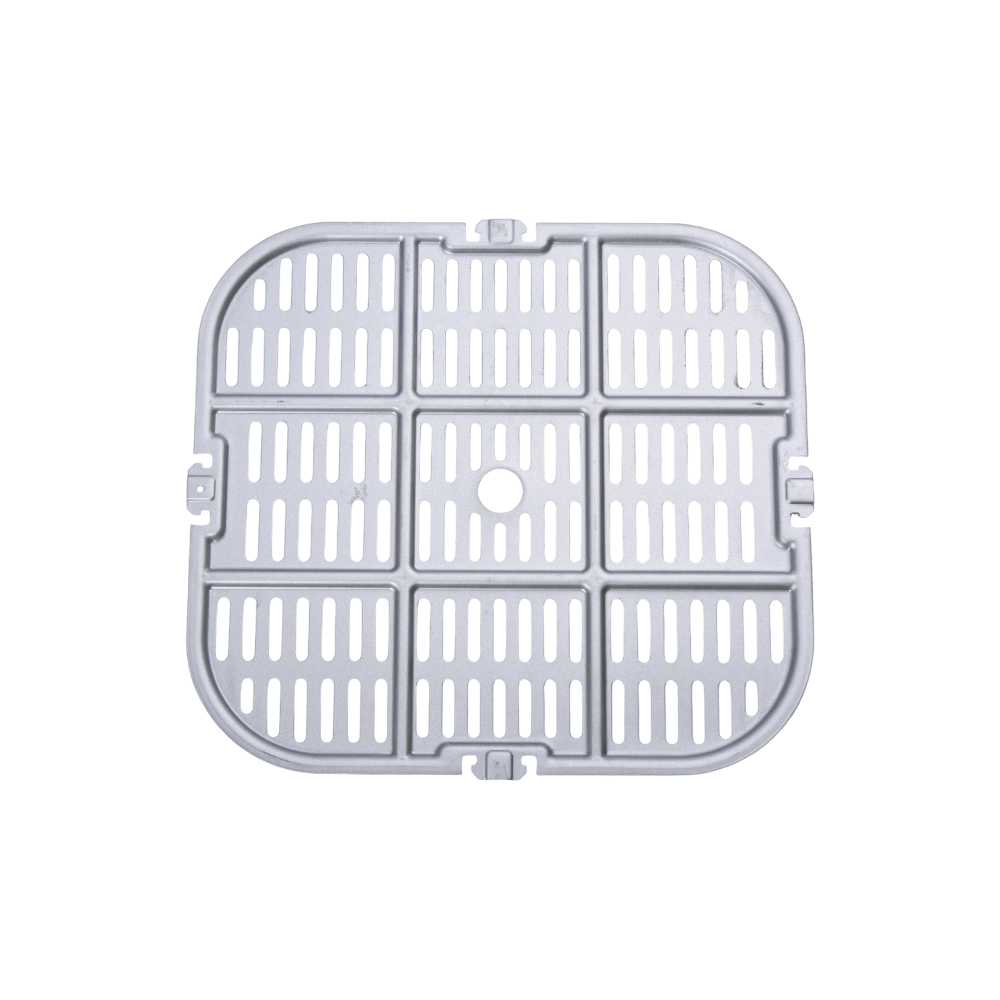
The exact form of the product can vary according to the air fryer model, capacity, and intended application. Some designs have a flat base with raised edges. Others include a grid, mesh, or series of stamped ventilation holes. Certain versions may have formed corners, reinforced rims, or small locating features that help position the tray correctly inside the appliance.
Core Product Features
Excellent Heat Conductivity
Metal is widely used for cooking accessories because it transfers heat efficiently. A well-selected metal material allows the baking tray to respond quickly to the temperature inside the air fryer. As heated air moves through the cooking chamber, the tray distributes heat across its surface and supports more uniform cooking.
Good heat conductivity is valuable when baking foods that require a stable temperature. Cakes, cookies, and pastry products can be affected by uneven heating. A tray with consistent material thickness and accurate forming helps reduce irregular hot spots and supports a more predictable cooking result.
Heat conductivity is also important during roasting and reheating. Food can warm more evenly, reducing the possibility that the exterior becomes overcooked while the center remains cold. While cooking results also depend on food size, appliance power, temperature settings, and air circulation, the tray provides a dependable foundation for efficient heat transfer.
Perforated or Mesh-Style Surface
The surface design of an air fryer baking tray has a direct effect on cooking performance. Perforations or mesh-style openings allow heated air to pass through and reach the underside of the food. This helps preserve the air fryer’s circulating-air principle instead of creating a completely blocked surface.
A carefully designed opening pattern can support several benefits. It can help remove moisture from the food surface, encourage browning, and improve crispness. It can also reduce the amount of direct contact between the food and the tray, which may make cooking more uniform.
Perforation design must be balanced carefully. Openings that are too large may allow small ingredients or soft food to fall through. Openings that are too small may restrict airflow and make cleaning more difficult. Precision stamping enables manufacturers to control hole size, spacing, position, and pattern with repeatable accuracy.
High-Temperature Durability
Air fryer accessories are exposed to repeated heating and cooling cycles. A suitable tray must remain stable at the temperatures commonly used for baking, grilling, roasting, and air frying. It should not easily warp, crack, or lose its functional shape under normal cooking conditions.
Material selection, thickness control, forming method, and edge treatment all contribute to thermal durability. A tray that is too thin may be lightweight but less rigid. A tray that is excessively heavy may reduce appliance capacity and become inconvenient to handle. Precision manufacturing allows the design to achieve an appropriate balance between strength, weight, and usability.
Rust and Stain Resistance
Kitchen accessories are regularly exposed to water, steam, oil, salt, sauces, and food acids. Rust and staining can affect appearance, hygiene, service life, and customer satisfaction. For this reason, the material and surface treatment of an air fryer baking tray must be selected for the intended cooking environment.
Rust-resistant construction helps the tray maintain a cleaner appearance after repeated use. Stain resistance is equally practical because food residue may otherwise leave persistent marks. A well-finished surface is easier to wipe, wash, and inspect, supporting better daily maintenance.
Surface condition is influenced by forming quality as well as material selection. Excessively rough areas, sharp burrs, or incomplete finishing can collect food residue. Proper stamping, deburring, cleaning, and inspection help produce a more suitable surface for kitchen use.
Easy Cleaning and Maintenance
Cleaning convenience is one of the most important factors in the long-term value of a kitchen accessory. Users are more likely to use a tray regularly when it does not require complicated maintenance. The Air Fryer Baking Tray is designed to resist the easy accumulation of food residue, helping users clean it after baking, grilling, or roasting.
A smooth and properly finished surface allows grease and crumbs to be removed more easily. Perforation patterns should also be designed with cleaning in mind. Excessively narrow slots or inaccessible corners can make washing inconvenient, while well-planned openings allow water and cleaning tools to reach more areas of the tray.
Users should still follow the maintenance instructions supplied for the specific material and finish. Prompt cleaning after use, avoidance of highly abrasive tools, and thorough drying can help preserve the product’s appearance and service life.
Stable and Practical Structure
The tray must remain stable inside the air fryer during loading, cooking, and removal. Raised edges can help contain food and reduce accidental spills. Formed rims may also improve rigidity and provide a safer area for handling with suitable heat-resistant tools.
Dimensional accuracy is essential. If the tray is too large, it may interfere with the appliance wall or basket. If it is too small, it may move during use or fail to provide sufficient cooking space. Consistent dimensions from one production batch to another help ensure reliable compatibility for the intended appliance model.
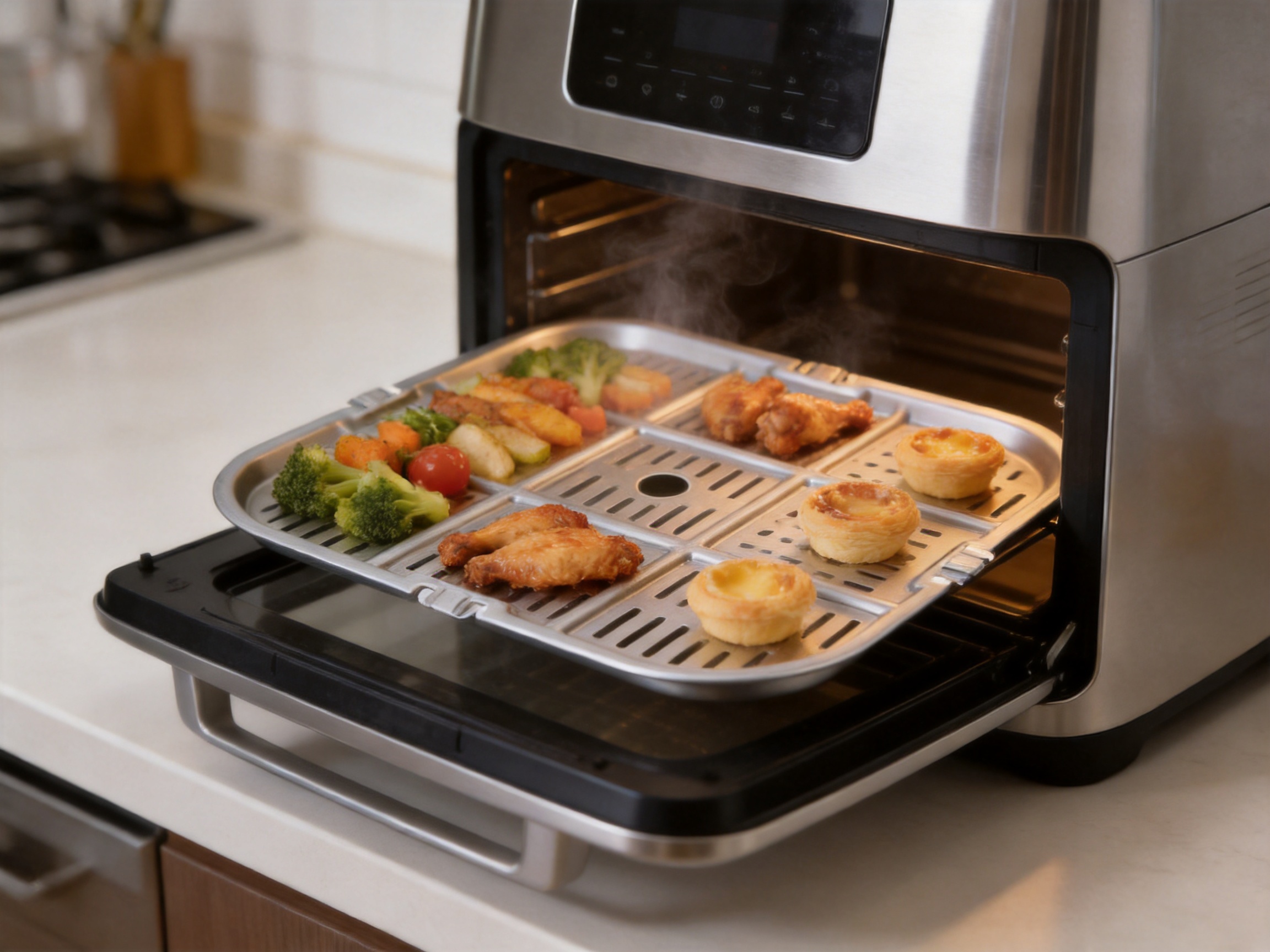
Cooking Applications and Everyday Versatility
The main advantage of an air fryer baking tray is its ability to support multiple cooking methods. Rather than serving one narrow purpose, it helps transform an air fryer into a compact baking and roasting system.
Baking Cakes and Small Pastries
The tray can provide a stable surface for cakes, muffins, cookies, biscuits, and other small baked products. Its formed shape can help contain dough or batter, while its metal construction promotes efficient heat transfer. For best results, users should select recipes and quantities suitable for the size of the air fryer and avoid overfilling the tray.
Because air fryers generally circulate hot air rapidly, baking times may differ from those of conventional ovens. Users can begin with the recipe’s suggested temperature and monitor the food during the final stage. The tray makes this process easier by providing a defined baking surface that can be removed when the food is ready.
Preparing Pizza and Flat Foods
A tray with an appropriate diameter and raised edge can support personal pizzas, flatbreads, toast, and similar foods. The surface helps keep the food level while it cooks. Perforations may encourage airflow below the dough and support a firmer underside, depending on the recipe and food thickness.
The tray is particularly useful for small portions that may be difficult to arrange directly in a deep basket. It can also make it easier to remove the finished food without breaking or deforming it.
Roasting Vegetables
Vegetables such as potatoes, peppers, mushrooms, onions, cauliflower, and zucchini can be roasted on the tray. Hot air can move around the food, while the tray keeps the ingredients organized. Users can apply a small amount of oil and seasoning before cooking to achieve a browned and flavorful surface.
The open surface design can help reduce the accumulation of moisture beneath the vegetables. Food should be arranged in a reasonably even layer to avoid blocking the air circulation that makes air frying effective.
Cooking Meat and Seafood
The baking tray can also support chicken portions, fish fillets, shrimp, sausages, and other foods commonly prepared in an air fryer. Its stable surface makes loading and removal more convenient, while the perforated structure may help hot air contact more of the food surface.
Food safety remains essential. Meat and seafood should be cooked to appropriate internal temperatures, and the tray should be cleaned thoroughly after use. The accessory supports cooking performance but does not replace safe food-handling practices.
Reheating and Crisping
An air fryer baking tray is useful for reheating pizza, bread, pastries, fried foods, and leftovers. Compared with microwave heating, circulating hot air can help preserve or restore surface crispness in many foods. The tray keeps smaller items from shifting and allows heat to move around them.
For reheating, users should avoid overcrowding. Excessive stacking can prevent the hot air from reaching all sides of the food and may result in uneven warming.
Advantages Over Basic or Poorly Designed Alternatives
Not all air fryer trays provide the same performance. Low-quality alternatives may suffer from inconsistent dimensions, weak edges, poor surface treatment, rough burrs, or inadequate airflow. These issues can reduce convenience and shorten product life.
More Consistent Dimensions
Precision stamping and forming provide better control over length, width, height, hole placement, and edge geometry. Consistency is important for both end users and appliance manufacturers. A tray that fits correctly is less likely to move, scrape against the appliance, or obstruct air circulation.
Better Airflow Management
A carefully engineered perforation pattern supports the movement of hot air while retaining appropriate food stability. Poorly arranged openings can create uneven airflow or allow ingredients to fall through. Controlled stamping gives the manufacturer the ability to reproduce the intended pattern accurately across production batches.
Improved Structural Reliability
Formed edges and reinforced areas can improve rigidity without requiring excessive material thickness. This helps the tray maintain its shape during handling and heating. A structurally stable tray is easier to insert, remove, wash, and store.
Cleaner Surface Quality
Manufacturing processes that include burr control, edge finishing, cleaning, and inspection can produce a surface that is more suitable for kitchen use. This is an important difference between a professionally manufactured accessory and an inexpensive product made without adequate finishing controls.
Greater Customization Potential
Commercial buyers may require a specific size, hole pattern, edge profile, material, surface finish, or packaging format. A manufacturer with stamping, deep-drawing, bending, and related metalworking capabilities can adapt the design more efficiently than a supplier that only resells standard products.
| Product Requirement | Design or Manufacturing Response | Practical Benefit |
|---|---|---|
| Even heating | Heat-conductive metal construction and controlled material thickness | More consistent baking, roasting, and reheating |
| Air circulation | Perforated or mesh-style surface | Improved airflow around the food |
| High-temperature use | Suitable material selection and stable forming | Reliable performance during repeated cooking cycles |
| Easy maintenance | Rust-resistant, stain-resistant, properly finished surfaces | Faster cleaning and improved appearance retention |
| Secure positioning | Accurate dimensions, formed edges, and controlled geometry | Better fit and easier handling |
| OEM or ODM requirements | Tooling, stamping, deep drawing, bending, and customization support | Efficient development of application-specific products |
Precision Manufacturing Behind the Product
The performance of an air fryer baking tray is closely connected to the manufacturing process. A tray may appear simple, but its quality depends on many details, including material preparation, tooling, stamping force, hole accuracy, forming sequence, edge condition, surface treatment, and final inspection.
Product Design and Engineering Review
Manufacturing begins with a review of the required dimensions and application. Engineers consider the air fryer’s internal space, basket structure, cooking capacity, expected load, temperature environment, and cleaning requirements. The design must provide adequate cooking area without interfering with air circulation or appliance components.
At this stage, the supplier may also review the proposed material, thickness, hole geometry, rim structure, corner radius, and packaging needs. Early engineering review helps identify potential problems before tooling is produced. It can also reduce unnecessary development time for OEM and ODM customers.
Material Preparation
Sheet metal is selected according to the required strength, thermal performance, corrosion resistance, surface quality, and forming behavior. The material must be suitable for the intended cooking environment and compatible with the selected manufacturing process.
Incoming material inspection may include checks of thickness, surface condition, width, flatness, and general conformity to specifications. Stable raw material quality supports more predictable stamping and forming results.
Precision Sheet Metal Stamping
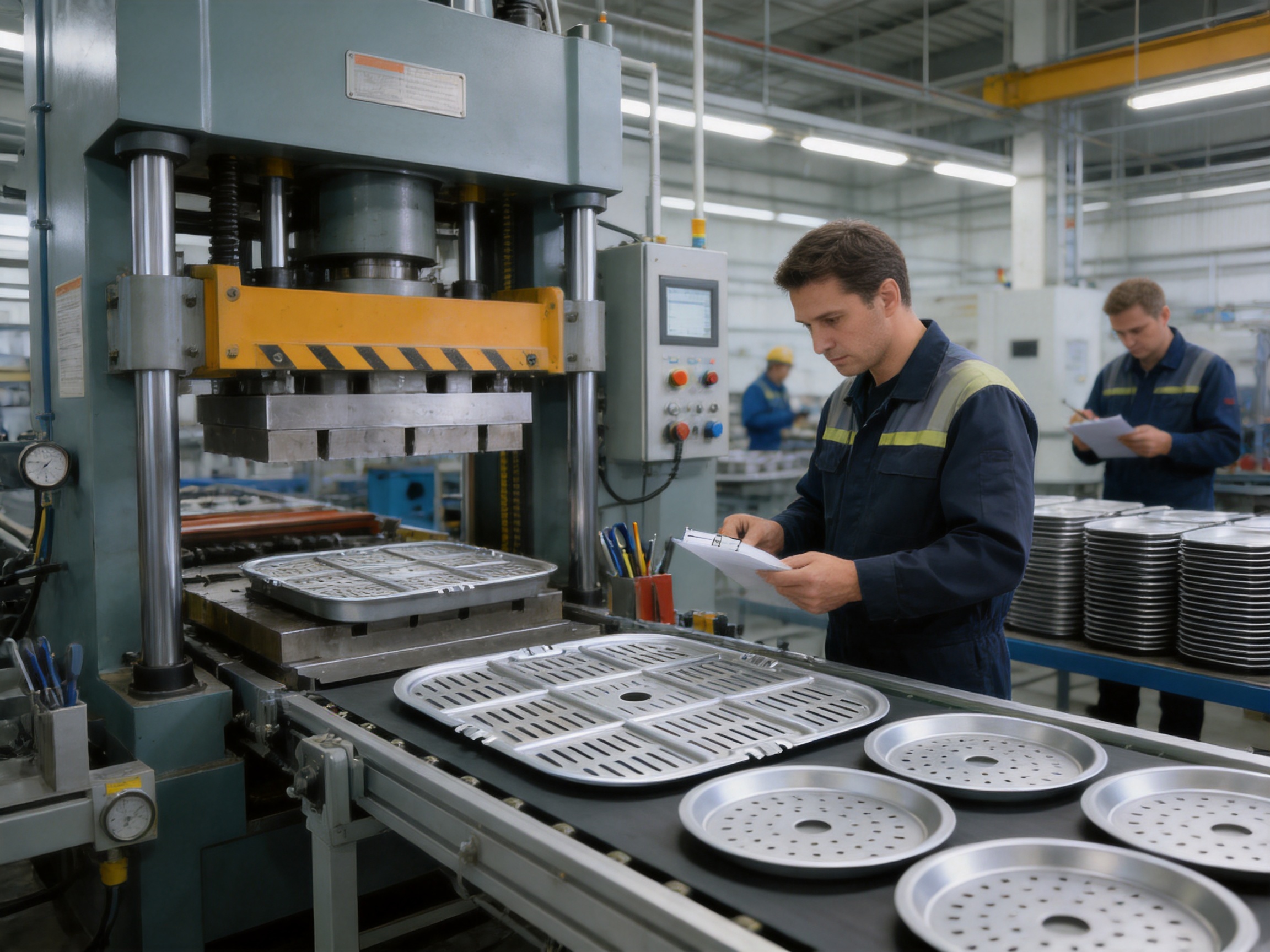
Stamping is a highly effective process for producing repeated metal components with consistent geometry. A press applies controlled force through a die set to cut, pierce, form, or shape the sheet metal. For an air fryer baking tray, stamping may be used to create ventilation holes, trim the outline, form edges, and produce other geometric features.
Precision stamping is especially valuable when the product requires many repeated openings. Manual drilling or inconsistent cutting can lead to variation in hole size, spacing, and edge condition. A properly designed stamping die can reproduce the pattern quickly and accurately throughout a production run.
Stamping also supports efficient manufacturing at medium and high volumes. Once the tooling has been validated, production can achieve repeatable cycle times and stable output. This helps control unit cost while maintaining a consistent appearance and functional performance.
Deep Drawing and Forming
Deep drawing is a metal-forming process used to create three-dimensional shapes from sheet material. Although the final tray may have a relatively shallow profile, drawing and forming techniques can be used to develop its depth, side walls, corners, and structural contours.
Successful deep drawing requires careful control of material flow. Excessive force, unsuitable radii, or poor lubrication can lead to wrinkles, cracks, thinning, or dimensional variation. Experienced manufacturers evaluate the forming sequence and tooling design to reduce these risks.
Deep-drawn metal parts are valuable in kitchen appliance applications because they can provide smooth, continuous forms with fewer assembled components. A tray produced from an appropriately designed sheet-metal blank may have improved structural integrity compared with a product assembled from multiple loosely connected pieces.
Bending and Edge Forming
Bending operations can create raised rims, support flanges, locating features, or reinforcing sections. Edge forming is important because the edge must be functional, safe to handle, and resistant to deformation.
Accurate bending requires control of angle, bend radius, springback, and tooling alignment. If the bend angle varies significantly, the tray may not sit level or fit correctly inside the air fryer. Professional production equipment and inspection procedures help maintain the required geometry.
Deburring and Edge Treatment
Cutting and stamping can leave small burrs along openings and outer edges. These must be controlled because sharp or rough areas can affect handling, cleaning, food contact, and overall appearance.
Deburring and edge treatment may be performed through mechanical, vibratory, abrasive, or other suitable methods. The selected process depends on the material, geometry, production volume, and surface requirements. The goal is to produce clean edges without damaging the tray’s dimensions or finish.
Cleaning and Surface Finishing
After forming and edge treatment, the tray may require cleaning to remove oils, particles, and processing residue. Surface treatment is selected according to the material and the customer’s specifications. The objective is to support corrosion resistance, appearance, cleanability, and suitability for the intended kitchen application.
Quality control at this stage may include visual inspection, surface checks, dimensional verification, and testing of representative samples. A clean, consistent finish improves both user confidence and product presentation.

Manufacturing Strengths of Yuyao Hongli Optoelectronics
Yuyao Hongli Optoelectronics Co., Ltd. is a comprehensive manufacturing enterprise with more than 20 years of industry experience. Founded in 2000 and located in Yangming Science and Technology Industrial Park in Yuyao, Zhejiang Province, China, the company has developed from its former name, Yuyao Hongli Optoelectronics Educational Instruments Co., Ltd., into a manufacturer serving multiple industrial and consumer product sectors.
The company operates a modern factory covering approximately 5,000 square meters. Its production resources include multiple stamping workshops and a workforce of more than 60 employees. This combination of facilities, equipment, and experienced personnel supports the production of metal stamping parts, drawn metal products, deep drawn metal parts, bending parts, kitchen appliance accessories, automotive stamping parts, and other customized components.
Broad Metalworking Experience
Experience across different product categories can be valuable when developing an air fryer baking tray. Metal components used in educational instruments, optical instruments, household electric heaters, small household appliances, auto parts, and hardware products often require careful attention to dimensional accuracy and repeatable forming.
This broad background allows the company to apply knowledge from different manufacturing applications. Press operation, tooling coordination, material handling, forming control, and inspection practices can all contribute to the consistent production of kitchen appliance accessories.
OEM and ODM Support
Many appliance brands require products that differ from standard catalog designs. They may need a tray with a particular diameter, height, ventilation pattern, rim structure, material, finish, or brand packaging. OEM and ODM support allows the manufacturer to work from customer drawings, samples, technical specifications, or application requirements.
For OEM projects, the company can manufacture according to approved customer designs. For ODM projects, it can support the adaptation or development of a product based on the customer’s market needs. This flexibility is useful for appliance brands, importers, distributors, and retailers seeking differentiated kitchen accessories.
Rapid Prototyping and Production Conversion
Product development often involves several stages, including concept review, sample production, testing, modification, tooling validation, and volume manufacturing. Efficient conversion between these stages can reduce delays and help customers bring new accessories to market more quickly.
Rapid prototyping also allows practical issues to be identified earlier. A sample may reveal that the tray needs a different edge height, a modified opening pattern, or an adjusted fit. Addressing these issues before mass production can reduce waste and avoid expensive changes later.
Quality Control and Stable Delivery
A reliable kitchen accessory supplier must maintain quality throughout production rather than relying only on final inspection. Process control helps ensure that material, dimensions, forming, surface condition, and packaging remain consistent from batch to batch.
Stable delivery depends on production planning, equipment availability, material coordination, workforce organization, and communication with customers. Yuyao Hongli Optoelectronics emphasizes efficient production conversion and stable delivery as part of its manufacturing service. These capabilities are important for customers managing product launches, seasonal demand, and ongoing replenishment.
Comprehensive Customer Service
Manufacturing support does not end when the parts leave the press. Customers may require assistance with drawings, samples, packaging, shipping coordination, product adjustments, and after-sales communication. A comprehensive service approach helps simplify cooperation, especially for overseas buyers and businesses developing customized products.
The company’s stated business philosophy emphasizes integrity, excellence, innovation, and sharing. These principles are relevant to long-term manufacturing relationships in which technical communication, delivery reliability, and problem-solving are as important as the product itself.
Quality Considerations for Buyers
When selecting an air fryer baking tray supplier, buyers should evaluate more than price. The most important questions concern fit, material, surface condition, production consistency, and the supplier’s ability to support future requirements.
Dimensional Compatibility
The buyer should confirm the tray’s length, width, diameter, height, corner shape, and usable cooking area. The tray should fit the intended air fryer without obstructing moving parts, heating elements, or ventilation channels. If the product is intended for a specific appliance model, dimensional drawings or physical samples should be reviewed before mass production.
Material and Surface Requirements
The material should be appropriate for high-temperature kitchen use and compatible with the requested finish. Buyers should communicate requirements concerning corrosion resistance, stain resistance, food-contact suitability, color, appearance, and cleaning expectations.
Opening Pattern and Food Retention
Perforation size and spacing should match the intended food applications. A tray for vegetables and meat may use a different opening pattern from a tray intended for small cookies or delicate food. The design should provide airflow while retaining the smallest food pieces that customers are expected to cook.
Load and Structural Performance
The tray should remain stable under the expected food load. Testing may include handling, insertion and removal, heating cycles, and visual checks for deformation. If the tray includes handles, supports, stacking features, or locating tabs, these should also be reviewed for strength and fit.
Production Capacity
For commercial buyers, the supplier’s equipment, workforce, factory area, and production planning capabilities should be considered. A supplier with relevant stamping workshops and experience in custom metal parts may be better positioned to support both sample orders and larger recurring production.
Recommended Use and Care
Before first use, the tray should be washed according to the product instructions to remove any packaging dust or handling residue. Users should verify that it is correctly positioned inside the air fryer and that sufficient clearance remains around the tray.
Food should be distributed evenly rather than piled too high. Overloading can block air movement and increase cooking time. It can also produce uneven browning. A moderate amount of space between food pieces generally supports more effective circulation.
Heat-resistant gloves, tongs, or suitable utensils should be used when removing the tray. Metal surfaces become very hot during cooking and may remain hot after the air fryer has been switched off.
After cooking, grease and food particles should be removed as soon as it is safe to handle the tray. Warm water and a mild cleaning solution are often sufficient for routine cleaning, subject to the product’s specific care instructions. Abrasive tools and harsh chemicals should be avoided when they may damage the surface.
The tray should be dried fully before storage. Regular inspection can identify signs of damage, excessive wear, deformation, or surface deterioration. If the tray no longer sits securely or develops sharp damaged areas, it should be replaced.
Why Precision Sheet Metal Stamping Matters
Precision sheet metal stamping is more than a high-speed production method. It is a way to control the repeatability of a product whose performance depends on many small details. For an air fryer baking tray, the relationship between openings, edges, dimensions, and formed surfaces affects cooking, handling, cleaning, and compatibility.
Accurate stamping reduces variation between individual trays. This is especially important for appliance manufacturers that include the accessory with a product or sell it as an official replacement. Consistency supports customer expectations and reduces complaints related to poor fit or uneven appearance.
Stamping also makes it possible to develop specialized designs. The manufacturer can create different hole patterns, edge profiles, and reinforcement features through suitable tooling. When combined with bending and drawing, the process can produce a tray that is specifically adapted to a customer’s appliance platform.
For high-volume production, stamping may also reduce labor dependence and improve production efficiency. Automated or semi-automated operations can help maintain repeatable cycle times, while inspection procedures provide additional control over the finished product.
Benefits for Different Types of Customers
Air Fryer Manufacturers
Air fryer manufacturers can use customized trays to improve the functionality of their appliance models. A correctly designed accessory may serve as a selling point by allowing baking, grilling, and roasting in addition to standard air frying. The tray can also be developed to match the brand’s appliance dimensions and visual design.
Kitchenware Brands
Kitchenware brands can offer the tray as a standalone accessory, replacement component, or product bundle. OEM and ODM manufacturing support allows them to specify packaging, surface treatment, product dimensions, and accessory features according to their market positioning.
Importers and Distributors
Importers and distributors benefit from a supplier that can provide consistent production, responsive communication, and the ability to handle repeat orders. A durable and versatile tray may appeal to a broad customer base because it supports several cooking applications.
Commercial and Hospitality Buyers
Small food businesses, hospitality operators, and shared kitchens may use air fryers for compact food preparation. A durable tray can help organize cooking tasks and expand the range of foods prepared in a limited space. In these environments, easy cleaning and repeatable performance are particularly important.
Product Development Teams
Designers and engineering teams can benefit from a supplier familiar with custom stamping, deep drawing, and bending. Early manufacturing feedback may help refine the design for better producibility, lower material waste, simpler assembly, or improved user handling.
Q&A: Air Fryer Baking Tray
Q1: What foods can be prepared with an air fryer baking tray?
The tray can support cakes, cookies, pizzas, pastries, vegetables, meat, seafood, reheated foods, and many other recipes suitable for an air fryer. The exact application depends on the tray dimensions, surface design, and the air fryer model.
Q2: Why does the tray have perforations or a mesh-style surface?
Perforations allow hot air to move around and beneath the food. This supports the air fryer’s circulating-air cooking method and may help improve browning and crispness. The opening size and spacing should be selected to balance airflow with food retention.
Q3: Is the tray suitable for high-temperature cooking?
The tray is designed for the high-temperature environment associated with air frying, baking, grilling, and roasting. Users should follow the operating temperature and care guidance supplied for the specific product and appliance.
Q4: Does the tray help food cook more evenly?
Its heat-conductive metal construction and airflow-supporting surface can contribute to more even cooking. Results also depend on the air fryer’s power, temperature control, food arrangement, portion size, and recipe.
Q5: Is the tray easy to clean?
The rust-resistant and stain-resistant design, together with a properly finished surface, helps reduce the accumulation of food residue. Cleaning should be performed according to the product instructions, using suitable tools and cleaning solutions.
Q6: Can the tray be customized?
Customization may include dimensions, opening pattern, edge structure, material, surface finish, packaging, and other technical requirements. OEM and ODM projects should be reviewed through drawings, samples, or detailed specifications.
Q7: What manufacturing processes are used to make the tray?
Depending on the design, production may include precision sheet metal stamping, piercing, deep drawing, bending, edge forming, deburring, cleaning, surface treatment, and final inspection.
Q8: What should buyers confirm before ordering?
Buyers should confirm appliance compatibility, dimensions, material, opening pattern, surface finish, expected order volume, packaging, inspection requirements, and delivery schedule. A sample approval process is recommended for customized products.
Q9: Why choose an experienced stamping manufacturer?
An experienced manufacturer can provide stronger control over tooling, material behavior, dimensional accuracy, production repeatability, and quality inspection. This is particularly useful when the product requires custom geometry or large-volume production.
Q10: Can the tray be used as a replacement accessory?
It can be developed as a replacement accessory when its dimensions and structure match the intended air fryer. Compatibility should be confirmed carefully before purchase, especially for trays designed for specific appliance models.
Conclusion
The Air Fryer Baking Tray is a practical kitchen appliance accessory that adds significant versatility to modern air fryers. Its applications extend from baking and grilling to roasting, reheating, and crisping. Heat-conductive metal construction supports efficient cooking, while a perforated or mesh-style surface encourages hot-air circulation. Rust resistance, stain resistance, durable forming, and easy maintenance further improve its value in everyday use.
Its advantages over poorly designed alternatives are closely connected to manufacturing quality. Accurate dimensions, controlled perforations, stable edges, clean surfaces, and reliable high-temperature performance require more than basic metal cutting. They depend on precision sheet metal stamping, deep drawing, bending, deburring, surface treatment, and systematic inspection.
With more than 20 years of experience, a 5,000-square-meter modern factory, multiple stamping workshops, and a team of more than 60 employees, Yuyao Hongli Optoelectronics Co., Ltd. provides a strong manufacturing foundation for this product category. Its experience in drawn metal products, deep drawn metal parts, precision sheet metal stamping, kitchen appliance accessories, automotive stamping parts, and related components supports both standard and customized production.
For brands, distributors, importers, and appliance manufacturers, the product offers a combination of functional design, production flexibility, OEM/ODM support, rapid prototyping, quality control, stable delivery, and after-sales service. For consumers, it provides an effective way to make better use of an air fryer and prepare a broader range of meals with one compact accessory.
References
1. General principles of sheet metal stamping, forming, piercing, bending, and dimensional inspection.
2. General guidance for the design and use of household cooking accessories made from heat-resistant metals.
3. Food-contact equipment hygiene and routine cleaning principles for reusable kitchen accessories.
4. Air circulation and heat-transfer considerations in countertop convection cooking appliances.
5. Manufacturing quality-control practices for precision stamped parts and deep-drawn metal components.
6. Product information supplied for the Air Fryer Baking Tray and related kitchen appliance accessories.
7. Corporate information supplied by Yuyao Hongli Optoelectronics Co., Ltd. regarding manufacturing capabilities, OEM/ODM services, product categories, and factory operations.
Product: Air fryer baking tray
Previous Post
No previous article
Next Post
Kitchen Utensil Base: Durable, Hygienic, and Precision-Formed Countertop Storage
News
-
-
What Are Stamped Parts? Stamped parts are metal components produced by pressing flat sheet metal between a die and a punch to cut, bend, or...
READ MORE -
What Is Deep Drawing Process and What Are Deep-Drawn Parts The deep drawing process is a sheet metal forming operation in which a flat meta...
READ MORE -
Manufacturing & Materials Engineering Why Deep Draw Components Outperform Fabricated Sheet Metal Parts in Leak-Proof Applications Seam...
READ MORE
Get Fresh Updates Via Email
We promise we will never disclose your email address, and you can opt out at any time.
-
Quick Links
Home About Us Products Service News Contact Us -
Product list
Deep-drawn parts Stamped parts Bending parts Kitchen appliance accessories Automotive stamping parts -
About Us
Factory Honour FAQ -
News
Company News Industry News -
Contact Us
Address: South side of Shunke Road, Yangming Science and Technology Industrial Park, Yuyao City, Zhejiang Province, China Tel: +86-13905842349/+86-13738485724 Email: hongli@hl-stamping.com
Copyright © Yuyao Hongli Optoelectronics Co., Ltd. All Rights Reserved.
Custom Precision-Sheet/Sheet Metal Stamping Manufacturers
