


 English
 русский
 Español
 عربى


Steel is the backbone of modern manufacturing, yet it is never a single, uniform material. When engineers and buyers ask, "How can you clas...
READ MORE

News
Home / Author / Chen Ruoxi — Overseas Product Sales Manager / How High-Quality Air Fryer Parts Improve Cooking Performance and Product Life
How High-Quality Air Fryer Parts Improve Cooking Performance and Product Life
2026-08-31
Air fryers have become an important category of small kitchen appliances because they offer a convenient way to prepare crispy foods with less oil than traditional frying methods. Behind the performance of every reliable air fryer is a group of carefully designed components that must manage heat, grease, moisture, food contact, repeated washing, and frequent mechanical handling. Air fryer parts are therefore much more than simple accessories. The quality of the basket, drip tray, handle, support structure, and related stamped or deep-drawn components directly affects cooking consistency, user safety, cleaning convenience, and the service life of the appliance.
High-quality air fryer parts must combine practical function with stable manufacturing accuracy. They need to fit the appliance correctly, maintain their shape at elevated temperatures, resist corrosion, and remain easy to clean after repeated use. Components manufactured through precision sheet metal stamping, deep drawing, bending, and forming can provide the dimensional consistency and structural reliability required for these demanding conditions. When these processes are supported by experienced engineering, appropriate tooling, strict inspection, and efficient production management, manufacturers can supply dependable components for both standard and customized air fryer designs.
Yuyao Hongli Optoelectronics Co., Ltd. specializes in metal stamping parts and related products, including kitchen appliance accessories, deep-drawn parts, stamped parts, bending parts, and automotive stamping parts. With more than 20 years of industry experience, the company has developed manufacturing capabilities that support OEM and ODM projects, rapid prototyping, customized production, and stable delivery. Its experience in precision metal processing provides a strong foundation for producing air fryer parts that meet the functional and appearance requirements of modern kitchen appliances.
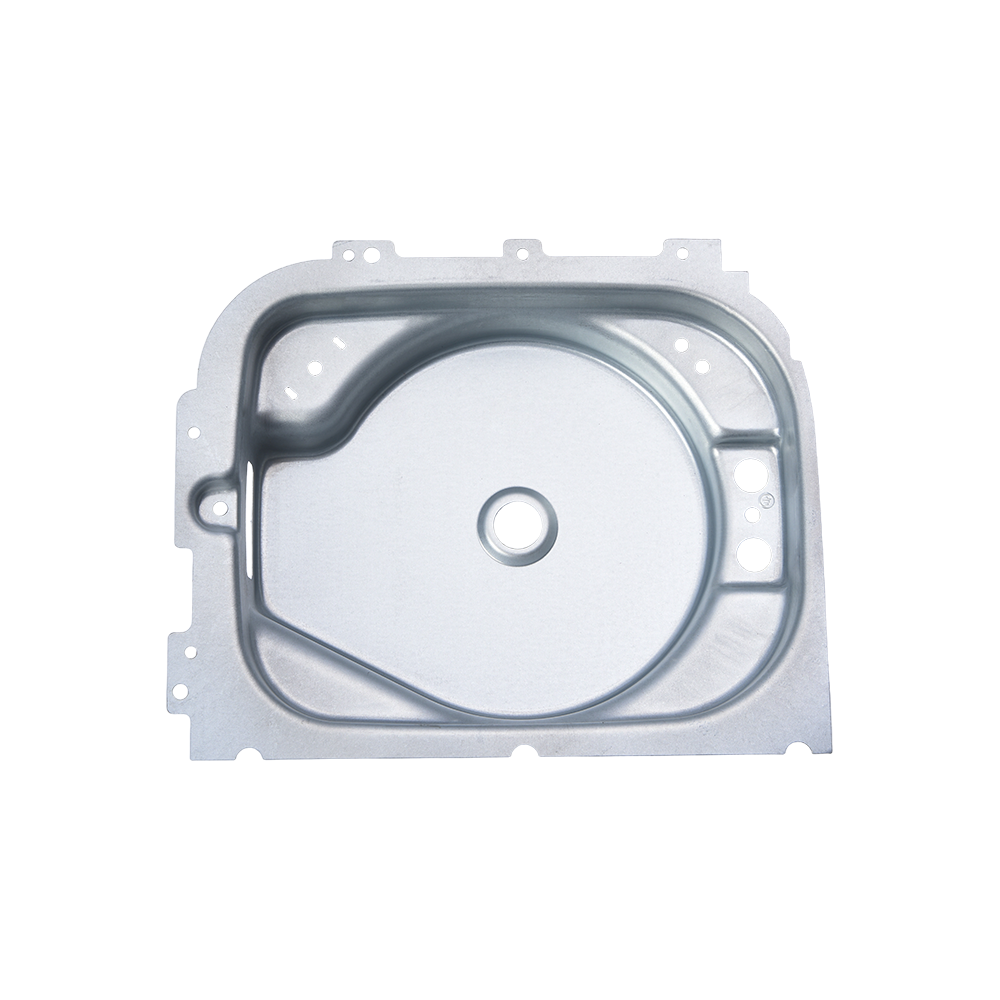
Air fryer parts
Understanding the Role of Air Fryer Parts
An air fryer operates by circulating hot air around food placed inside a cooking chamber. The internal accessories must support this airflow while also holding food securely, allowing excess oil to drain, and protecting the user from direct contact with hot surfaces. A mesh basket, drip tray, support frame, tray handle, and fastening components may appear simple individually, but each part contributes to the performance of the complete appliance.
The basket is usually responsible for holding food while allowing heated air to pass around it. A suitable mesh or perforated structure promotes better air circulation and helps separate food from accumulated grease. The drip tray sits below the basket and collects oil, crumbs, and cooking residue. It helps prevent contamination of the heating area and makes the appliance easier to maintain. A properly designed handle allows the user to remove the hot basket or tray with greater control, reducing the risk of accidental contact with heated surfaces.
These components must work together as a system. A basket that is too dense may restrict airflow. A tray with insufficient depth may allow grease to overflow. A handle with poor attachment strength may become loose after repeated use. A tray that is not sufficiently rigid may deform and interfere with insertion or removal. These issues demonstrate why product performance depends on detailed component design and controlled manufacturing rather than on material selection alone.
Air fryer parts also need to accommodate the changing requirements of different appliance models. Household air fryers may vary in capacity, shape, basket geometry, handle location, surface finish, and internal support structure. Commercial or semi-commercial appliances may require heavier-gauge material, stronger reinforcement, larger trays, and more frequent cleaning resistance. A capable parts supplier must be able to interpret drawings, samples, and technical specifications and then convert them into repeatable production processes.
Key Performance Requirements for Air Fryer Accessories
Heat Resistance
Air fryer components are exposed to elevated cooking temperatures during normal operation. The actual temperature range depends on the appliance design, cooking program, food type, and location of the component within the chamber. Parts positioned close to the heating element or hot airflow must maintain their shape and function without excessive distortion. The material and surface treatment must also be selected with consideration for repeated heating and cooling cycles.
Heat resistance is not limited to the ability to survive one high-temperature cycle. A durable component must tolerate many cycles over its expected service life. Repeated thermal expansion and contraction can place stress on bends, joints, fasteners, and formed corners. Accurate forming, appropriate radii, and reliable joining methods help reduce the possibility of cracking, loosening, or permanent deformation.
Corrosion and Rust Resistance
Cooking environments contain moisture, salt, oils, acids, and food residues. If an air fryer part is not adequately protected, these substances can cause staining, corrosion, or surface deterioration. Rust resistance is particularly important for baskets and trays because these components may be exposed to water and detergents during frequent cleaning.
Material selection, surface finishing, and production cleanliness all influence corrosion performance. A smooth and well-finished surface has fewer locations where food residue and moisture can remain trapped. Properly controlled forming and deburring can reduce sharp edges and damaged areas that might become starting points for corrosion. Depending on the product specification, a manufacturer may use suitable stainless steel or another application-appropriate material and apply a compatible finishing process.
Mechanical Strength and Dimensional Stability
A basket or drip tray must support food, grease, and handling forces without bending excessively. The part must also maintain its dimensions so that it slides into the appliance correctly and remains aligned with the surrounding structure. Small dimensional deviations can result in poor fit, rattling, difficult insertion, or contact with the heating chamber.
Deep drawing and stamping processes can produce strong, integrated forms with fewer separate joints. Bending operations can create reinforcing flanges, mounting edges, and support sections that increase rigidity. The correct combination of material thickness, geometry, forming sequence, and tooling helps the part achieve a balance between strength and weight.
Cleanability and Hygiene
Air fryer accessories come into direct or indirect contact with food, grease, and food particles. Their design should therefore support quick and thorough cleaning. Smooth surfaces, controlled corners, appropriate openings, and limited residue-collecting areas can make a substantial difference in daily use.
A component that is difficult to clean may retain grease and crumbs, leading to unpleasant odors, smoke, or poor hygiene. The heat-resistant tray handle should also be designed to reduce areas where food residue can accumulate. Easy maintenance improves the user experience and encourages proper care of the appliance.
Safe Handling
Handles, edges, and attachment points require special attention because users interact with them while the parts may still be hot. Edges should be controlled through deburring, edge rolling, or other suitable finishing operations. Handle attachments must be sufficiently secure to withstand lifting, pulling, and repeated loading.
A well-designed handle provides a stable grip and helps keep the user's hand away from hot metal surfaces. It should remain functional after repeated temperature exposure and cleaning. The connection between the handle and the basket or tray must be evaluated for strength, alignment, and long-term reliability.
Advantages of Precision-Made Air Fryer Parts
Compared with low-precision or inconsistently manufactured components, precision-made air fryer parts offer several important advantages. The first is reliable fit. When the basket and tray are produced within controlled dimensional tolerances, they are more likely to move smoothly in and out of the appliance and remain properly positioned during cooking.
The second advantage is consistent cooking performance. A basket with uniform openings and stable geometry supports more predictable airflow. A tray with consistent depth and alignment can collect grease more effectively. Stable dimensions also help appliance manufacturers maintain consistency across large production batches.
The third advantage is improved product appearance. Visible accessories influence a consumer’s perception of appliance quality. Even when a part is primarily functional, uneven edges, inconsistent spacing, rough surfaces, or visible forming marks may create the impression of poor workmanship. Controlled stamping, drawing, bending, and finishing can produce components with a cleaner and more professional appearance.
The fourth advantage is lower long-term manufacturing risk. A supplier with suitable tooling capability can reduce variation, minimize rework, and identify potential production issues before mass manufacturing begins. This is especially important for appliance brands that require repeat orders over an extended product life cycle.
Precision manufacturing can also support more efficient assembly. Correctly formed mounting points and attachment features reduce the need for manual adjustment. Consistent parts help appliance factories maintain production speed and reduce line stoppages caused by poor fit or dimensional inconsistency.
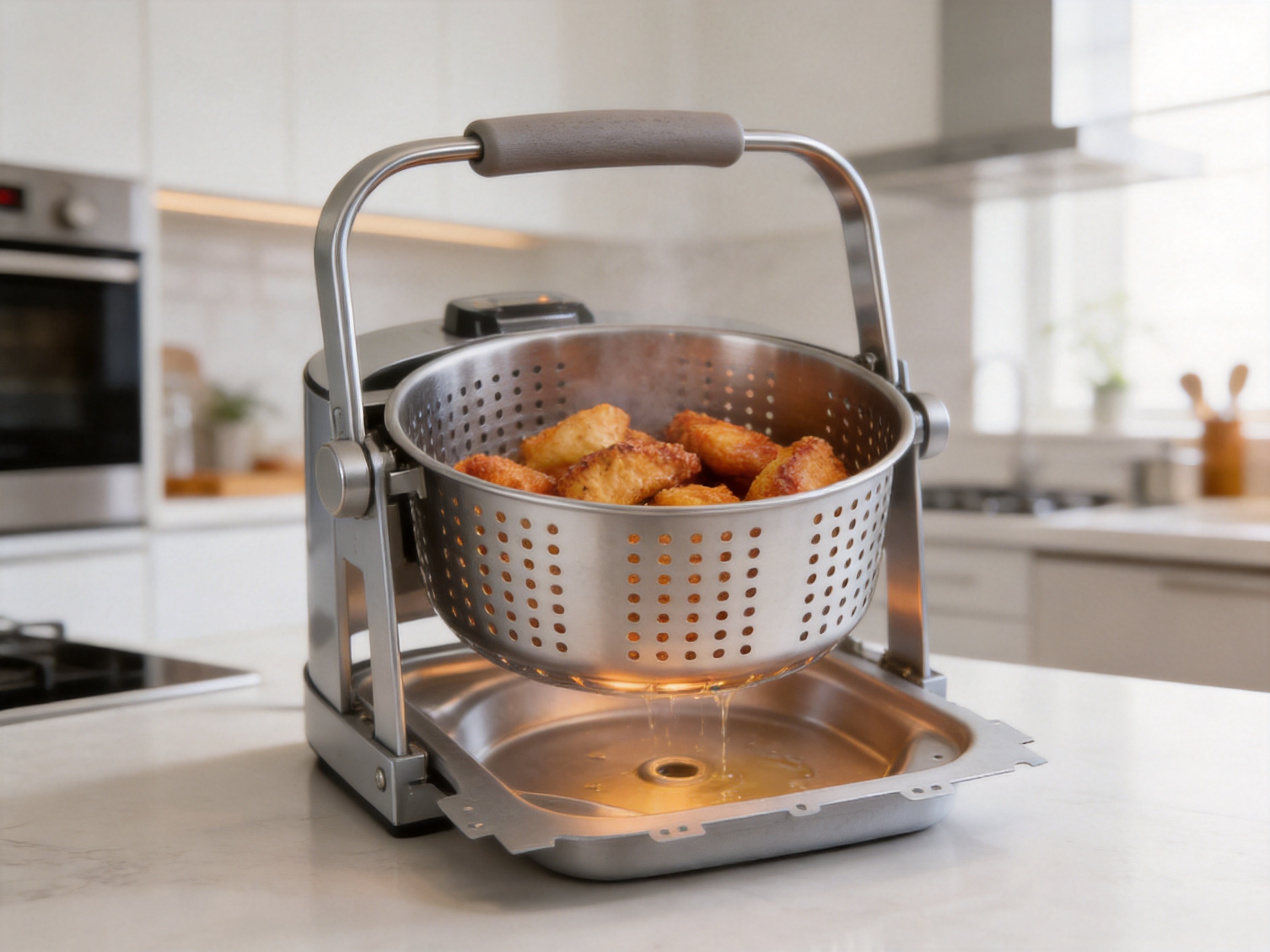
Mesh Baskets for Air Fryers
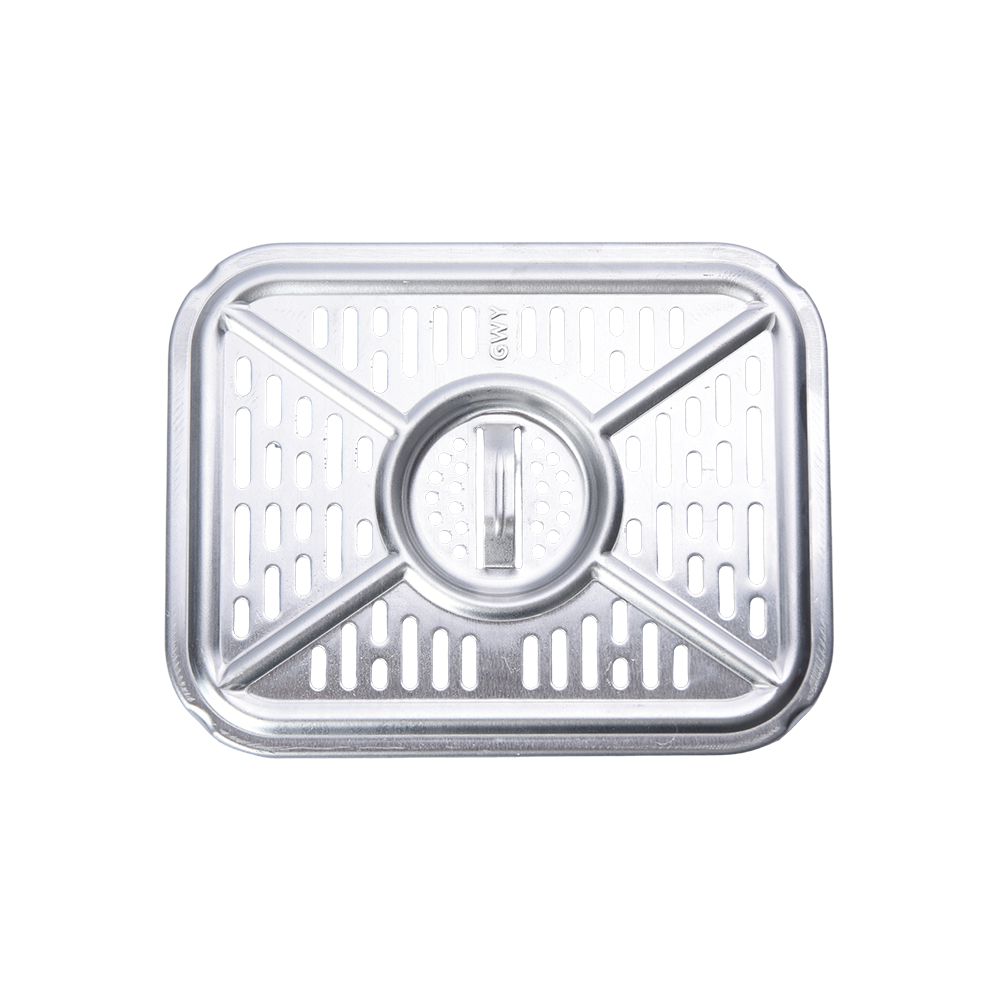
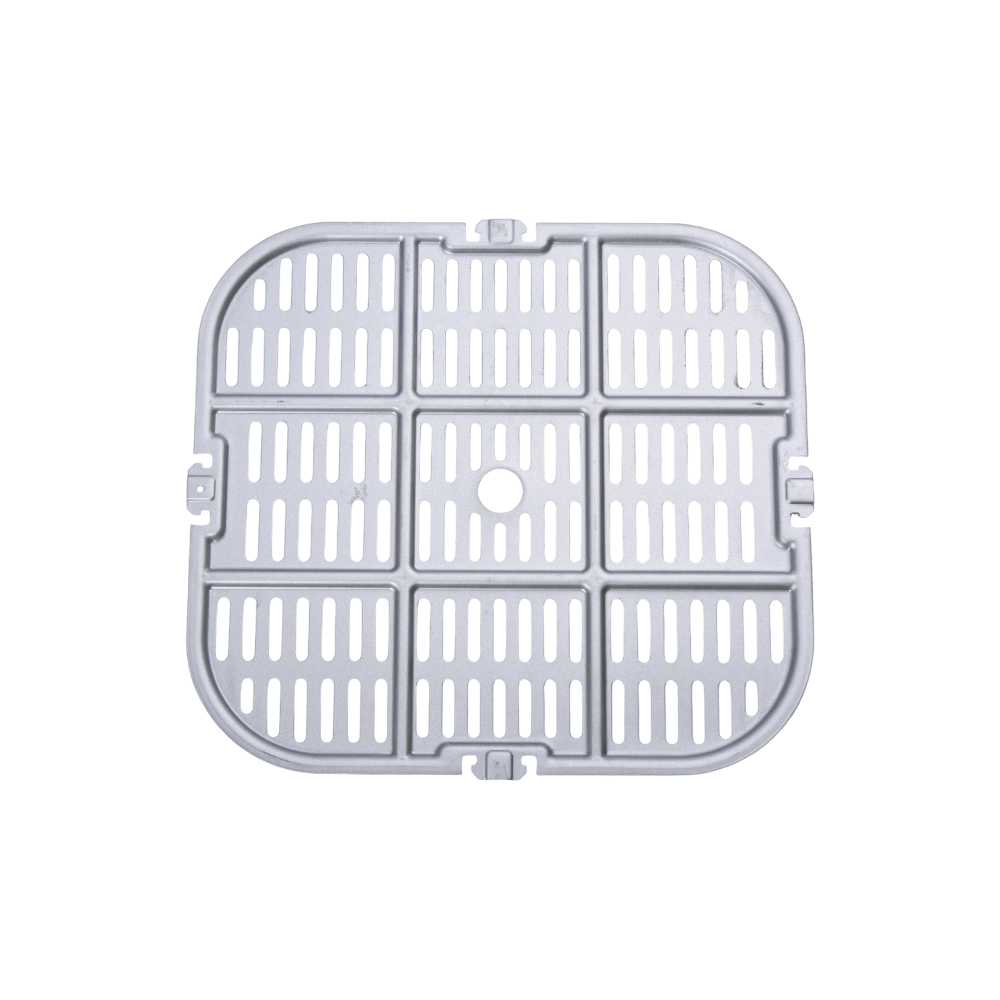
The mesh basket is one of the most recognizable air fryer components. It holds food above the drip tray and creates space for hot air to circulate around the food. The design of the mesh structure affects airflow, grease drainage, food support, cleaning, and overall durability.
Airflow and Drainage
Evenly distributed openings allow heated air to reach more of the food surface. This contributes to a crisp exterior and more uniform cooking. The openings must be large enough to support air movement and grease drainage, yet sufficiently controlled to prevent smaller food pieces from falling through.
The basket geometry should also avoid unnecessary areas where oil and crumbs can collect. A well-designed basket supports the cooking process while making it easier for users to remove food and clean the accessory after use.
Structural Design
Although a mesh basket may appear lightweight, it must resist deformation during loading, cooking, removal, and washing. Formed edges, reinforced rims, support rails, or integrated bends can improve stiffness. The connection between the basket and the handle must be designed to withstand repeated lifting without loosening.
Manufacturing accuracy is especially important when the basket contains multiple openings, bends, or formed sections. Variations in opening size, edge position, or basket height can affect both appearance and functional fit. Proper tooling and process control help maintain repeatability across production batches.
Surface Quality
The basket surface should be smooth enough to support cleaning and reduce residue accumulation. Sharp burrs can create safety risks and may damage cleaning tools. Forming operations must therefore be followed by appropriate inspection and finishing. Depending on the customer’s specification, the component may require a particular surface appearance, coating, or corrosion-resistant treatment.
Drip Trays and Grease Collection Components
The drip tray collects excess oil, food residue, and crumbs that pass through the basket. It protects the lower area of the air fryer and helps prevent grease from reaching sensitive internal components. The tray must have adequate capacity and must remain stable while the basket is inserted or removed.
Tray depth, corner design, wall height, and support structure all affect performance. If the tray is too shallow, grease may spill during cooking or handling. If the walls are too high or the fit is too tight, airflow and usability may be affected. A carefully formed tray can provide an effective balance between capacity, accessibility, and structural strength.
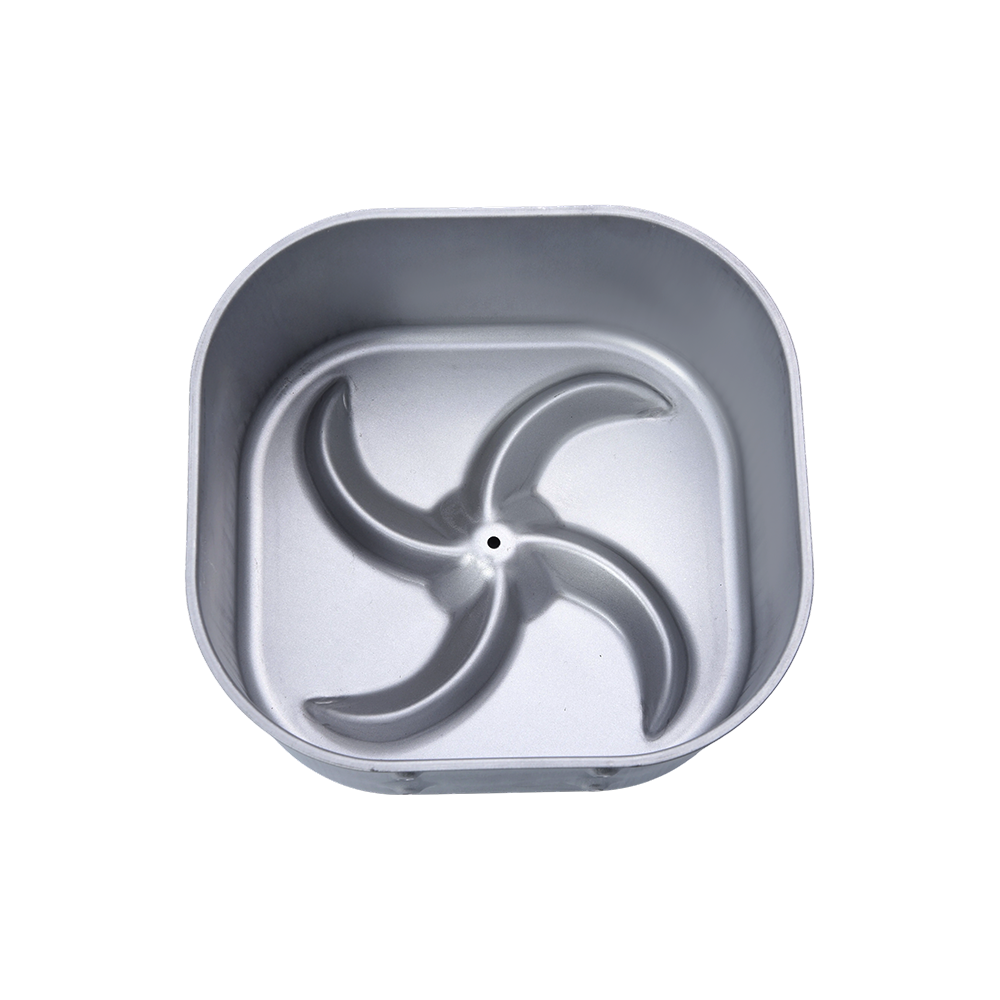
Deep-drawing technology is particularly useful for producing tray-like components with continuous walls and a consistent shape. Compared with assembling several separate pieces, a drawn structure can reduce the number of joints and potential leakage points. It can also improve appearance and simplify cleaning when the internal surface is smooth and properly finished.
Deep drawing requires close control of material behavior, blank size, tooling geometry, drawing depth, and forming speed. If these factors are not balanced, the part may develop wrinkles, thinning, tearing, or dimensional instability. An experienced manufacturer can evaluate the design and determine whether multiple drawing stages, intermediate forming, trimming, or additional calibration are needed.
Heat-Resistant Tray Handles
The tray handle is an essential safety-related component. It allows users to control a hot basket or tray without placing their hands near the cooking chamber. The handle must provide a secure grip, maintain its attachment strength, and remain suitable for repeated exposure to heat and cleaning.
Handle design includes more than the shape of the gripping area. The attachment point, load direction, clearance from hot surfaces, material compatibility, and assembly method must all be considered. A handle that is comfortable but poorly attached does not provide reliable safety. A strong handle with an uncomfortable grip may also reduce the practical value of the product.
Metal forming can be used to create support brackets, mounting plates, reinforcement elements, and other handle-related parts. Stamped and bent components can be designed to provide accurate attachment positions and consistent alignment. When necessary, these parts can be combined with heat-resistant non-metallic grip materials according to the appliance specification.
During quality control, handle assemblies should be checked for alignment, attachment strength, surface condition, and movement. Testing should reflect realistic user actions, including repeated pulling, lifting, insertion, and removal. This type of evaluation helps identify weaknesses before the parts are delivered for appliance assembly.
Manufacturing Processes Used for Air Fryer Parts
Precision Sheet Metal Stamping
Stamping is a productive method for forming metal parts from sheet material. It can be used for brackets, support plates, reinforcement pieces, mounting components, clips, and other air fryer accessories. The process may include blanking, piercing, forming, embossing, and trimming operations.
One of the main advantages of stamping is repeatability. Once the tooling and process parameters have been validated, large quantities of similar parts can be produced efficiently. Stamping also supports the creation of precise holes, slots, ribs, flanges, and other functional features that may be difficult to achieve consistently through manual fabrication.
For appliance components, stamping dies must be designed with attention to material thickness, forming direction, part geometry, springback, edge quality, and production volume. A well-engineered die reduces variation and helps maintain stable quality throughout the manufacturing run.
Deep Drawing
Deep drawing forms a flat metal blank into a cup, tray, shell, or other three-dimensional shape. It is suitable for air fryer trays and similar components that require continuous walls and a clean internal surface. The process can create strong parts with fewer seams than multi-piece construction.
Successful deep drawing depends on the relationship between the material and the tooling. Important considerations include draw ratio, corner radius, blank-holder force, lubrication, punch and die clearance, and the number of forming stages. Material flow must be controlled so that the part reaches the required depth without excessive thinning or wrinkling.
After drawing, additional operations may include trimming, piercing, flanging, calibration, deburring, and surface treatment. These operations help the finished part meet dimensional, functional, and appearance requirements.
Bending and Forming
Bending processes create angles, flanges, support sections, and reinforcement features. A properly designed bend can significantly increase the stiffness of a component without requiring a large increase in material thickness. Bending is useful for brackets, rails, mounting plates, tray supports, and structural edges.
Springback must be considered because sheet metal may partially return toward its original shape after bending. Tool compensation, suitable bend radii, and process verification help ensure that the finished part meets the required angle and position. Accurate bending is important for assembly because even a small angular error may affect the alignment of the completed air fryer accessory.
Trimming, Piercing, and Deburring
Trimming removes excess material after drawing or forming. Piercing creates holes, slots, and openings for assembly, ventilation, drainage, or attachment. These operations must be controlled to avoid distortion and excessive burrs.
Deburring and edge finishing improve safety and usability. Since air fryer parts may be handled during assembly, cleaning, and daily use, sharp edges should be eliminated or controlled. Consistent edge finishing also improves the visual quality of the product.
Assembly and Finishing
Some air fryer components require the assembly of multiple formed pieces, handles, fasteners, or support elements. Assembly methods must be selected according to the required strength, appearance, temperature exposure, and cleaning conditions. The manufacturer should control alignment and connection quality throughout the assembly process.
Surface finishing may include cleaning, polishing, passivation, coating, or another specified treatment. The selected finish should be compatible with the intended operating environment and customer requirements. Finishing is not only an appearance step; it may also influence corrosion resistance, cleanability, friction, and the perceived quality of the appliance.
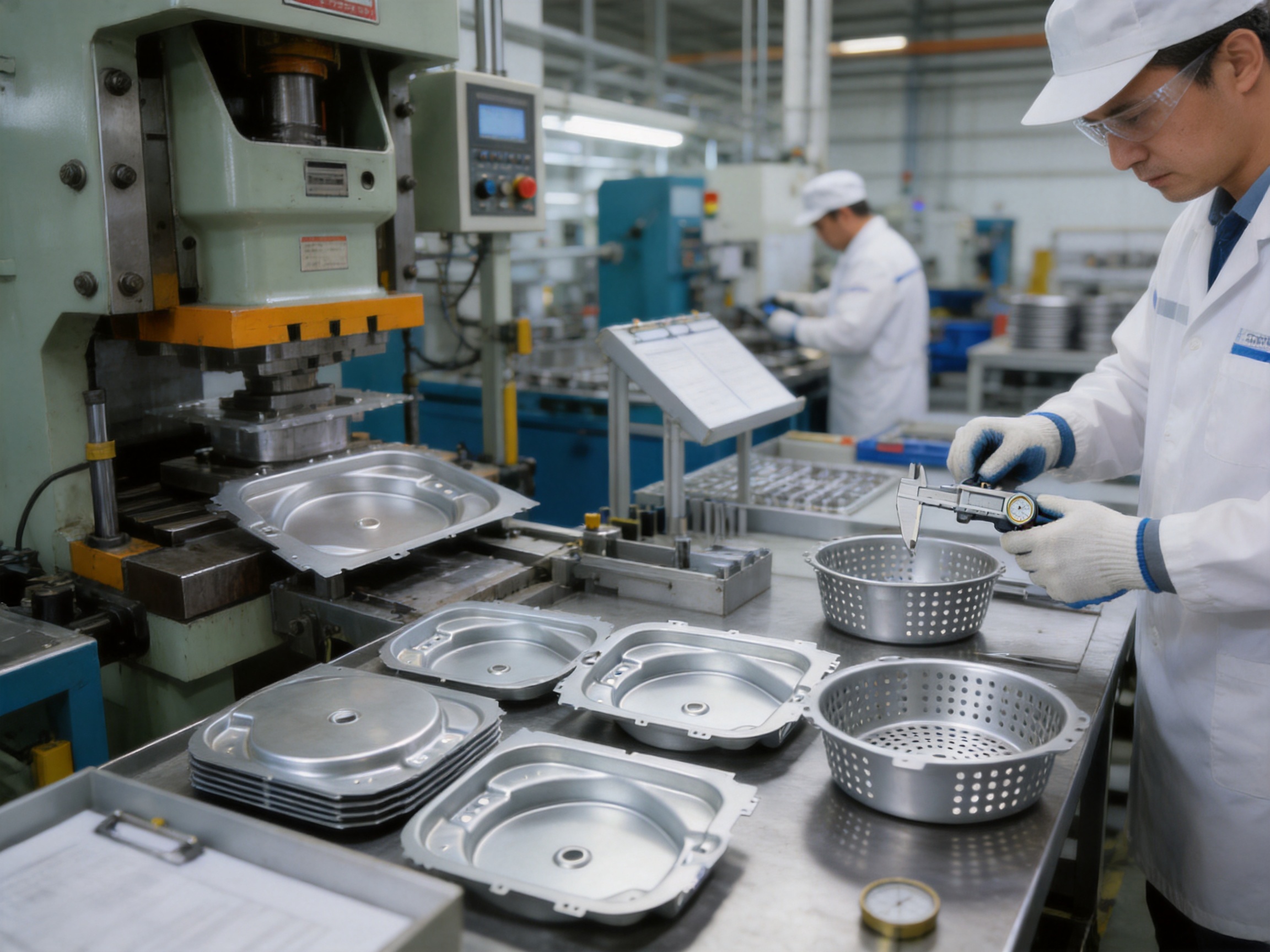
Quality Control from Design to Delivery
Reliable air fryer parts begin with effective engineering review. Before production starts, the manufacturer should examine the product drawing, three-dimensional model, sample, or technical specification. This review can identify issues related to material flow, wall thickness, bend radii, hole positions, assembly access, and cleaning requirements.
Prototype production provides an opportunity to verify form, fit, and function. Rapid prototyping can help customers evaluate a basket, tray, bracket, or handle before committing to mass production tooling. It also allows design changes to be made at an earlier stage, when modifications are generally less costly and less disruptive.
During production, inspections may include material verification, dimensional measurement, visual examination, edge inspection, surface evaluation, and functional fit testing. Depending on the project, the supplier may also perform load testing, repeated insertion testing, handle strength testing, or corrosion-related evaluations specified by the customer.
Quality control should not depend solely on final inspection. Process stability is equally important. Monitoring stamping parameters, drawing conditions, forming alignment, tool wear, and finishing consistency can help prevent defects from reaching the final inspection stage. A stable process is especially valuable for OEM customers that require repeatable results across multiple orders.
Traceability and production documentation also support dependable cooperation. Clear records of materials, tooling revisions, inspection results, and corrective actions make it easier to manage product changes and address questions during long-term supply. A professional supplier should be able to communicate effectively about technical requirements, production schedules, packaging, and after-sales support.
Why Manufacturing Experience Matters
Air fryer parts are part of a broader family of precision metal components used in household appliances, automotive products, optical instruments, educational instruments, and hardware applications. Experience across several industries can strengthen a manufacturer’s ability to solve production problems because different sectors require different combinations of strength, accuracy, surface quality, and cost control.
Yuyao Hongli Optoelectronics Co., Ltd. was founded in 2000 and has more than 20 years of industry experience. Located in Yuyao, Zhejiang Province, China, the company operates from a modern factory of approximately 5,000 square meters. Its workforce includes more than 60 employees, and its production resources include multiple stamping workshops.
The company’s manufacturing scope covers metal stamping parts, deep-drawn parts, bending parts, kitchen appliance accessories, automotive stamping parts, hardware products, small household appliance components, and related products. This range demonstrates an ability to work with different component geometries and functional requirements.
For air fryer customers, this experience can be valuable in several ways. First, it supports practical design communication. Customers may approach a project with a drawing or product concept that requires adjustment for manufacturability. An experienced supplier can review the proposal and suggest changes related to forming, tooling, material use, assembly, or production efficiency.
Second, established manufacturing experience supports more efficient production conversion. Once a design is approved, the supplier can organize tooling, trial production, inspection, and volume manufacturing in a coordinated manner. This can help reduce unnecessary delays between prototype approval and regular production.
Third, a broad product background can support customization. Air fryer manufacturers may require different tray dimensions, basket structures, mounting points, handle positions, or surface treatments. A supplier experienced in stamping, drawing, and bending can adapt its process planning to these variations instead of offering only a limited range of standard parts.
OEM and ODM Support for Appliance Manufacturers
OEM and ODM customers often need more than a component supplier. They need a manufacturing partner that can participate in product development, provide practical feedback, maintain confidentiality, and deliver stable parts according to an agreed schedule. Air fryer parts are frequently customized to match the appearance and internal architecture of a specific appliance, making early communication particularly important.
OEM production may begin with customer-owned drawings, samples, or specifications. The supplier converts those requirements into tooling and production instructions. The process may include design review, material confirmation, prototype development, first-article inspection, process approval, and mass production.
ODM cooperation may involve a greater degree of supplier participation. The customer may provide performance objectives or general product requirements, while the manufacturer contributes recommendations for component structure, forming methods, materials, and production efficiency. A collaborative approach can help create a practical part that meets both functional and commercial targets.
Customization can include basket size, opening pattern, tray depth, reinforcement design, handle structure, mounting method, material thickness, surface finish, packaging, and labeling. Each change should be reviewed for its effect on tooling cost, production speed, strength, weight, cleanability, and appliance compatibility.
Cost Efficiency without Sacrificing Quality
Cost is an important consideration in the small appliance industry, but the lowest initial price does not always represent the lowest total cost. Poorly made parts may create higher rejection rates, assembly delays, warranty claims, customer complaints, and replacement expenses. A more reliable approach is to evaluate total value, including quality stability, service life, delivery performance, and technical support.
Precision stamping and deep drawing can reduce unit cost when production volume is suitable. Once the tooling is developed and validated, these processes can produce consistent parts at an efficient rate. Integrated forming may also reduce the number of separate components and assembly operations.
Material utilization is another important factor. Tooling and blank design can influence scrap levels. A knowledgeable manufacturer can review nesting, forming direction, part layout, and process sequence to improve material efficiency without weakening the finished component.
Tool life and maintenance also affect long-term cost. Proper die design, suitable materials, controlled production parameters, and scheduled maintenance can help reduce unexpected downtime. Consistent tool management supports stable dimensions and reduces the risk of producing large quantities of defective parts.
| Evaluation Area | Value of a Precision-Made Component | Potential Result for the Appliance Manufacturer |
|---|---|---|
| Dimensional accuracy | Stable basket, tray, and mounting dimensions | Improved fit, smoother assembly, and fewer adjustments |
| Material and surface quality | Better resistance to heat, moisture, grease, and corrosion | Longer service life and improved customer confidence |
| Forming consistency | Uniform geometry across production batches | Predictable airflow, drainage, and appliance performance |
| Edge finishing | Reduced burrs and controlled contact surfaces | Safer handling and easier cleaning |
| Tooling and process control | Repeatable high-volume production | Lower rejection rates and more stable delivery |
| Customization capability | Parts adapted to specific appliance designs | Greater product differentiation and development flexibility |
Design Considerations for Better Air Fryer Parts
Material Selection
The appropriate material depends on temperature exposure, food-contact requirements, corrosion conditions, strength, forming characteristics, surface finish, and cost. Stainless steel is often considered for components requiring corrosion resistance and durability, while other sheet materials may be suitable for structural or concealed parts according to the application.
Material selection should be made with the complete manufacturing process in mind. A material that performs well in service may be difficult to draw or bend without suitable tooling and process control. Conversely, a material that forms easily may not provide the required corrosion resistance or strength. The best choice balances production feasibility and final performance.
Wall Thickness and Weight
Wall thickness influences stiffness, heat transfer, weight, material cost, and forming difficulty. Excessively thin material may deform under load, while unnecessarily thick material can increase weight and cost. The target thickness should be determined by the part geometry and expected operating conditions.
Deep-drawn parts may experience localized thinning during forming. Engineering review should evaluate high-stress areas, corners, transitions, and attachment points. Reinforcing beads, flanges, or support features may provide additional strength without making the entire component thicker.
Corner Radii and Transitions
Sharp internal corners can increase forming stress and create locations for tearing or residue collection. Suitable radii support smoother material flow and may improve cleanability. Transitions between flat, curved, and bent sections should be designed with both manufacturing and usage in mind.
Drainage and Cleaning Features
Openings, drainage paths, and surface transitions should be arranged to reduce standing grease and trapped food particles. The design should allow users to rinse or wipe the component without excessive effort. At the same time, openings must not weaken the basket or create unsafe edges.
Assembly Compatibility
Every air fryer part must fit with adjacent components. Hole positions, handle attachments, tray guides, support points, and clearances should be reviewed as a complete assembly. Prototyping is useful for confirming that the accessory can be inserted, removed, cleaned, and operated as intended.
Production Capacity and Delivery Reliability
For appliance manufacturers, delivery reliability is often as important as part quality. A shortage of baskets, trays, or support components can interrupt assembly and affect product launch schedules. A supplier with organized workshops, clear process planning, and practical production capacity is better positioned to support regular orders and demand changes.
Yuyao Hongli Optoelectronics operates multiple stamping workshops and has a modern manufacturing facility of approximately 5,000 square meters. Its production experience includes manufacturing, processing, wholesale, retail, import, and export services. This business structure supports cooperation with customers that require both customized development and ongoing supply.
Efficient production conversion begins with accurate technical information. Drawings, material requirements, tolerances, expected quantities, inspection standards, and packaging instructions should be confirmed before production. Clear communication reduces misunderstandings and helps the supplier plan tooling, labor, inspection, and delivery resources more effectively.
Stable delivery also depends on quality consistency. If a production batch requires extensive sorting or rework, shipment may be delayed even when the nominal manufacturing lead time appears adequate. Process control, in-process inspection, and final verification help protect delivery schedules by reducing unexpected quality interruptions.
Applications beyond Standard Household Air Fryers
Although household air fryer baskets and trays are common products, the same manufacturing methods can support a broader range of kitchen appliance accessories. Components may be developed for compact air fryers, multi-function cooking machines, countertop ovens, electric grills, food warming equipment, and other appliances that require heat-resistant metal structures.
Different applications may require different design priorities. A compact appliance may emphasize lightweight construction and efficient use of internal space. A larger unit may require greater stiffness and load capacity. A commercial application may require a stronger structure, more frequent washing resistance, and longer operating cycles. By adjusting material, thickness, forming sequence, and surface treatment, manufacturers can develop parts for different equipment categories.
The company’s experience with household electric heaters, small household appliances, hardware products, and automotive stamping parts provides a broad manufacturing background. This does not mean that every application uses the same design, but it indicates familiarity with components that must meet demanding requirements for strength, repeatability, and production efficiency.
How to Select a Reliable Air Fryer Parts Supplier
Customers should evaluate whether a supplier can support the full product development cycle rather than simply quote a unit price. Important questions include whether the supplier has experience with stamping, deep drawing, bending, and appliance accessories; whether it can provide prototypes; whether it can manage tooling; and whether it has a documented inspection process.
The supplier’s factory capability should also be considered. Production area, workshop organization, equipment condition, staffing, and experience with export orders can all influence delivery performance. A supplier with a clear manufacturing structure is more likely to handle changes and resolve production issues efficiently.
Communication quality is another important consideration. Technical information should be reviewed carefully, and questions should be addressed before tooling begins. A responsive supplier can help identify design risks early and provide more realistic recommendations regarding tolerances, materials, finishes, and production quantities.
Customers should also examine the supplier’s approach to after-sales service. If a dimensional issue, packaging problem, or product change occurs, the supplier should be prepared to investigate the cause and cooperate on corrective action. Long-term cooperation depends on accountability, transparency, and consistent support.
Information Required for a Custom Air Fryer Parts Project
To begin a customized project, customers should provide available drawings, three-dimensional files, samples, photographs, or detailed descriptions. The more complete the information, the more accurately the manufacturer can evaluate the design and prepare a quotation.
Useful technical information includes the part’s overall dimensions, material preference, thickness, tolerances, surface finish, heat exposure, expected load, assembly method, and annual or monthly quantity. If the component is used in a food-contact area, the customer should also state relevant safety, hygiene, or compliance requirements.
Samples can be useful when a drawing is not available, but samples should be accompanied by information about the intended function. A manufacturer needs to understand whether a visible mark is acceptable, whether a specific edge must remain smooth, whether the part must be dishwasher-resistant, and whether the component must fit an existing appliance housing.
Packaging requirements should also be discussed. Metal baskets and trays may need separators, protective films, custom cartons, or other measures to prevent scratches and deformation during transportation. Proper packaging protects the surface quality achieved during manufacturing and reduces handling damage.
Sustainability and Responsible Production
Efficient metal manufacturing can support responsible resource use when material planning, tooling design, and process control are carefully managed. Reducing scrap, minimizing rework, extending tool life, and producing durable components all contribute to more efficient use of resources.
Durable air fryer parts can also reduce the need for frequent replacement. A basket or tray that maintains its shape, resists corrosion, and remains easy to clean may support a longer appliance service life. In this way, product durability has practical value for both consumers and appliance manufacturers.
Responsible production also includes safe working practices, organized workshops, appropriate handling of materials, and controlled management of finishing processes. Customers increasingly expect suppliers to consider not only product price and delivery but also the broader reliability of the manufacturing operation.
Common Problems Caused by Poorly Manufactured Parts
Low-quality baskets may have uneven openings, weak edges, poor alignment, or excessive burrs. These defects can reduce airflow, make cleaning difficult, or create a safety concern. Inconsistent basket dimensions may also cause the component to rub against the appliance housing or fail to slide smoothly.
Poorly formed drip trays may warp, leak at joints, or have insufficient capacity. Deformation can affect the position of the cooking basket and may cause grease to collect in unintended areas. Rough internal surfaces can retain food residue and make cleaning more difficult.
Weak handles may loosen or detach during repeated use. Misaligned handles can make the tray uncomfortable to carry and may increase the risk of accidental tipping. These problems are often linked to inadequate attachment design, poor material selection, inconsistent forming, or insufficient testing.
Surface defects may include scratches, stains, oxidation, sharp edges, and uneven finishing. While some defects are primarily cosmetic, others can affect corrosion resistance and hygiene. A robust quality system should identify and control these issues before shipment.
Benefits of Long-Term Supplier Cooperation
Long-term cooperation allows the supplier to become familiar with the customer’s specifications, inspection standards, packaging preferences, and delivery requirements. This familiarity can improve communication and reduce the time required to prepare repeat orders.
Over time, production data may also reveal opportunities for improvement. The supplier and customer may identify ways to simplify a forming sequence, reduce material waste, improve a handle attachment, adjust a tray radius, or optimize packaging. Continuous improvement can provide better value without compromising the original performance requirements.
Long-term cooperation is particularly useful when an appliance manufacturer develops several models that share related components. A common production platform may be adapted for different capacities or configurations, helping the customer manage product variation more efficiently while maintaining a consistent quality standard.
Yuyao Hongli Optoelectronics emphasizes integrity, excellence, innovation, and sharing as guiding business principles. These principles support a cooperative approach in which product quality, customized solutions, reliable delivery, and after-sales service are treated as connected parts of the customer relationship.
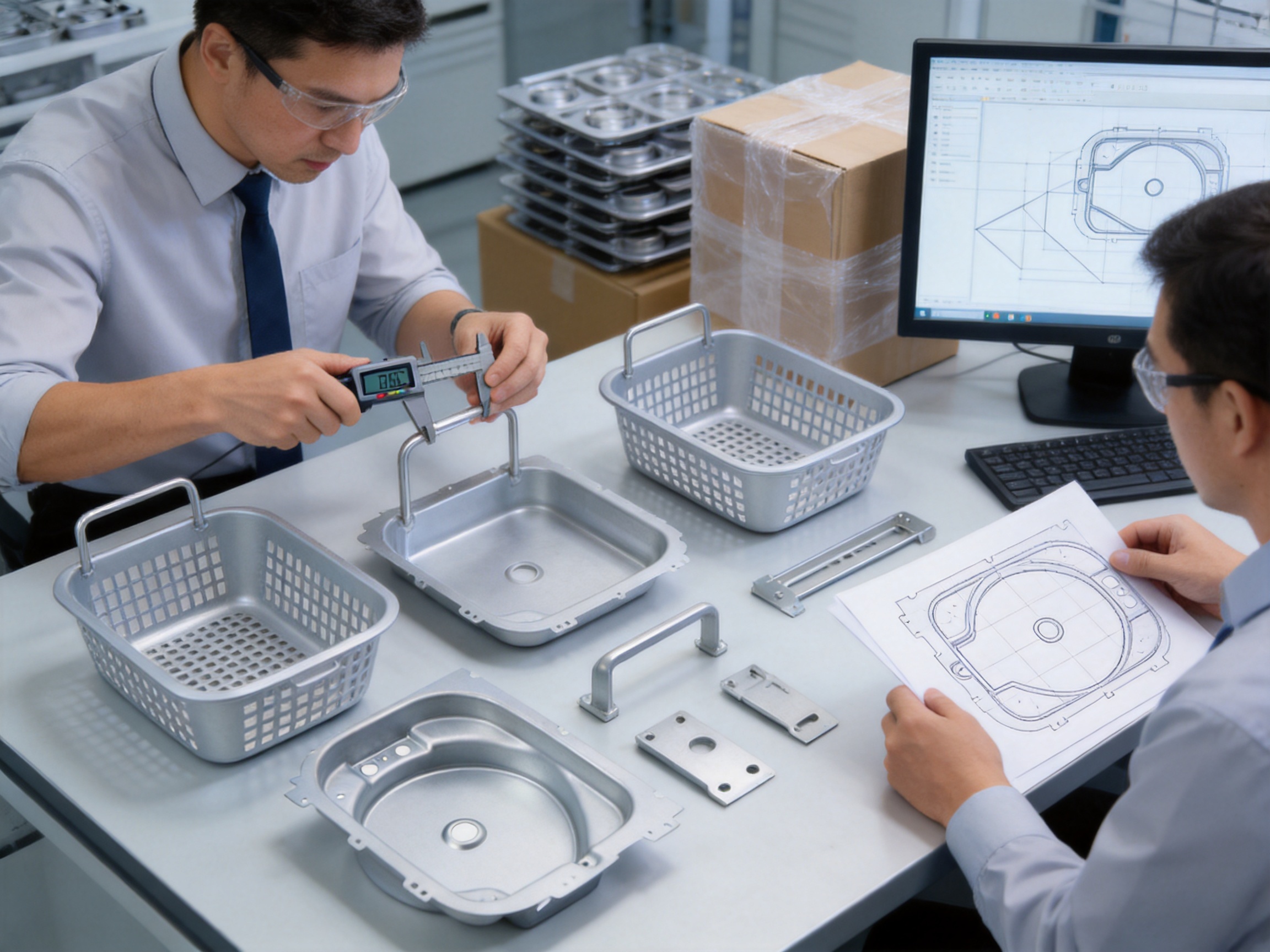
Frequently Asked Questions
What are the main air fryer parts produced through metal forming?
Common examples include mesh baskets, drip trays, tray supports, brackets, reinforcement pieces, mounting plates, and handle-related metal components. The exact parts depend on the air fryer design and the customer’s technical requirements.
Why are stamping and deep drawing suitable for air fryer accessories?
Stamping is suitable for producing repeatable flat and formed parts with holes, flanges, ribs, and mounting features. Deep drawing is useful for tray-shaped or shell-shaped components that require continuous walls and a clean formed structure. Both processes can support consistent production when the tooling and process parameters are properly controlled.
Can the air fryer basket and drip tray be customized?
Yes. Customization may include dimensions, opening pattern, material, thickness, tray depth, reinforcement structure, handle position, mounting method, edge treatment, and surface finish. Customers should provide drawings, samples, or detailed specifications for an engineering review.
How can a manufacturer improve the cleanability of an air fryer part?
Cleanability can be improved through smooth surfaces, controlled corners, suitable openings, effective drainage, reduced residue-collecting areas, and proper edge finishing. The final design should be evaluated according to the expected cleaning method and frequency of use.
What should be considered when selecting material for an air fryer part?
The main considerations include heat exposure, corrosion resistance, food-contact requirements, strength, forming performance, surface appearance, weight, and cost. The selected material must work effectively in both the manufacturing process and the finished appliance.
How does deep drawing affect the design of a drip tray?
Deep drawing can create a tray with continuous walls and fewer joints. However, the design must account for draw depth, corner radius, material flow, possible thinning, wrinkling, trimming, and dimensional control. Engineering review is important before tooling begins.
What quality checks are important for air fryer baskets and trays?
Important checks may include material verification, dimensional measurement, opening or hole inspection, surface evaluation, edge inspection, corrosion-related requirements, fit testing, and handle strength testing. The exact inspection plan should be based on the product specification.
Can the supplier support prototypes before mass production?
Prototype development and rapid production conversion can help customers verify form, fit, and function before full-scale manufacturing. Prototypes are also useful for identifying design changes that may improve manufacturability or user convenience.
What industries does the manufacturer serve?
The manufacturer supplies products and services related to educational instruments, optical instruments, household electric heaters, small household appliances, automotive parts, hardware products, plastic products, deep-drawn parts, stamped parts, bending parts, kitchen appliance accessories, and automotive stamping parts.
What company capabilities are relevant to an air fryer parts project?
The company has more than 20 years of industry experience, a 5,000-square-meter modern factory, multiple stamping workshops, and more than 60 employees. It supports OEM and ODM customization, rapid prototyping, production processing, export cooperation, quality control, delivery management, and after-sales service.
How should a customer begin a custom project?
The customer should provide available drawings, models, samples, dimensions, material information, expected quantities, surface requirements, assembly details, and inspection standards. The supplier can then review manufacturability, recommend a process, estimate tooling and production requirements, and prepare a project quotation.
Conclusion
Air fryer parts have a direct influence on cooking performance, safety, hygiene, appearance, and product durability. Mesh baskets must support airflow and grease drainage. Drip trays must collect residue without leaking or deforming. Handles must provide safe and stable control. Every component must tolerate heat, moisture, repeated handling, and frequent cleaning.
Precision sheet metal stamping, deep drawing, bending, trimming, deburring, assembly, and surface finishing provide practical methods for manufacturing these components. When these processes are combined with careful engineering review, prototype verification, process control, and final inspection, they can produce air fryer accessories with reliable fit and consistent performance.
Yuyao Hongli Optoelectronics Co., Ltd. offers relevant manufacturing experience through its work with metal stamping parts, deep-drawn products, bending components, kitchen appliance accessories, and other industrial products. Its modern factory, multiple stamping workshops, OEM and ODM support, rapid prototyping capability, and commitment to quality and service make it suitable for customers seeking customized air fryer parts and long-term production cooperation.
For appliance manufacturers, selecting a capable supplier is an important step in developing dependable products. The right supplier can contribute not only finished components but also manufacturability advice, process optimization, stable delivery, and responsive technical support. With the correct design and controlled production method, air fryer parts can help create appliances that perform consistently and provide a better experience throughout their service life.
References
1. General principles of sheet metal stamping, forming, trimming, piercing, and bending for appliance component manufacturing.
2. General engineering practices for deep-drawn metal trays, shells, containers, and continuous-wall components.
3. General design considerations for heat-resistant, corrosion-resistant, and cleanable kitchen appliance accessories.
4. General quality-control practices for dimensional inspection, surface inspection, edge finishing, assembly verification, and production traceability.
5. Product information supplied for air fryer parts, including mesh baskets, drip trays, heat-resistant tray handles, and related kitchen appliance accessories.
6. Company information supplied for Yuyao Hongli Optoelectronics Co., Ltd., including manufacturing history, factory scale, product scope, OEM/ODM services, and production capabilities.
Product: Air fryer parts
Previous Post
Air Fryer Base: Precision Metal Engineering for Safer, More Durable Kitchen Appliances
Next Post
Precision Circular Stamped Parts with a Central Hole for Reliable Industrial Assembly
News
-
-
Sheet metal is one of those materials that quietly holds everyday life together. The tray inside your air fryer, the bracket behind a car b...
READ MORE -
What Are Stamped Parts? Stamped parts are metal components produced by pressing flat sheet metal between a die and a punch to cut, bend, or...
READ MORE -
What Is Deep Drawing Process and What Are Deep-Drawn Parts The deep drawing process is a sheet metal forming operation in which a flat meta...
READ MORE
Get Fresh Updates Via Email
We promise we will never disclose your email address, and you can opt out at any time.
-
Quick Links
Home About Us Products Service News Contact Us -
Product list
Deep-drawn parts Stamped parts Bending parts Kitchen appliance accessories Automotive stamping parts -
About Us
Factory Honour FAQ -
News
Company News Industry News -
Contact Us
Address: South side of Shunke Road, Yangming Science and Technology Industrial Park, Yuyao City, Zhejiang Province, China Tel: +86-13905842349/+86-13738485724 Email: hongli@hl-stamping.com
Copyright © Yuyao Hongli Optoelectronics Co., Ltd. All Rights Reserved.
Custom Precision-Sheet/Sheet Metal Stamping Manufacturers
