


 English
 русский
 Español
 عربى
عربى

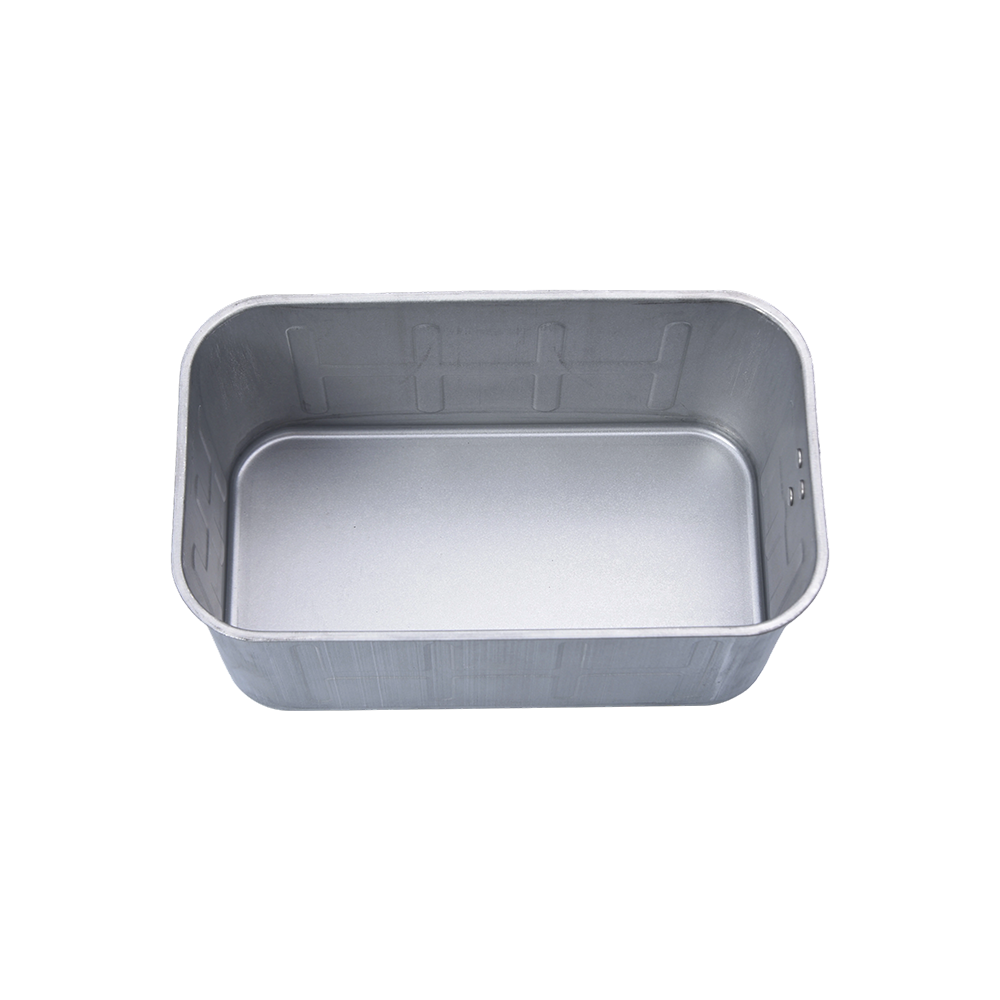
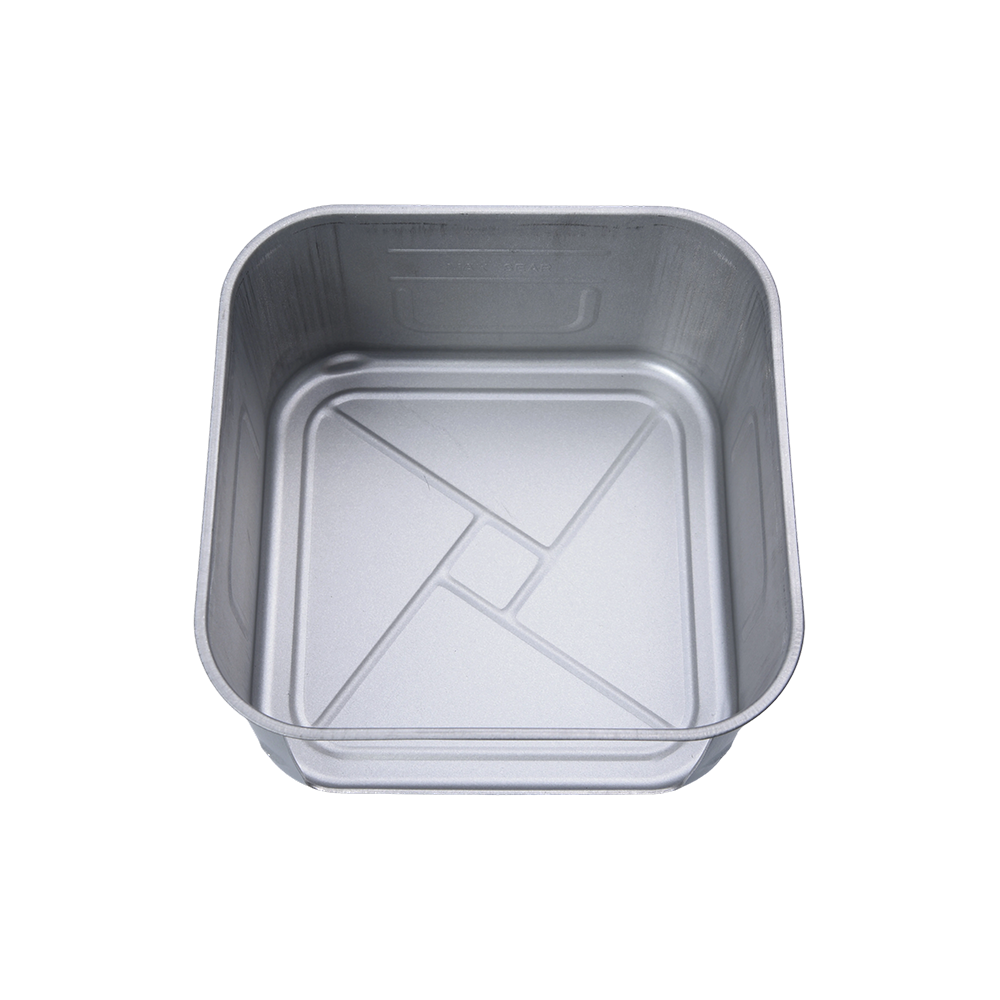
What Is Deep Drawing Process and What Are Deep-Drawn Parts The deep drawing process is a sheet metal forming operation in which a flat meta...
READ MORE

News
Home / Author / Liu Yanan — Product After-Sales Service Specialist / Deep-Drawn Square Containers with One-Sided Cutouts: Precision, Flexibility, and Reliable Industrial Performance
Deep-Drawn Square Containers with One-Sided Cutouts: Precision, Flexibility, and Reliable Industrial Performance
2026-08-21
Deep-drawn metal products are essential in applications where strength, dimensional stability, cleanliness, and efficient production must work together. Among these products, the deep-drawn square container with one side cut out offers a particularly useful combination of structural integrity and functional accessibility. Its seamless drawn body provides the durability expected from a formed metal component, while the precisely engineered side opening allows the container to connect with, fit around, or provide access to other components within an assembly.
This product is designed for customers seeking more than a standard box, tray, or stamped enclosure. It is a purpose-built component produced through controlled deep-drawing and secondary sheet-metal operations. The square geometry maximizes usable space, the one-sided cutout supports system integration, and the available finishing options allow the component to meet both technical and visual requirements. Depending on the application, the product can serve industrial equipment manufacturers, food-processing machinery producers, medical-device companies, household-appliance manufacturers, automotive suppliers, and other businesses requiring custom metal forming.
Manufactured by Yuyao Hongli Optoelectronics Co., Ltd., the product benefits from more than two decades of experience in stamping, deep drawing, bending, and customized metal-part production. The company operates from a modern facility in Yuyao, Zhejiang Province, with multiple stamping workshops, a workforce of more than 60 employees, and a production area of approximately 5,000 square meters. Its capabilities support prototype development, OEM and ODM production, batch manufacturing, quality control, and international customer service.
The purpose of this article is to examine the product’s design, manufacturing process, performance advantages, customization possibilities, quality considerations, and application value. It also explains why a deep-drawn square container with a one-sided cutout can outperform ordinary assembled or welded alternatives in demanding production environments.
1. Product Overview
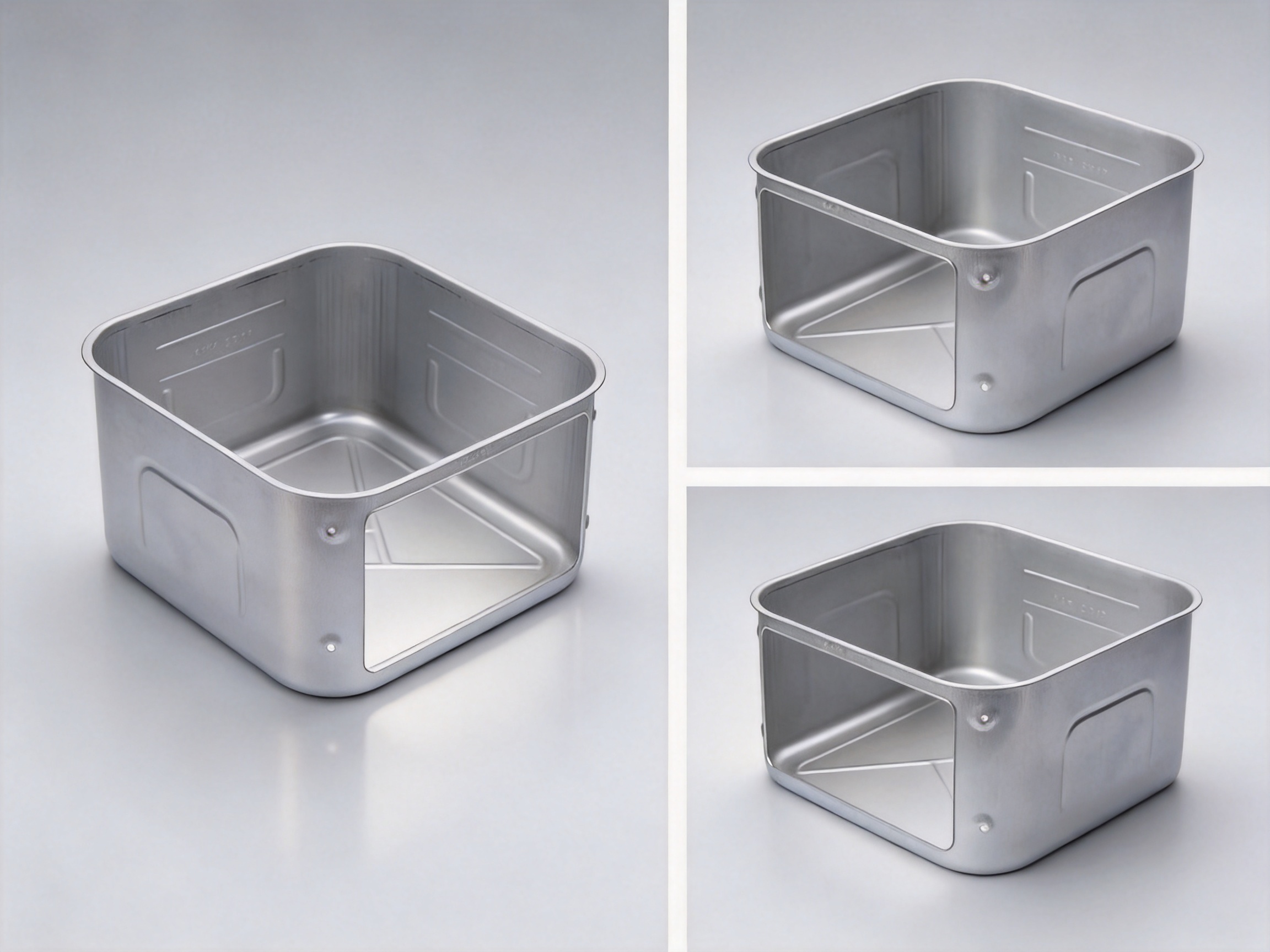
The deep-drawn square container with one side cut out is a formed metal component produced from sheet material. During deep drawing, a flat blank is pressed into a die to create a container-like shape. Instead of assembling several flat pieces by welding, the body is formed as an integrated structure. A secondary cutting process then creates a precisely positioned opening on one side of the container.
The resulting component combines a square or rectangular profile with a functional side access area. The exact shape, depth, wall thickness, corner radius, opening dimensions, and edge treatment can be adjusted according to the customer’s drawings or application requirements. This flexibility enables the component to be used as a housing, liner, shield, support enclosure, guide structure, access tray, protective cover, or process-related container.
The product is especially suitable for situations in which one side must remain open or partially open to allow inspection, feeding, installation, ventilation, component passage, or connection with an adjoining structure. The cutout may be positioned on the front, rear, left, right, or another specified surface. Its dimensions can also be adapted to accommodate cables, pipes, moving parts, tools, sensors, fittings, or operator access.
Although the product has a straightforward appearance, its successful manufacture requires careful control of material flow, draw depth, corner geometry, springback, cutting accuracy, edge condition, and surface quality. A poorly designed or poorly produced container may wrinkle, crack, distort, develop sharp edges, or fail to fit its mating components. The production approach used for this product is therefore based on coordinated forming, cutting, inspection, and finishing operations rather than on simple pressing alone.
2. Main Design Features
2.1 Integrated Deep-Drawn Construction
The most important structural feature is the integrated drawn body. Deep drawing reduces the number of separate parts required to make the container and can eliminate many weld seams, fastening points, and overlapping joints. A continuous body provides a clean appearance and can improve resistance to vibration, handling stress, and localized contamination.
Compared with a container assembled from multiple bent panels, an integrated drawn component can offer better consistency from piece to piece. The forming die defines the principal shape, allowing the same geometry to be reproduced over a production run. This repeatability is valuable for customers that require reliable assembly dimensions and stable performance in automated or semi-automated production lines.
2.2 Square Geometry for Efficient Space Utilization
The square shape is well suited to applications where equipment space is organized around straight lines, rectangular housings, or modular frames. Compared with a round container of similar overall dimensions, a square container can make more efficient use of available corners and flat mounting surfaces. It can also provide a larger usable contact area for brackets, seals, labels, sensors, or adjacent panels.
The square profile is particularly beneficial in electrical equipment, appliance assemblies, storage-related mechanisms, medical instruments, and automotive components. It can be designed to fit into a defined cavity while maintaining clear internal volume. Corner radii can be optimized to balance formability, cleaning requirements, structural strength, and appearance.
2.3 Precisely Cut One-Sided Opening
The side cutout is the product’s primary functional distinction. It creates an access zone without requiring the customer to perform additional cutting after delivery. The opening can be designed for direct access to the internal cavity, for the passage of another part, or for installation into a surrounding framework.
Providing the cutout during professional production offers several advantages. The location can be controlled relative to the base, corners, and reference edges. The size can be held within an agreed tolerance. The cut edge can be deburred, rounded, brushed, or otherwise treated. These details reduce the risk of assembly interference and help protect operators, cables, seals, and adjacent components.
The cutout may also be adapted to functional needs such as ventilation, drainage, cleaning, material loading, inspection, or movement. A customer can specify whether the opening should be centered, offset, elongated, rectangular, stepped, or combined with other punched or formed features.
2.4 Customizable Dimensions and Thicknesses
Standardized product dimensions are useful for repeat orders, but many industrial applications require a custom form. The deep-drawn square container can be manufactured in different lengths, widths, heights, wall thicknesses, opening dimensions, and edge configurations. Customization is normally developed from a technical drawing, sample, three-dimensional model, or detailed application description.
Material thickness must be selected according to the required strength, draw depth, material grade, weight, and forming feasibility. A thinner material can reduce mass and cost, while a thicker material can improve rigidity and resistance to impact. The correct choice is not based on thickness alone. The design must also consider corner radii, support conditions, handling loads, temperature, chemical exposure, and the type of equipment in which the component will be installed.
2.5 Surface Finishing Options
Surface treatment can be selected according to the product’s environment and appearance requirements. Brushed finishes can provide a uniform directional texture and help reduce the visual impact of minor handling marks. Polished finishes can offer a smoother and more reflective surface where appearance or cleanability is important. Electropolishing can improve surface smoothness and cleanliness while supporting corrosion resistance for suitable materials and applications.
Other finishing requirements may be discussed during product development, including deburring, edge smoothing, cleaning, protective packaging, and special surface preparation for later coating or assembly. The appropriate finish depends on the base material, end-use environment, customer specifications, and required inspection criteria.
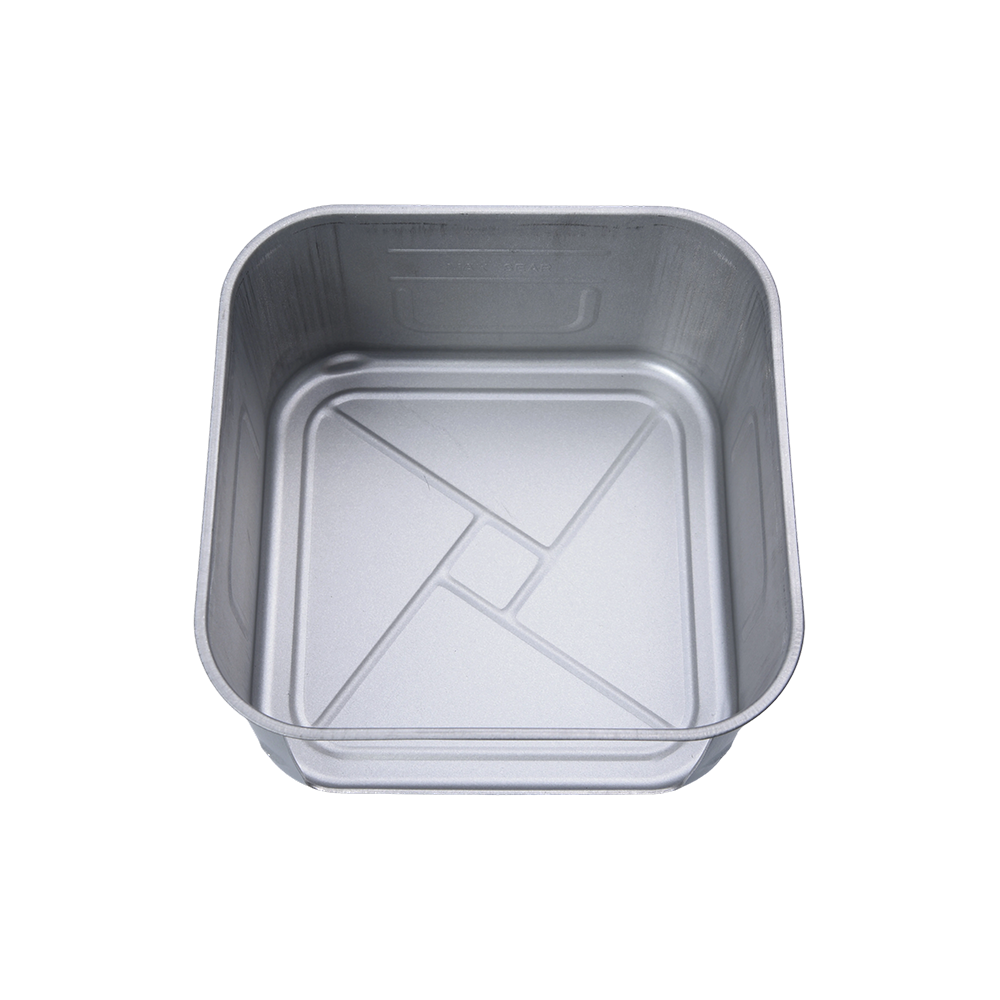
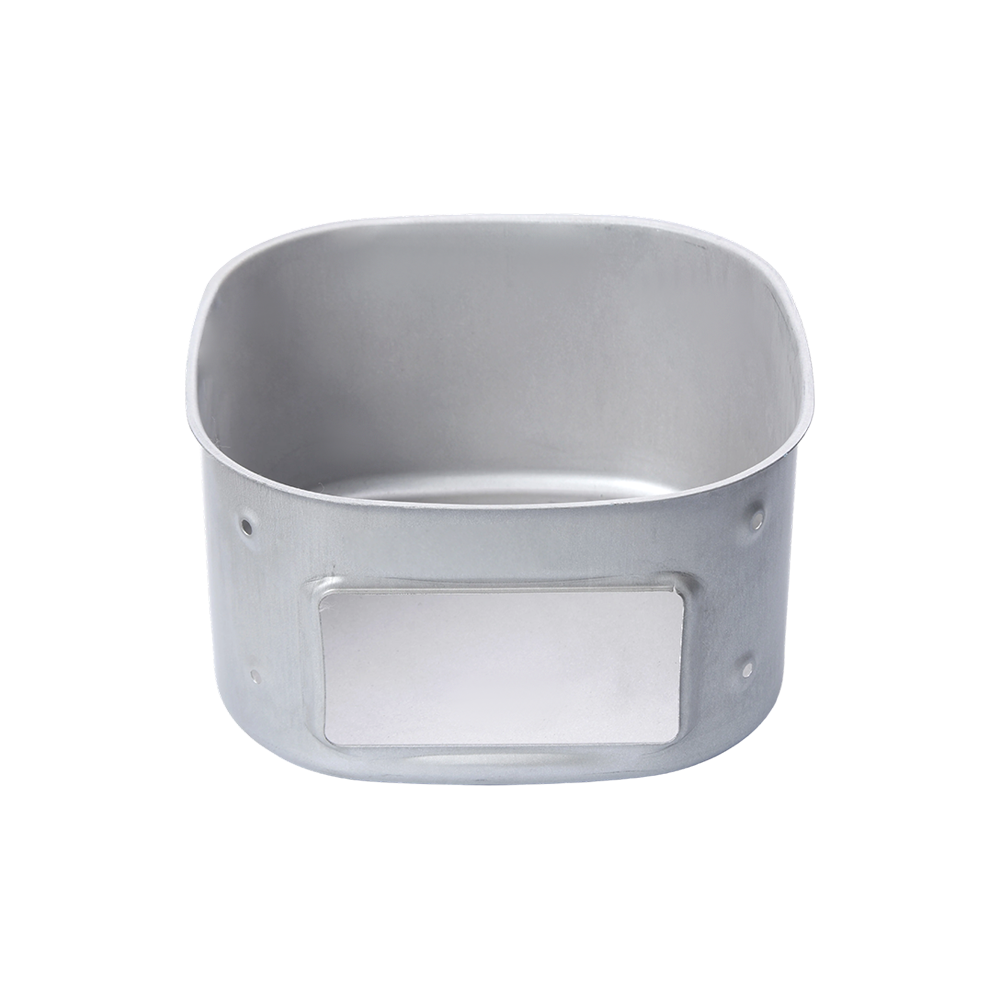
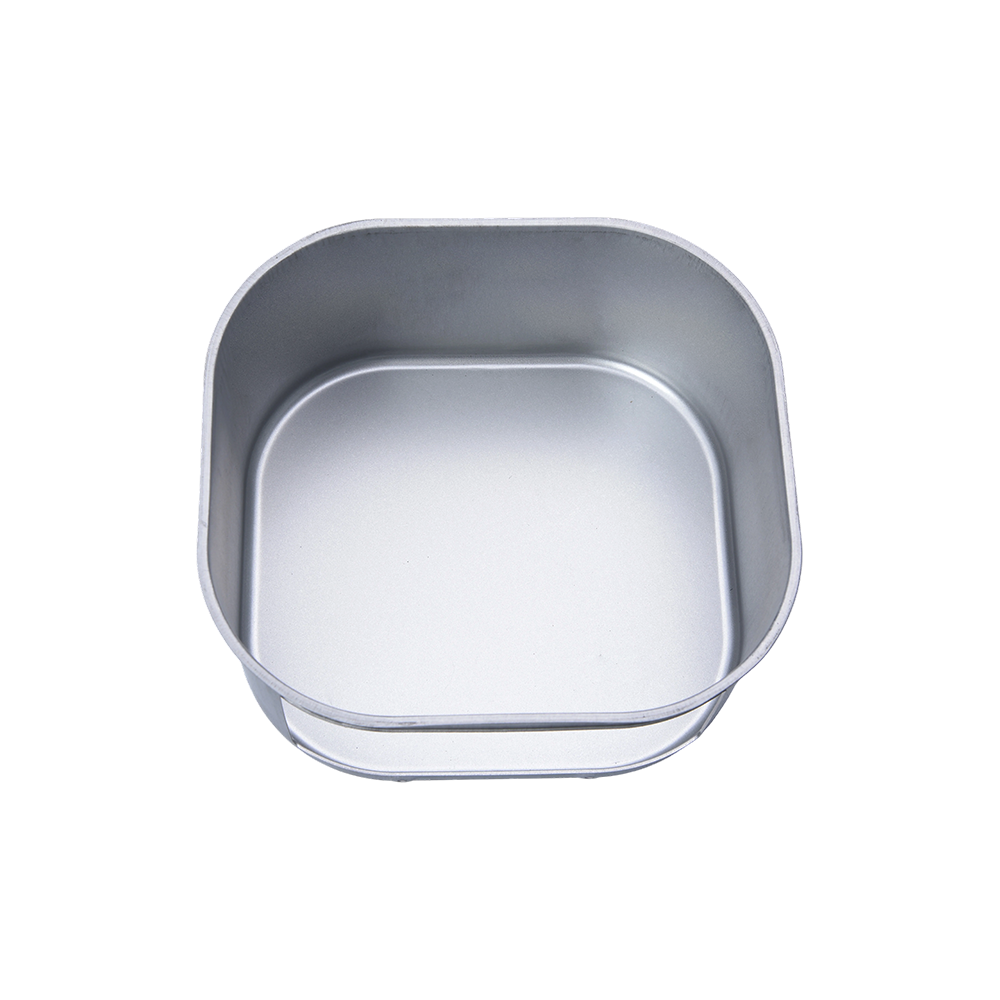
Deep-drawn square shape with one side cut out
3. Manufacturing Process
3.1 Engineering Review and Product Feasibility
Production begins with a review of the customer’s specifications. Engineers evaluate the proposed geometry, material, thickness, draw ratio, corner shape, opening location, dimensional tolerances, surface requirements, and expected production volume. This stage is important because deep-drawing performance depends on the relationship between the blank size, die geometry, punch shape, material properties, and forming sequence.
If the design includes a deep cavity, narrow corner, large opening, or unusual wall transition, the manufacturing team can recommend adjustments that improve formability and reduce the likelihood of cracking or wrinkling. The objective is not to change the customer’s functional intent, but to ensure that the part can be produced consistently and economically.
Engineering review may also determine whether the cutout should be created during a progressive operation, after the main drawing operation, or through a separate precision cutting step. The best approach depends on the opening shape, material thickness, quantity, tolerance, and relationship between the opening and the drawn walls.
3.2 Material Preparation
The selected sheet material is prepared in accordance with the approved design. Material choice may be based on strength, corrosion resistance, surface appearance, cleanliness, weight, formability, and compatibility with the customer’s operating environment. For food-processing or medical-related applications, particular attention may be given to surface condition, cleanability, and the avoidance of unnecessary crevices or rough edges.
Before forming, the sheet may be cut into blanks of an appropriate size and shape. Blank preparation affects material utilization and forming behavior. An optimized blank can reduce waste, improve draw stability, and support more consistent wall distribution. For larger production programs, efficient blank nesting and repeatable material handling can contribute significantly to cost control.
3.3 Tooling and Die Development
Deep drawing requires carefully designed tooling. The punch, die, blank holder, guide elements, and related components must work together to control the movement of the sheet during forming. Tool design takes into account the container’s outside dimensions, internal dimensions, corner radii, draw depth, material thickness, and desired surface condition.
The one-sided cutout also influences tooling strategy. If the opening is created after drawing, the drawn container must be supported accurately during the cutting operation. If specific features are integrated into the forming sequence, the tooling must prevent distortion of the surrounding walls. Proper die development helps maintain the relationship between the opening and the rest of the container.
Tooling accuracy is one of the major factors separating professional deep-drawn production from improvised metal fabrication. A suitable die minimizes inconsistent wall movement, reduces surface marks, and establishes repeatable dimensions. It also allows the company to maintain stable production over repeated orders and replacement cycles.
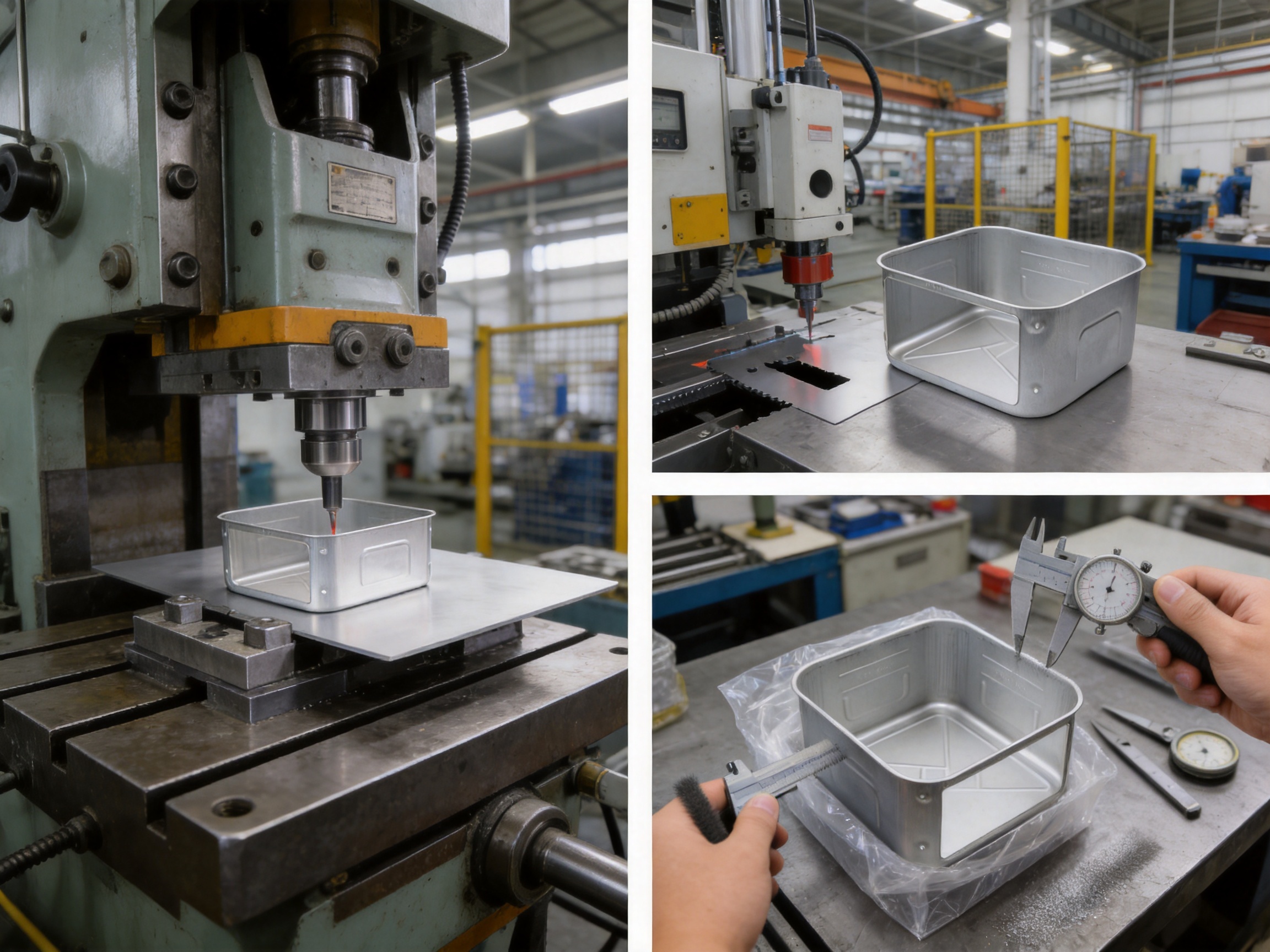
3.4 Deep-Drawing Operation
During deep drawing, the blank is positioned over the die and formed by a punch. The sheet flows into the die cavity under controlled pressure. The blank holder helps manage material movement and reduces the risk of wrinkles in areas where excess material could accumulate.
Process parameters must be matched to the material and geometry. Excessive forming force can cause tearing, while insufficient control may lead to wrinkles, uneven walls, or dimensional instability. The drawing speed, lubrication, punch radius, die radius, blank-holder pressure, and number of forming stages may all influence the final result.
For a relatively shallow container, one primary drawing operation may be sufficient. For a deeper or more complex design, multiple operations may be used. Intermediate forming stages can distribute deformation more evenly and protect the material from excessive strain. The number of operations is selected according to part geometry, material behavior, and production efficiency.
3.5 Cutout Formation
After the main body has been drawn, the one-sided opening is produced using an appropriate cutting method. The choice may include punching, trimming, milling, laser cutting, or another controlled process. The method is selected according to the opening’s shape, edge requirements, production volume, material thickness, and tolerance.
For repeat production, dedicated punching or trimming tooling can provide high speed and consistent results. For prototypes, low-volume orders, or designs with frequently changing dimensions, flexible cutting methods can reduce tooling requirements and shorten development time. In all cases, the container must be held securely to prevent movement or distortion during cutting.
Cutout accuracy involves more than the nominal length and width of the opening. Its position relative to the base, sidewalls, corners, and reference surfaces is also important. If the component will be inserted into another assembly, even a small positional error may affect fit. Professional inspection therefore evaluates both the opening itself and its relationship to the overall container.
3.6 Deburring and Edge Treatment
Cutting operations may leave burrs or sharp edges. These are removed through deburring, edge smoothing, brushing, tumbling, manual finishing, or another suitable process. The specific method depends on the material, shape, opening size, and required surface standard.
Edge treatment is essential for safety and reliability. A smooth edge helps protect workers during handling and reduces the risk of damage to cables, seals, gloves, food-contact materials, or neighboring parts. It can also improve the product’s appearance and make it easier to clean.
3.7 Surface Finishing and Cleaning
Once forming and cutting are complete, the product can receive its specified surface treatment. Brushing, polishing, or electropolishing may be applied depending on the material and application. Finishing must be performed carefully because aggressive treatment can alter edge geometry, reduce dimensional accuracy, or create uneven visual patterns.
Cleaning removes forming residues, particles, and handling contaminants. For products intended for sensitive equipment or controlled environments, cleaning and packaging requirements can be incorporated into the production plan. The goal is to deliver a component that is not only dimensionally correct but also suitable for the customer’s next manufacturing stage.
3.8 Inspection and Packing
Inspection may include dimensional measurement, visual examination, cutout verification, edge inspection, surface review, and functional fit checking. The inspection method is matched to the customer’s drawing and the importance of each feature. Critical dimensions can be recorded or checked using appropriate gauges and measuring equipment.
Packaging is also important for deep-drawn parts with visible surfaces. Protective materials can help prevent scratches, dents, and contact damage during storage and transportation. Packaging quantities and labeling can be arranged to support the customer’s receiving, inventory, and assembly processes.
4. Advantages Over Conventional Alternatives
4.1 Fewer Welded Seams
A multi-piece square container commonly requires several panels to be cut, bent, aligned, and welded. Each joint introduces a possible source of distortion, surface irregularity, leakage, corrosion concentration, or dimensional variation. The deep-drawn construction reduces the number of such joints and creates a more coherent body.
Fewer seams can also simplify cleaning and inspection. In environments where residue must not accumulate, a smooth integrated form may be preferable to a structure containing multiple internal weld transitions. The exact suitability depends on the material and application, but the seamless or near-seamless approach offers a strong starting point for hygienic and durable design.
4.2 Improved Structural Consistency
Because the primary container shape is formed in a controlled die, the product can achieve better consistency than manually assembled sheet-metal boxes. Repeated production parts share the same fundamental geometry, making them easier to install and replace. This is particularly valuable for customers operating multiple production lines or using the component in standardized equipment platforms.
4.3 Efficient Use of Internal Space
The square drawn form offers useful internal capacity without requiring a complex assembled frame. Flat sides can support efficient arrangement of adjacent components, while the cutout gives direct access to a defined region. The combination can help designers reduce the number of separate brackets, covers, access panels, or adapters in an assembly.
4.4 Better Integration Potential
The one-sided cutout is designed as part of the product rather than added by the customer after delivery. This allows the opening to be positioned accurately and finished properly. It can be aligned with a feeder, frame, inspection port, heating element, cable route, or moving mechanism.
When the customer performs cutting in-house, the process may require additional fixtures, tools, labor, and inspection. It may also create burrs, deformation, inconsistent locations, or damage to the surface. Receiving a finished component with the opening already formed can shorten assembly time and reduce production risk.
4.5 Reduced Secondary Assembly
Integrated forming can reduce the need for screws, brackets, welds, and adhesives. Fewer assembly steps can lower labor requirements and reduce the number of opportunities for error. It may also simplify purchasing because the customer obtains one finished component instead of several subcomponents.
Reducing part count does not always produce the lowest total cost automatically, because tooling and engineering investment must be considered. However, for suitable production volumes, the repeatability and speed of stamping and deep drawing can provide an attractive total-cost advantage over labor-intensive fabrication.
4.6 Adaptability for Different Industries
The product can be customized for different materials, sizes, finishes, and opening configurations. This makes it more adaptable than a fixed standard container. A single manufacturing partner can support different versions for industrial equipment, household appliances, food-processing systems, medical instruments, and automotive assemblies.
4.7 Attractive and Professional Appearance
Deep-drawn surfaces can provide a clean, uniform appearance. When combined with brushing, polishing, or electropolishing, the component can meet visual expectations in exposed equipment or consumer-facing products. The absence of multiple visible joints can also contribute to a more refined appearance.
5. Manufacturing Strengths and Company Capabilities
5.1 More Than Twenty Years of Industry Experience
Yuyao Hongli Optoelectronics Co., Ltd. has more than 20 years of experience in metal stamping and related manufacturing. Established in 2000, the company has developed from its earlier educational-instrument business into a broader manufacturing enterprise serving multiple industries.
Long-term experience is valuable in deep drawing because practical knowledge often determines whether a design is merely theoretically possible or consistently manufacturable. Experience with different materials, shapes, tooling conditions, and customer requirements helps the company identify production risks early and recommend practical solutions.
5.2 Integrated Production Capabilities
The company’s product range includes deep-drawn parts, stamped parts, bending parts, kitchen-appliance accessories, automotive stamping parts, hardware products, plastic products, educational instruments, optical instruments, household electric-heater components, and small-appliance parts. This range indicates an ability to coordinate several metalworking processes rather than relying on a single operation.
For the square container with a one-sided cutout, integrated capability is particularly helpful. The part may require deep drawing, trimming, punching, bending, deburring, surface finishing, inspection, and packaging. Managing these operations through an experienced manufacturing organization can reduce communication gaps and improve process continuity.
5.3 Modern Factory and Multiple Workshops
The company operates a modern production facility covering approximately 5,000 square meters and includes multiple stamping workshops. This infrastructure supports production planning, tooling management, material handling, process separation, and order coordination.
Multiple workshops can also help organize different production requirements. Prototype work, small-batch customization, repeat stamping, and larger-volume orders may require different equipment or scheduling approaches. A structured factory environment makes it easier to assign resources according to part complexity and delivery needs.
5.4 OEM and ODM Support
OEM and ODM services allow customers to order parts based on their own designs or to work with the manufacturer during product development. OEM production is suitable when the customer already has approved drawings and technical specifications. ODM cooperation is useful when the customer has a functional concept but needs assistance with manufacturability, tooling, material selection, or detailed construction.
For a custom deep-drawn container, early cooperation can prevent avoidable problems. The company can review whether the cutout is located too close to a corner, whether the draw depth is realistic, whether the wall thickness is adequate, or whether the selected finish is compatible with the material. These discussions can reduce later modifications and improve the efficiency of tooling development.
5.5 Rapid Prototyping and Production Conversion
Product development often moves through several stages: concept, drawing, prototype, testing, design revision, pilot production, and mass production. The ability to support these stages through one manufacturing partner can shorten the transition from design to supply.
Prototype quantities may be produced to verify fit, opening access, surface appearance, and assembly function. After testing, the design can be refined before production tooling and repeat manufacturing are finalized. This process is especially useful when the container is being integrated into a new appliance, machine, medical device, or vehicle component.
5.6 Quality Control and Stable Delivery
Quality control is essential for drawn parts because visual defects and dimensional problems can originate at several stages. The company emphasizes quality management, stable delivery, and after-sales service as part of its manufacturing approach.
A reliable supply relationship requires more than producing a technically acceptable first batch. It requires consistency across repeat orders, clear communication about revisions, traceable specifications, appropriate packaging, and prompt handling of questions or corrective actions. These factors are especially important when the part is installed in a larger product with fixed assembly dimensions.
5.7 International Customer Service
The company provides manufacturing, processing, wholesale, retail, import, and export services. Its location in Zhejiang Province offers access to an established manufacturing and logistics network. International customers can work with the company on customized metal parts while coordinating specifications, samples, order quantities, packaging, and delivery schedules.
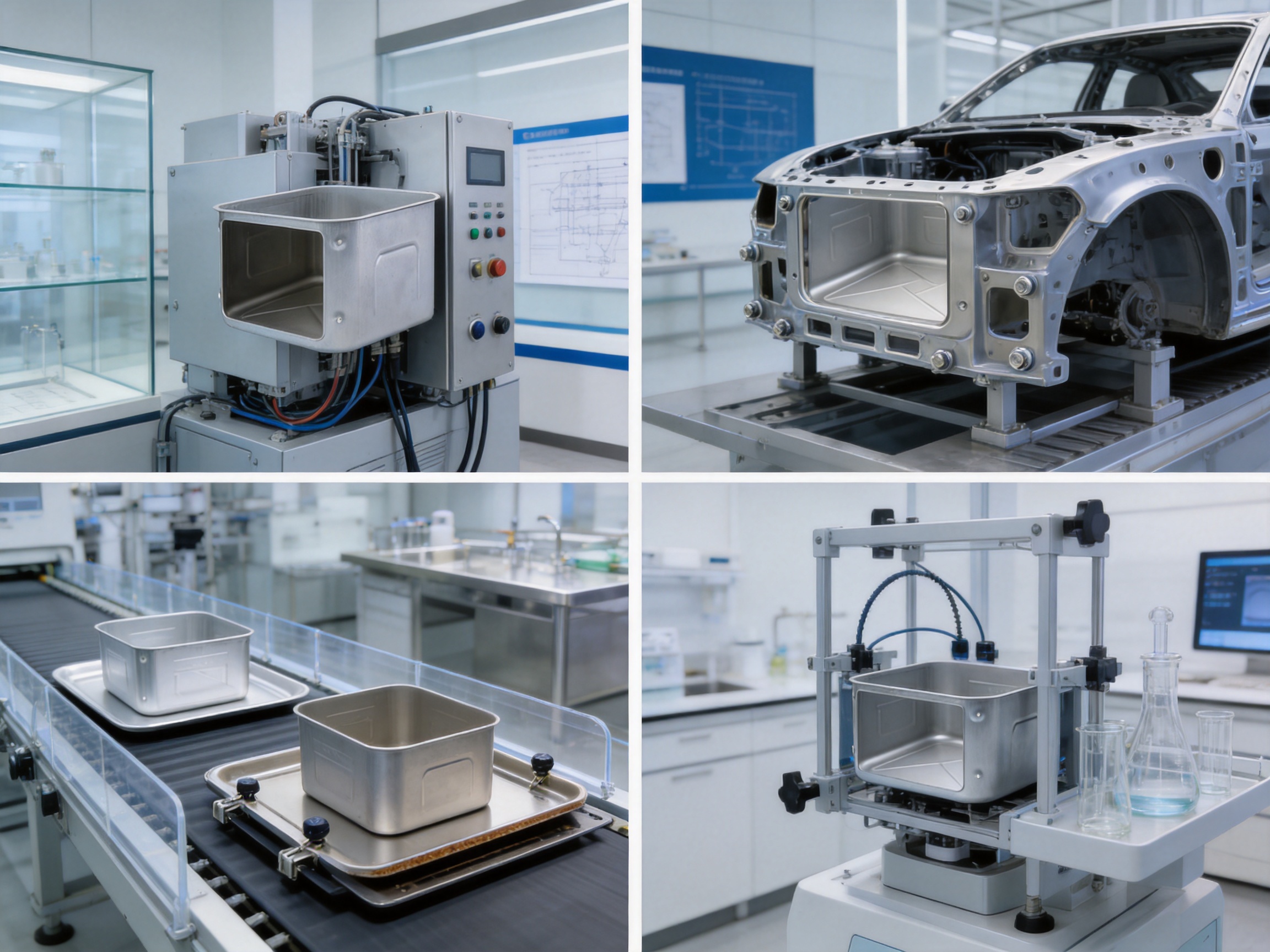
6. Applications
6.1 Industrial Equipment
Industrial equipment frequently requires custom enclosures, guides, shields, trays, covers, and supporting components. The square container can be designed to fit within a machine frame or around a mechanical, electrical, or thermal element. The side opening may provide access for adjustment, inspection, ventilation, or connection.
Its drawn construction can withstand routine handling and vibration when properly designed. The product can also be produced with mounting features, holes, flanges, or additional formed details if required by the equipment layout.
6.2 Food-Processing Machinery
Food-processing equipment benefits from components that are easy to inspect and clean. A deep-drawn container with a suitable surface finish can provide a smooth, accessible form for handling, guiding, collecting, or protecting materials within a machine.
The opening can support loading, discharge, cleaning access, or integration with another processing section. Material selection and surface finishing must be confirmed according to the specific food-contact, temperature, chemical, and sanitation requirements of the application.
6.3 Medical and Laboratory Equipment
Medical and laboratory equipment often requires compact metal components with controlled geometry and clean surfaces. The product may be used as an internal tray, protective housing, support enclosure, or instrument subassembly.
In these applications, design attention may focus on smooth edges, surface cleanliness, dimensional fit, and compatibility with cleaning or sterilization procedures. Requirements should be clearly specified during quotation and engineering review, since the appropriate material and finishing process depend on the intended use.
6.4 Household Appliances
Household appliances frequently contain formed metal parts that must fit into compact spaces and withstand heat, vibration, repeated operation, or user handling. The square container may be adapted for heaters, small appliances, kitchen equipment, control assemblies, protective structures, or internal support components.
Its cutout can simplify the routing of wires, positioning of controls, connection of ducts, or access to replaceable parts. Brushed or polished surfaces may also be selected when the component is visible to the user.
6.5 Kitchen Appliance Accessories
Kitchen-appliance accessories require a combination of practicality, appearance, durability, and cleanability. A formed square component may be used as a tray, insert, holder, guide, shield, or accessory housing. The side cutout can make it easier to remove the component, access contents, or connect it to the appliance body.
For kitchen applications, edge quality is especially important. Proper deburring and finishing help improve handling safety and reduce areas where residue may accumulate. Material and surface requirements should be selected based on whether the product contacts food directly or functions as an internal non-contact component.
6.6 Automotive Components
Automotive stamping parts must meet demanding requirements for repeatability, fit, durability, and production efficiency. The deep-drawn container can be developed for protective covers, brackets, structural subcomponents, housings, guides, shields, or interior mechanisms.
The cutout may support assembly access, cable routing, component clearance, or integration with the vehicle body. Automotive customers may also require specific dimensional controls, packaging methods, sample approvals, and production documentation. These requirements can be addressed during the project planning stage.
7. Customization Options
7.1 Shape and Overall Dimensions
Customers can request specific length, width, height, corner radius, base shape, and wall configuration. The square profile may be modified into a rectangular proportion when the available installation space requires it. The final geometry should be evaluated for both functional performance and deep-drawing feasibility.
7.2 Opening Position and Size
The side cutout can be moved or resized according to the surrounding assembly. Customers should provide the opening’s position from clear reference edges, not only its general location. This helps ensure that the production part matches the intended installation geometry.
Information about corner radii, edge clearances, stepped profiles, required access angles, and mating components can also improve the engineering review. If the opening must accommodate a moving part, the complete movement envelope should be considered rather than only the static part dimensions.
7.3 Material and Thickness
Material and thickness can be selected based on strength, corrosion resistance, weight, finish, temperature, cleaning agents, and forming characteristics. The customer’s operating environment should be explained clearly because a material suitable for a dry indoor appliance may not be appropriate for a wet, chemical, outdoor, or high-temperature application.
7.4 Surface Treatment
Brushed, polished, and electropolished surfaces are available options. A customer may also request a particular visual direction, roughness target, edge condition, or protective packing method. Surface treatment should be finalized before production because it can affect appearance, tolerance, cost, and delivery time.
7.5 Additional Features
Depending on the design, the container may be combined with additional stamped holes, slots, flanges, beads, bends, mounting points, or locating features. These elements can reduce the need for later assembly and improve the part’s integration into the customer’s product.
Every additional feature should be reviewed in relation to the drawing sequence. A hole located too close to a drawn corner may distort during forming, while a flange may require a separate bending or trimming operation. Coordinated engineering helps achieve the desired functionality without unnecessary manufacturing complexity.
8. Quality Considerations for Buyers
8.1 Dimensional Accuracy
Buyers should identify which dimensions are critical to assembly and which are less important. Overall length, width, height, base flatness, wall position, opening size, and opening location may each require different inspection methods and tolerances.
It is useful to provide datum references and define how the part will be measured. A drawing that identifies critical features clearly helps the manufacturer establish suitable inspection procedures and reduces misunderstandings during production.
8.2 Wall Thickness and Forming Behavior
Deep drawing can cause material distribution to vary across the body. Corners, transitions, and heavily formed regions may experience different levels of strain from flat areas. The selected material and geometry should therefore be reviewed together rather than independently.
If the customer requires a minimum wall thickness in a particular area, this should be stated explicitly. The manufacturer can then evaluate the forming sequence and determine whether additional operations or design adjustments are necessary.
8.3 Surface Condition
Visible surfaces should be identified on the technical drawing or sample approval documents. Customers may need to distinguish between cosmetic surfaces and hidden surfaces. This distinction helps establish reasonable inspection standards and prevents unnecessary rejection of parts for marks that do not affect function.
At the same time, significant scratches, dents, cracks, wrinkles, discoloration, or uneven finishing should be controlled. The appropriate acceptance criteria depend on the product’s appearance, exposure, and end-use requirements.
8.4 Edge Safety
The one-sided opening makes edge quality a critical consideration. The cut edge should be free from dangerous burrs and should have the agreed radius or treatment. If the component will be handled frequently, installed near wiring, or used in food or medical equipment, edge requirements should be stated before production.
8.5 Packaging and Transportation
Drawn containers can be nested, separated, or individually protected depending on their shape and finish. Nested parts should not rub against one another if the surface is highly visible or polished. Protective films, paper, bags, partitions, or custom cartons may be considered to reduce transportation damage.
9. Cost and Production Efficiency
The economic value of a deep-drawn part depends on the complete production system, not only the unit price. Tooling cost, material utilization, operation count, labor, finishing, inspection, packaging, delivery, and expected order volume should all be considered.
For medium- and high-volume production, deep drawing can provide a strong cost advantage because the press operation is repeatable and fast after tooling has been developed. Reduced welding and assembly can further lower labor content. The integrated structure may also reduce the number of purchased components in the customer’s bill of materials.
For prototypes or small orders, the most economical method may involve flexible cutting and forming rather than fully dedicated tooling. The manufacturer can discuss the appropriate production route based on quantity, geometry, deadline, and future volume potential. If a prototype is likely to transition into mass production, it is beneficial to consider the future tooling strategy at the beginning.
Material utilization is another important factor. Efficient blank design can reduce scrap, while a well-planned forming sequence can reduce rejected parts. Process stability also improves cost performance because fewer defects mean less rework, sorting, and replacement activity.
10. Why Choose a Specialized Manufacturing Partner
Choosing a supplier for a deep-drawn square container requires more than comparing quotations. The supplier should understand how the part will be used, how it will be assembled, and which features are critical. A specialized manufacturer can contribute to design improvement before tooling begins and can coordinate forming, cutting, finishing, and inspection under one production plan.
Yuyao Hongli Optoelectronics combines deep-drawn-part production with stamping, bending, appliance-accessory manufacturing, and automotive-part experience. This broader background can be useful when a customer’s component includes multiple formed details or belongs to a larger product family.
The company’s OEM and ODM support provides flexibility for both established drawings and early-stage concepts. Its rapid-prototyping capability can help customers validate a design before committing to larger quantities. Its factory resources, experienced personnel, and focus on quality and delivery support long-term supply relationships.
Another important advantage is communication continuity. When engineering questions, tooling decisions, production scheduling, surface treatment, inspection, and after-sales support are coordinated by one experienced supplier, customers can reduce the administrative burden associated with managing multiple subcontractors.
11. Recommended Customer Information
To obtain an accurate quotation and realistic delivery plan, customers should provide as much of the following information as possible:
1. A two-dimensional drawing, three-dimensional model, physical sample, or clear dimensional description.
2. Required material grade or the intended operating environment if material selection is open.
3. Sheet thickness or acceptable thickness range.
4. Overall container dimensions, internal dimensions, and required draw depth.
5. Exact cutout size, position, corner radius, and edge requirements.
6. Critical tolerances and important assembly reference points.
7. Surface finish requirements, including brushed, polished, electropolished, or other requested treatments.
8. Estimated prototype quantity, trial quantity, and annual or batch volume.
9. Intended application, operating temperature, exposure to moisture or chemicals, and cleaning conditions.
10. Packaging, labeling, inspection, and delivery requirements.
Providing this information early helps the manufacturer recommend an efficient process and prevents avoidable changes after tooling or sample production has begun.
12. Product Specification Guide
| Item | Available or Customizable Requirement | Typical Consideration |
|---|---|---|
| Product type | Deep-drawn square container with one-sided cutout | Used as a housing, tray, insert, guide, shield, or integrated machine component |
| Basic geometry | Square or rectangular drawn body | Selected according to available space and required internal volume |
| Side opening | Custom position, width, height, shape, and edge treatment | Designed for access, clearance, ventilation, loading, inspection, or connection |
| Material | Selected according to application and forming requirements | Consider strength, corrosion resistance, weight, cleanliness, and surface appearance |
| Thickness | Custom thickness based on design and material | Balanced against rigidity, drawability, weight, and cost |
| Surface treatment | Brushed, polished, electropolished, or specified alternative | Chosen according to appearance, smoothness, cleanability, and corrosion needs |
| Secondary operations | Trimming, punching, deburring, bending, cleaning, and inspection | Determined by part geometry and customer drawing |
| Production service | Prototype, OEM, ODM, small-batch, and repeat production | Process selected according to quantity, complexity, and future demand |
| Industries | Industrial, food-processing, medical, appliance, kitchen, and automotive | Requirements vary according to operating environment and compliance needs |
13. Q&A
Q1: What is a deep-drawn square container with one side cut out?
It is a metal container formed from sheet material through a deep-drawing process, followed by a controlled cutting operation that creates an opening on one side. The integrated body provides a stable square or rectangular structure, while the opening supports access, clearance, ventilation, loading, inspection, or connection with another component.
Q2: What is the main advantage of deep drawing compared with assembling several panels?
Deep drawing can reduce the number of seams, welds, fasteners, and assembly steps. It can provide a more consistent structure, cleaner appearance, and efficient repeat production. The exact benefit depends on the part geometry, material, volume, and application.
Q3: Can the opening be placed on any side?
The opening position can generally be customized according to the customer’s design. It may be located on the front, rear, left, right, or another specified surface. The position must be reviewed in relation to the draw geometry, corner radii, wall thickness, and cutting method.
Q4: Can the size and shape of the cutout be changed?
Yes. The opening can be adjusted in width, height, shape, corner radius, and position. Rectangular, elongated, stepped, and other configurations may be possible, subject to tooling and forming feasibility.
Q5: What materials can be used?
Material selection depends on the application, forming requirements, strength, corrosion resistance, operating temperature, weight, surface appearance, and cleaning conditions. Customers can specify a material grade or describe the working environment so that a suitable option can be evaluated.
Q6: Is the product suitable for food-processing or kitchen applications?
It may be suitable for food-processing equipment and kitchen appliances when the material, surface treatment, cleaning method, and edge condition meet the application requirements. Whether the part has direct food contact or is used as an internal non-contact component should be clarified during the engineering stage.
Q7: Which surface treatments are available?
Brushed, polished, and electropolished finishes are available options. The selected treatment should match the base material and the customer’s requirements for appearance, smoothness, cleanability, and corrosion resistance.
Q8: Can the product be supplied with deburred edges?
Yes. Deburring and edge treatment can be included in the production process. The required edge radius or smoothness should be specified, especially when the product will be handled frequently or installed near wiring, seals, food-contact materials, or medical components.
Q9: Can additional holes, flanges, or bends be added?
Additional stamped holes, slots, flanges, bends, or locating features may be possible depending on the design. The manufacturing sequence should be reviewed to ensure that each feature can be formed without distorting the container or reducing dimensional stability.
Q10: Is prototype production available?
Prototype and rapid-development support are available. A prototype can be used to confirm installation fit, opening access, surface appearance, and functional performance before larger-scale production is initiated.
Q11: What information is needed for a quotation?
A drawing, three-dimensional model, sample, or detailed dimensions are helpful. Material, thickness, surface finish, opening requirements, quantity, tolerance, application, packaging, and delivery expectations should also be provided whenever possible.
Q12: How does the company support OEM and ODM projects?
For OEM projects, production follows the customer’s approved design and specifications. For ODM projects, the manufacturer can assist with manufacturability review, material selection, tooling considerations, prototyping, and production conversion. The level of support depends on the project’s technical requirements.
Q13: Is the product available in standard sizes?
The product can be developed in custom sizes. Standard or repeat dimensions may be used when appropriate, but customers can also specify their own length, width, depth, thickness, opening size, and surface requirements.
Q14: How does deep drawing affect production cost?
Deep drawing may require tooling investment, but it can reduce unit cost in repeat production by lowering assembly labor and increasing forming consistency. For prototypes or low quantities, flexible forming and cutting methods may be more suitable. The best process depends on quantity, geometry, and long-term demand.
Q15: Can the container be used in automotive applications?
It can be customized for automotive stamping applications, including protective structures, housings, guides, brackets, shields, and other formed components. Automotive projects may require additional dimensional, packaging, sample-approval, and production-control requirements, which should be discussed before order confirmation.
14. Conclusion
The deep-drawn square container with one side cut out is a versatile precision metal product designed for applications that require both structural strength and direct access. Its integrated drawn body reduces the need for multiple panels and welds, while the custom side opening allows the component to fit naturally into larger equipment and assemblies.
Its key advantages include efficient square geometry, repeatable forming, reduced secondary assembly, customizable dimensions, controlled cutout positioning, smooth surface options, and compatibility with a broad range of industrial applications. With suitable material selection, edge treatment, and finishing, the product can support demanding requirements in industrial equipment, food-processing machinery, medical instruments, kitchen appliances, household products, and automotive systems.
The manufacturing strength behind the product is equally important. Yuyao Hongli Optoelectronics Co., Ltd. brings more than 20 years of industry experience, a modern factory of approximately 5,000 square meters, multiple stamping workshops, more than 60 employees, and capabilities covering deep drawing, stamping, bending, finishing, OEM and ODM development, prototyping, and batch production.
For customers seeking a dependable alternative to welded or manually assembled containers, this product provides a practical path toward improved integration, consistent quality, and efficient production. By sharing complete drawings and application requirements at the beginning of the project, customers can work with the manufacturer to optimize design, tooling, surface finish, inspection, packaging, and delivery.
References
1. Kalpakjian, S., and Schmid, S. R. Manufacturing Engineering and Technology. General principles of sheet-metal forming and production planning.
2. ASM International. ASM Handbook, Volume 14B: Metalworking—Sheet Forming. Technical background on deep drawing, forming behavior, tooling, and defects.
3. American Society for Metals. Sheet Metal Forming Processes and Equipment. Reference material concerning forming operations, material flow, and process control.
4. Society of Manufacturing Engineers. Fundamentals of Pressworking and Stamping. Guidance on stamping equipment, tooling, part design, and production efficiency.
5. International Organization for Standardization. ISO 9001: Quality Management Systems—Requirements. General principles for consistent manufacturing and customer-focused quality management.
6. Product and company information supplied for the deep-drawn square container with one-sided cutout and related metal manufacturing services.
Product: Deep-drawn square shape with one side cut out
Previous Post
High-Performance Air Fryer Containers for Efficient, Durable Cooking
Next Post
Precision Stamped Sheet Metal Parts for Automotive Applications
News
-
-
When you need a metal component whose depth clearly exceeds its width, such as a one-piece battery enclosure, an air-fryer inner container,...
READ MORE -
A flat mounting plate with three punched holes and a rectangular container with a fitted lid can come off presses in the same workshop, yet...
READ MORE -
What Are Stamped Parts? Stamped parts are metal components produced by pressing flat sheet metal between a die and a punch to cut, bend, or...
READ MORE
Get Fresh Updates Via Email
We promise we will never disclose your email address, and you can opt out at any time.
-
Quick Links
Home About Us Products Service News Contact Us -
Product list
Deep-drawn parts Stamped parts Bending parts Kitchen appliance accessories Automotive stamping parts -
About Us
Factory Honour FAQ -
News
Company News Industry News -
Contact Us
Address: South side of Shunke Road, Yangming Science and Technology Industrial Park, Yuyao City, Zhejiang Province, China Tel: +86-13905842349/+86-13738485724 Email: hongli@hl-stamping.com
Copyright © Yuyao Hongli Optoelectronics Co., Ltd. All Rights Reserved.
Custom Precision-Sheet/Sheet Metal Stamping Manufacturers
