


 English
 русский
 Español
 عربى


Manufacturing & Materials Engineering Why Deep Draw Components Outperform Fabricated Sheet Metal Parts in Leak-Proof Applications Seam...
READ MORE

News
Home / Author / Liu Yanan — Product After-Sales Service Specialist / High-Performance Air Fryer Containers for Efficient, Durable Cooking
High-Performance Air Fryer Containers for Efficient, Durable Cooking
2026-09-02
The air fryer container is more than a simple accessory. It is the inner cooking component that directly influences heat circulation, food texture, cleaning convenience, appliance safety, and the overall service life of an air fryer. A well-designed container must withstand repeated exposure to high temperatures, resist rust and corrosion, maintain dimensional stability, and provide a dependable fit inside the appliance. At the same time, its structure should support efficient airflow so that food can become crisp on the outside while retaining moisture inside.
Modern consumers expect kitchen appliances to be convenient, reliable, hygienic, and long-lasting. For air fryer manufacturers, distributors, and replacement-parts suppliers, these expectations create a need for containers that combine functional performance with consistent manufacturing quality. A container that is poorly formed, dimensionally inaccurate, difficult to clean, or vulnerable to corrosion can reduce the performance of the complete air fryer. In contrast, a precisely manufactured inner pot can improve cooking consistency and contribute to a better user experience.
Air fryer containers manufactured through deep drawing, precision stamping, and controlled forming processes offer an effective solution for both original equipment manufacturers and replacement-part markets. These processes make it possible to produce strong, repeatable, and accurately shaped metal components in substantial volumes. With suitable material selection, tooling design, surface treatment, inspection, and packaging, the container can meet the practical requirements of frequent household use.
This article examines the construction, performance advantages, manufacturing technology, quality-control methods, customization options, and application value of air fryer containers. It also explains why an experienced metal stamping manufacturer is an important partner when customers require stable quality, efficient production, and reliable OEM or ODM support.
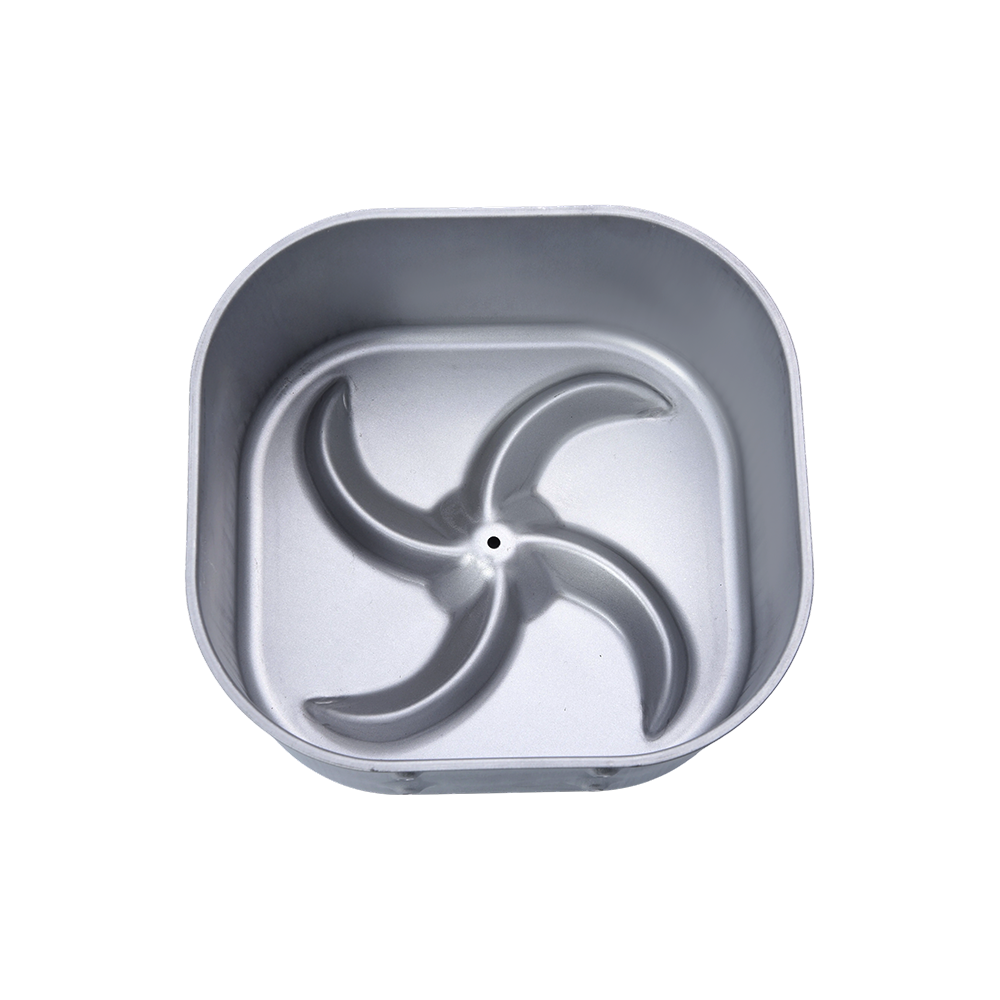
Air Fryer Container
1. The Role of the Air Fryer Container
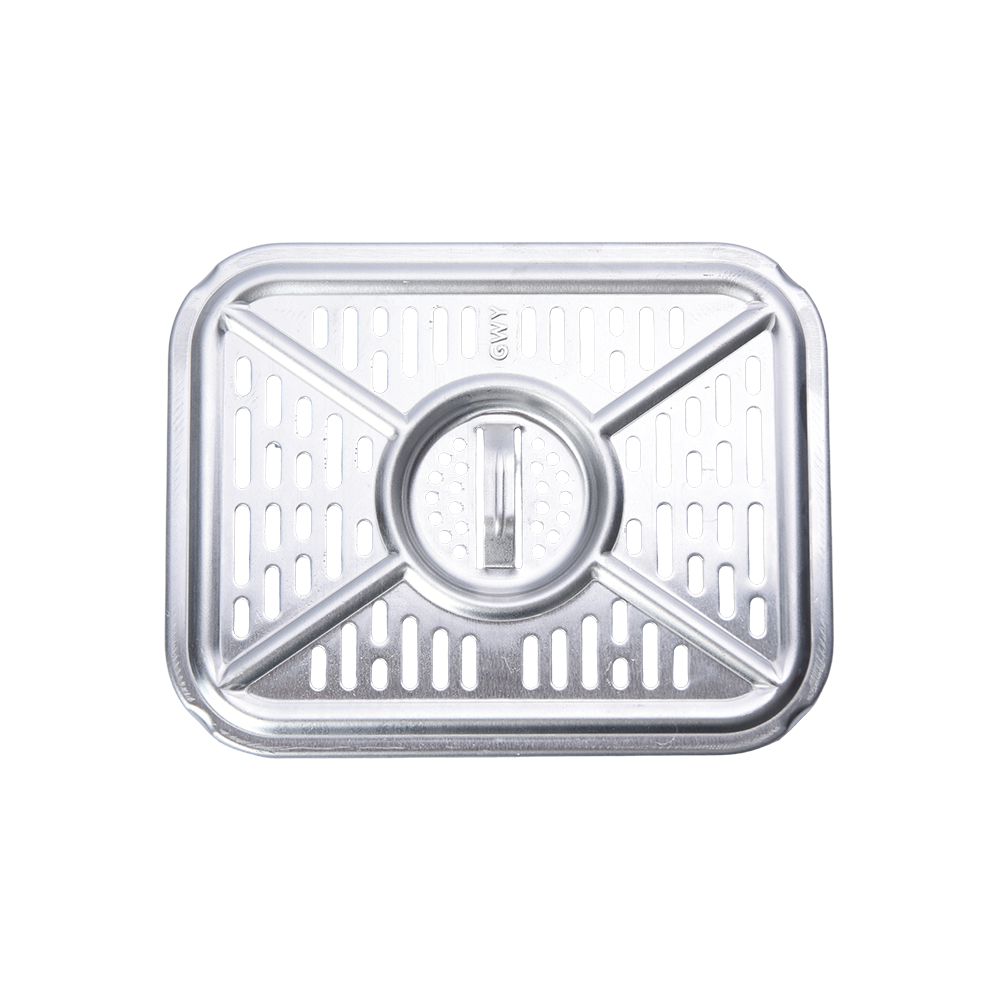
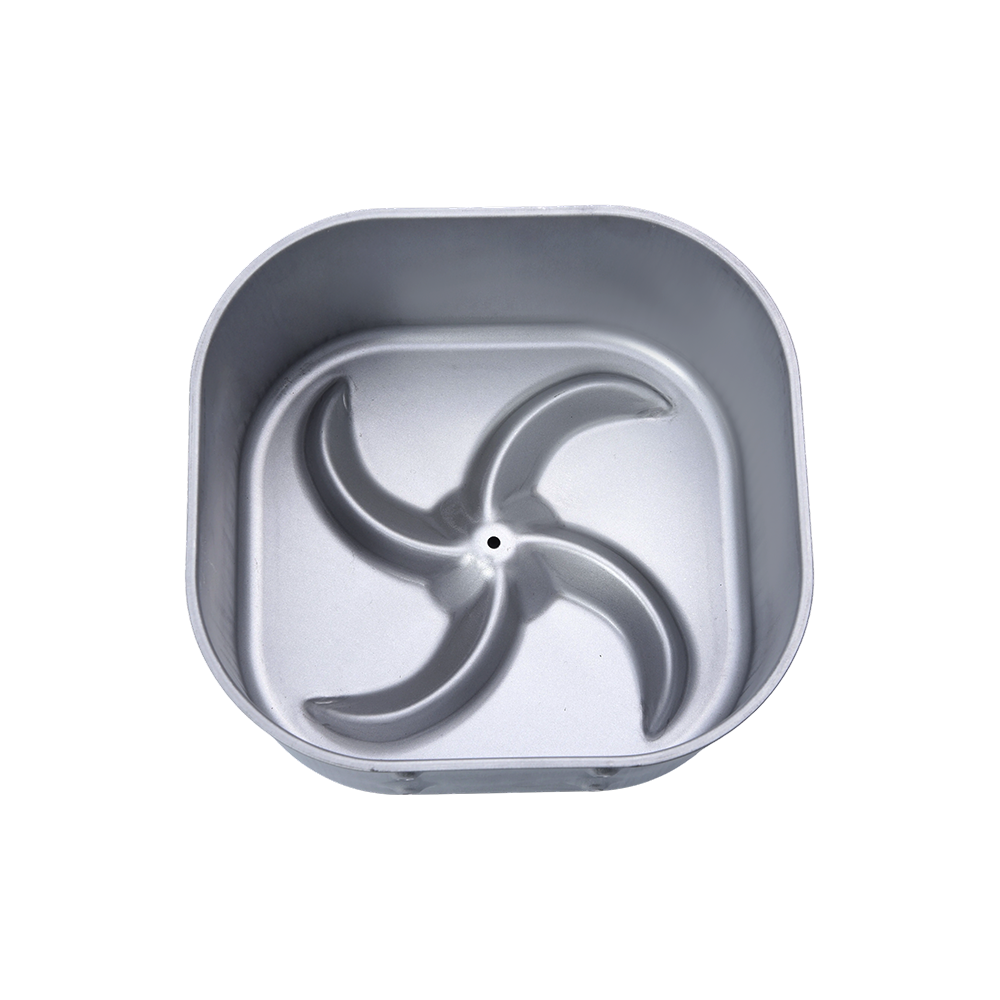
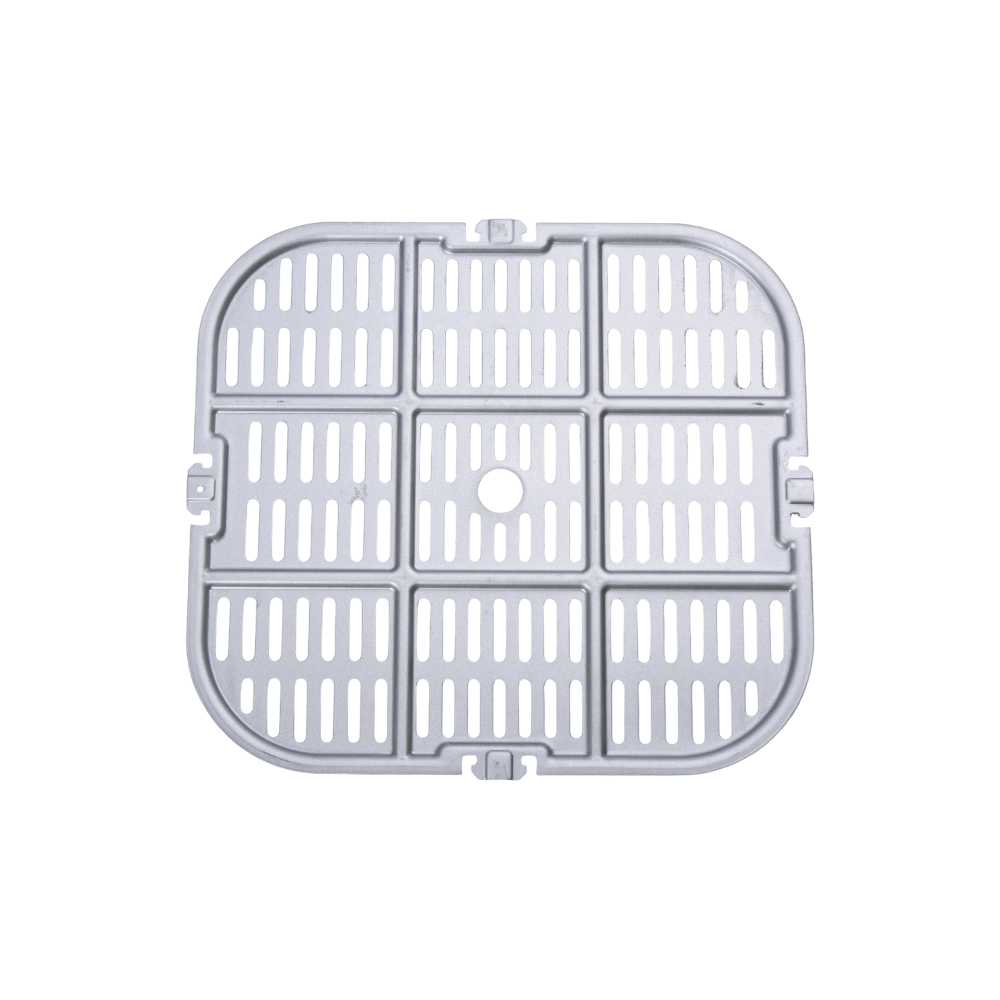
The container, also called an inner pot, basket, tray, or cooking insert depending on its structure and application, is positioned inside the air fryer and receives the food during cooking. It must interact effectively with the appliance’s heating and airflow system. In many designs, the container incorporates holes, slots, perforations, or a mesh-like structure. These openings allow hot air to move around the food rather than remaining concentrated in one area.
Air circulation is central to the air frying process. A heating element raises the temperature of the circulating air, while a fan distributes that air throughout the cooking chamber. The container must therefore permit sufficient airflow without compromising its strength or ability to retain food. The pattern, size, quantity, and placement of openings all influence cooking performance.
A suitable container also supports the mechanical requirements of the appliance. It should slide smoothly into the fryer, remain stable during use, and be easy to remove after cooking. The rim, handle interface, base, side wall, and support features must work together to prevent unwanted movement. If the container is too flexible, too loose, or inaccurately shaped, it may interfere with the drawer or heating chamber.
From a maintenance perspective, the container must tolerate exposure to grease, sauces, salt, moisture, and food residue. The surface should be easy to wipe or wash, and its geometry should avoid unnecessary recesses where residue can accumulate. A well-formed, smooth, and appropriately finished container helps simplify cleaning after every cooking cycle.
For appliance manufacturers, the container is also a product-defining component. Its appearance, tactile quality, fit, and durability contribute to the perceived value of the complete air fryer. Consistent forming and surface quality are therefore just as important as basic functionality.
2. Key Performance Requirements
High-Temperature Resistance
Air fryer containers operate in a heated environment, often over repeated cooking cycles. The material and manufacturing process must be selected to support high-temperature use without unacceptable deformation, cracking, discoloration, or loss of structural strength. The container should remain stable while exposed to the normal thermal conditions specified by the appliance design.
High-temperature performance depends on several factors. These include the selected metal grade, sheet thickness, forming ratio, corner radius, work-hardening characteristics, surface treatment, and the quality of the finished edges. A reliable manufacturer evaluates these factors together rather than treating material selection as an isolated decision.
Dimensional stability is especially important. Even a small amount of distortion can affect the fit between the container and the fryer body. It may also alter airflow paths or make the container difficult to insert and remove. Precision tooling and controlled forming conditions help maintain the intended shape after production and during normal use.
Rust and Corrosion Resistance
An air fryer container is frequently exposed to steam, water, oils, acidic ingredients, cleaning agents, and food salts. These conditions can encourage corrosion if the material or surface finish is unsuitable. Rust resistance and corrosion resistance are therefore essential characteristics for a durable kitchen appliance component.
Corrosion protection may be supported by the choice of stainless steel or another appropriate metal, as well as by finishing and cleaning procedures. The final solution should be selected according to the customer’s performance requirements, cooking temperature range, appearance expectations, and cost target. A professional manufacturer can recommend a suitable material and process combination for the intended application.
Surface integrity is also important. Scratches, burrs, cracks, exposed edges, and poorly cleaned residues may create local areas where corrosion begins. Careful stamping, deburring, washing, inspection, and packaging reduce these risks and help preserve the appearance of the component throughout its service life.
Mechanical Strength
The container must support food loads, withstand handling, and tolerate repeated insertion and removal. Its side walls and base should resist denting under normal conditions. The rim should maintain its shape, while any connecting points for handles, supports, or accessory parts should remain secure.
Deep drawing and stamping can create strong, integrated forms with fewer separate joints. When the geometry is designed correctly, the formed metal distributes loads across the container rather than concentrating stress at weak points. This can provide an advantage over loosely assembled or inconsistently welded alternatives.
Efficient Airflow
Airflow is one of the most important functional advantages of a perforated air fryer container. Openings allow hot air to reach more surfaces of the food. This promotes even heating and supports the crisp texture associated with air frying.
The perforation layout must balance circulation with support. Oversized or poorly placed openings may allow small food pieces to fall through or reduce the stability of the cooking surface. Openings that are too small or too limited may restrict airflow. Precision stamping enables manufacturers to create repeatable hole patterns and maintain a consistent relationship between the openings, side walls, and supporting surfaces.
For different food types and air fryer models, the ideal pattern may vary. Customers may request round holes, elongated slots, staggered arrangements, reinforced openings, or a combination of solid and perforated areas. A manufacturing partner with tooling and prototyping capabilities can help convert these requirements into a practical production design.
Ease of Cleaning
Grease and food residue are unavoidable in many air fryer applications. The container should therefore be designed for simple cleaning. Smooth surfaces, rounded transitions, well-finished edges, and an appropriate coating or material finish all contribute to maintenance convenience.
A container that resists stains and retains less grease can reduce cleaning time. This is especially valuable for households that use an air fryer frequently, as well as for commercial or institutional kitchens where equipment may be cleaned several times a day.
Manufacturing quality affects cleanability. Excessive burrs, rough stamped edges, deep tool marks, or inconsistent surface treatment can create areas where food residue remains trapped. Controlled production and inspection help ensure that the final product is not only attractive but also practical to use.
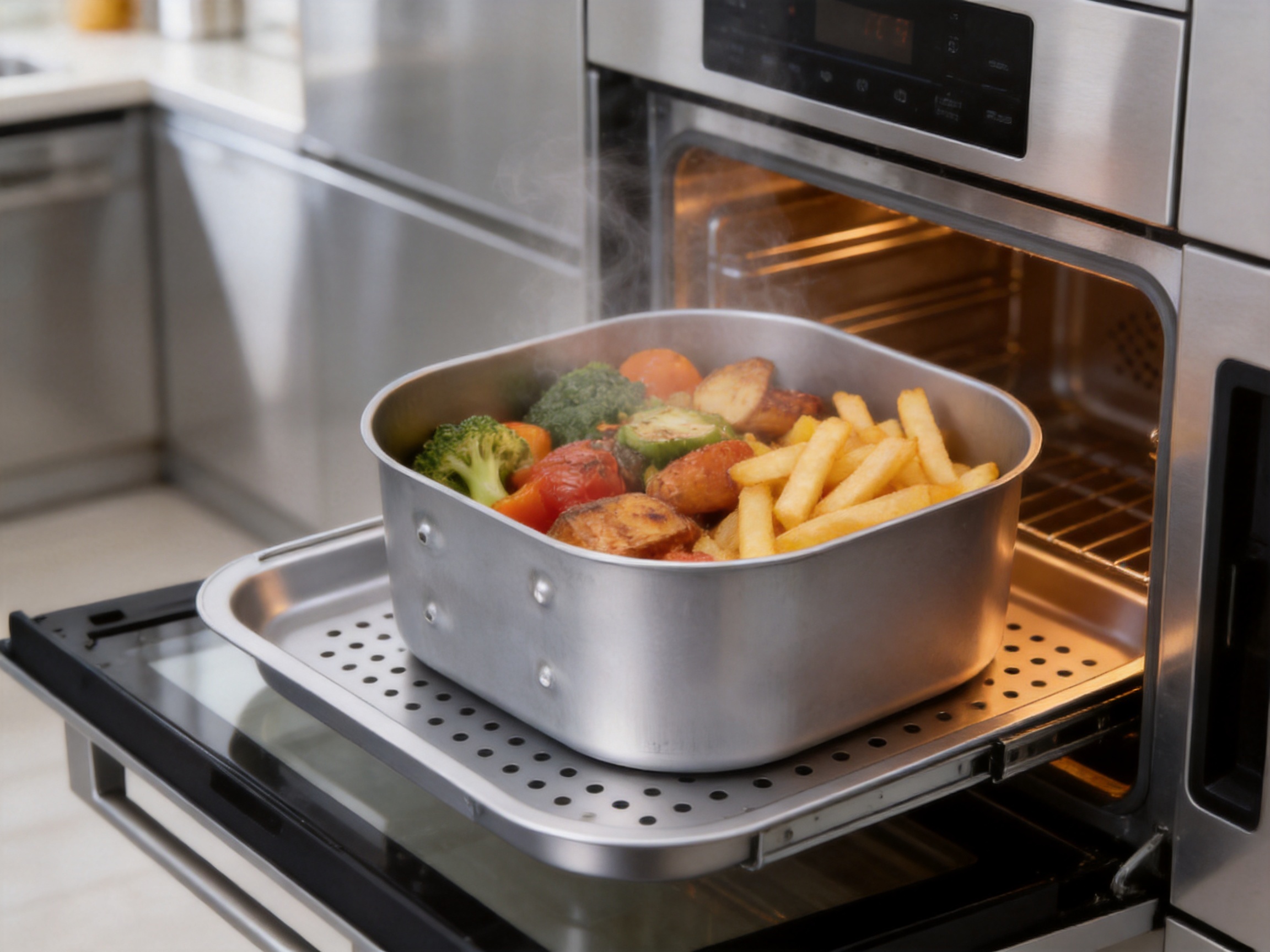
3. Advantages Compared with Lower-Quality Alternatives
Air fryer containers may appear simple, but differences in manufacturing quality become clear after repeated use. Low-quality alternatives may suffer from thin or inconsistent walls, poor dimensional accuracy, uneven perforations, rough edges, weak attachment points, or inadequate corrosion protection. These problems can affect both safety and user satisfaction.
More Consistent Dimensions
Precision stamping and deep drawing provide repeatable dimensions when the dies, presses, materials, and process parameters are properly controlled. Consistent dimensions help the container fit the intended appliance model without excessive looseness or interference.
Accurate dimensions also simplify assembly at the customer’s facility. When every part meets the approved drawing, production teams can reduce manual adjustments, rework, and line interruptions. This is particularly important for OEM customers producing large quantities of air fryers.
Improved Structural Reliability
A well-engineered formed container can provide a stable cooking platform and resist ordinary deformation. Reinforced rims, carefully designed corners, suitable sheet thickness, and optimized forming sequences all contribute to strength.
Compared with containers produced without sufficient tooling control, precision-formed components are less likely to show irregular bases, asymmetrical walls, or inconsistent edges. These details can make a major difference in practical use, particularly when the component is removed while hot or loaded with food.
Better Airflow Uniformity
Consistent perforation is another important differentiator. Uniform holes or slots help maintain predictable airflow across the cooking surface. If openings vary considerably in size or position, the heating pattern may become less consistent and the appearance of the product may be reduced.
Modern stamping equipment can produce repeated patterns with controlled spacing and clean edges. This supports both cooking performance and a professional appearance suitable for branded appliances.
Longer Service Life
High-quality materials and carefully managed forming processes help the container tolerate repeated heating, cooling, washing, and handling. Long service life reduces the frequency of replacement and supports a more sustainable product strategy.
For distributors and appliance brands, durable components can also reduce warranty claims and customer complaints. A reliable container improves the reputation of the complete air fryer rather than functioning merely as a replaceable accessory.
More Attractive Surface Quality
Consumers often judge product quality by visible details. A clean surface, even finish, smooth rim, and consistent perforation pattern create a favorable impression. Cosmetic quality is particularly important for replacement parts because customers compare the new component directly with the original item.
Controlled handling, protective packaging, and final inspection help prevent scratches and dents before the product reaches the customer. This attention to detail distinguishes a professional component supplier from a basic metal parts vendor.
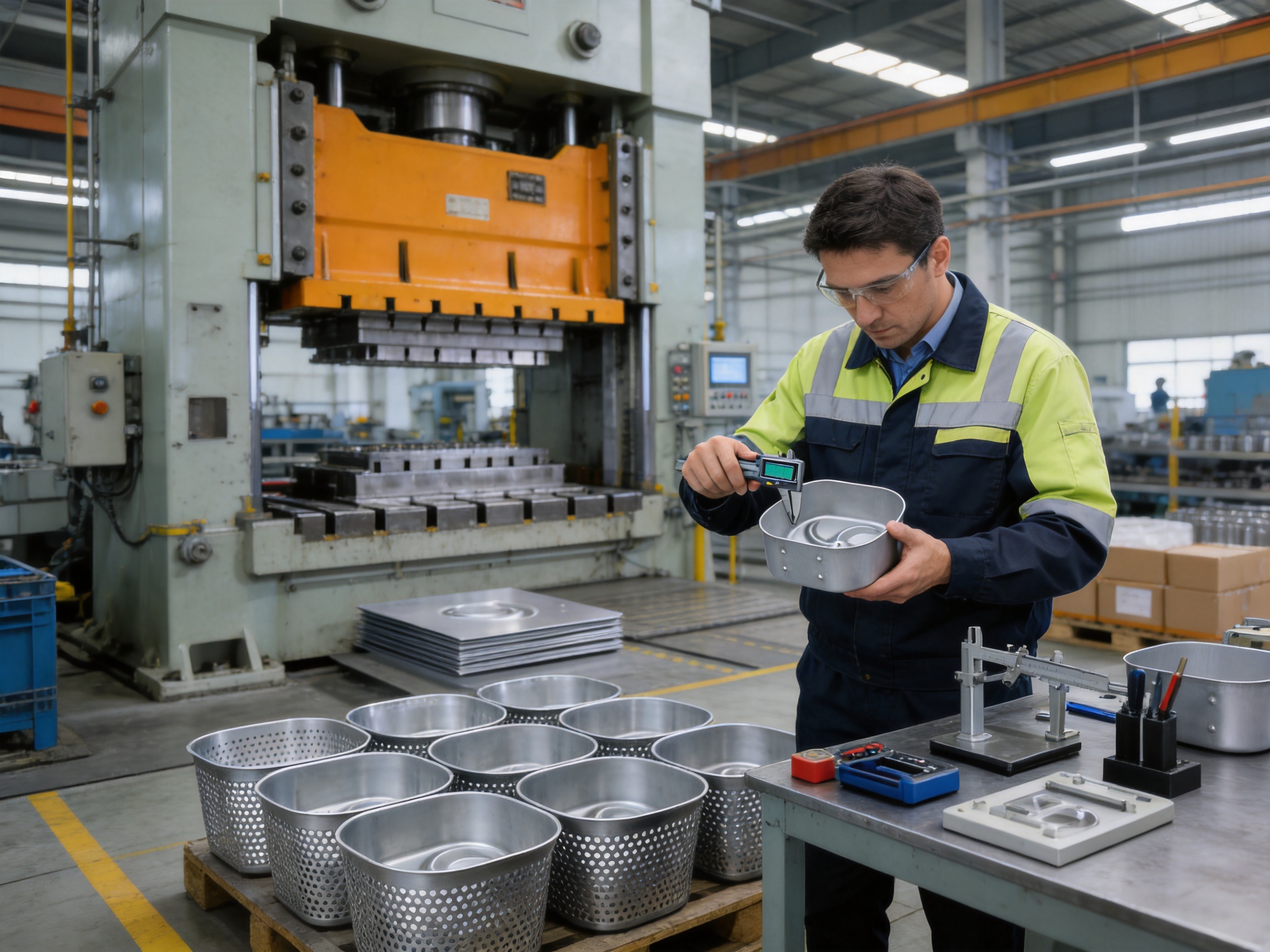
4. Deep Drawing and Precision Stamping Technology
Deep drawing is a forming process in which a flat sheet of metal is shaped into a three-dimensional container using a punch, die, and controlled pressure. The process is suitable for producing cylindrical, rectangular, rounded, or customized hollow components. It can create a container body with integrated walls and a base, reducing the need for multiple joined pieces.
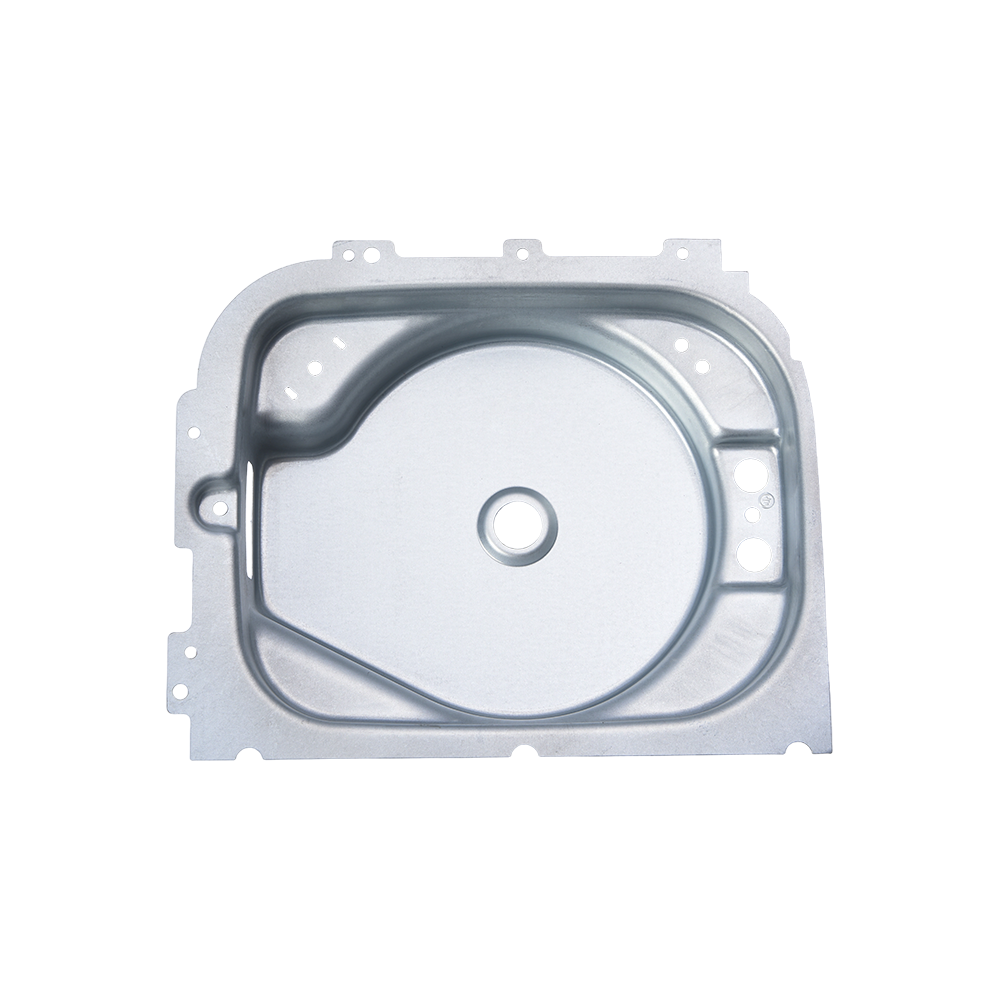
Precision stamping uses dies and presses to cut, pierce, emboss, bend, or form sheet metal. For air fryer containers, stamping may be used to create perforations, trim edges, form reinforcing features, produce mounting points, and complete secondary shaping operations.
The combination of deep drawing and stamping is highly suitable for this product category. Deep drawing establishes the basic inner-pot geometry, while stamping provides the openings and additional details needed for airflow, assembly, and structural support. Depending on the design, production may use progressive dies, transfer operations, compound dies, or separate forming and piercing stages.
Material Preparation
Production begins with sheet-metal preparation. The material is selected according to the approved specification and checked for thickness, flatness, surface condition, and general conformity. Proper material preparation reduces variations during forming and supports consistent finished dimensions.
The blank size must be calculated according to the container geometry and drawing ratio. An unsuitable blank may cause excessive thinning, wrinkles, tearing, or unnecessary material waste. Experienced process engineers use the product drawing, material characteristics, and tooling design to establish an efficient starting point.
Die and Tooling Design
Tooling design strongly influences the quality of a deep-drawn product. The punch radius, die radius, clearance, draw beads, blank holder pressure, and forming sequence must be coordinated. Sharp transitions can increase stress, while insufficient control may result in wrinkles or distortion.
For perforated components, the piercing die must also be designed to maintain hole accuracy and edge quality. The die layout should consider the material flow created by the deep-drawing operation. If piercing occurs too early or in an unsuitable position, the holes may distort during later forming.
A well-designed tool improves production efficiency and extends die life. It can also reduce scrap, minimize manual correction, and support repeatable output across long production runs.
Controlled Forming
During forming, press speed, lubrication, blank-holder pressure, and material orientation may affect the final result. Process control helps prevent common problems such as wrinkling, cracking, excessive thinning, springback, and uneven wall height.
For a container that must fit a specific air fryer, controlling springback is particularly important. The manufacturer may use adjustments in die geometry, forming sequence, calibration, or secondary sizing to achieve the required dimensions. Sample parts are measured against approved drawings before mass production begins.
Perforation and Edge Processing
Perforations may be formed before, during, or after the main drawing operation depending on the design. The selected sequence must preserve hole shape and avoid damaging the container wall. After piercing, burrs and sharp edges must be removed or controlled to an acceptable level.
Edge processing may include trimming, deburring, smoothing, washing, or additional forming. These operations improve handling safety and help prevent food residue from collecting around rough edges. They also prepare the part for any required surface treatment.
Final Forming and Finishing
Secondary forming may be used to calibrate the rim, flatten a base, add support features, or create interfaces for handles and other parts. Finishing operations depend on the material and customer specification. These may include cleaning, polishing, coating, passivation, or other approved treatments.
The final process should preserve the functional surface and maintain the appearance required by the customer. Any treatment must be compatible with the intended kitchen application and specified operating conditions.
5. Manufacturing Strengths of an Experienced Supplier
Yuyao Hongli Optoelectronics Co., Ltd. is a China-based manufacturer with more than 20 years of industry experience. Founded in 2000, the company has developed from its earlier identity as Yuyao Hongli Optoelectronics Educational Instruments Co., Ltd. into a comprehensive manufacturer serving multiple product sectors.
The company operates from a modern factory of approximately 5,000 square meters in Yangming Science and Technology Industrial Park, Yuyao, Zhejiang Province. Its production organization includes multiple stamping workshops and a workforce of more than 60 employees. This combination of facilities, personnel, and accumulated experience provides a solid foundation for the manufacture of deep-drawn parts, stamped parts, bending parts, kitchen appliance accessories, and automotive stamping parts.
For air fryer container projects, manufacturing experience across several metal-processing categories is valuable. The same engineering principles used in appliance accessories can also support automotive components, hardware products, optical instruments, household electric heaters, and other precision parts. This broad exposure encourages disciplined process planning and an understanding of different customer requirements.
Integrated Manufacturing Capability
A supplier with integrated capabilities can manage more than a single stamping operation. Product development may include drawing review, material evaluation, tooling planning, forming, piercing, bending, finishing, inspection, packing, and shipment coordination.
This reduces the number of handoffs between unrelated vendors. Fewer handoffs can improve communication, shorten response time, and make it easier to identify the source of a quality issue. It also gives customers a clearer point of contact throughout the project.
OEM and ODM Support
Air fryer containers often require model-specific dimensions or features. The supplier may need to work from a two-dimensional drawing, three-dimensional file, physical sample, or written specification. OEM and ODM support allows the component to be developed according to the customer’s appliance design rather than forcing the customer to select a standard part that may not fit perfectly.
Customization may involve container dimensions, wall height, base geometry, hole pattern, rim profile, material, surface treatment, mounting points, and packaging. A practical development process begins by clarifying the application and then reviewing manufacturability before tooling is finalized.
Rapid Prototyping and Production Conversion
Prototype development allows customers to verify fit, appearance, airflow-related design features, handling, and assembly before committing to a large production quantity. Early samples can identify issues that may not be visible in a computer model, such as interference with a drawer, insufficient clearance, or an uncomfortable edge.
After approval, the design can be converted into efficient batch production. A supplier experienced in both prototyping and mass production can help maintain continuity between the sample and the final production version. This reduces the risk that the approved prototype and delivered parts will differ significantly.
Stable Delivery and Production Planning
Reliable delivery depends on more than press capacity. It requires material planning, tooling readiness, production scheduling, in-process inspection, finished-goods control, and appropriate packaging. An organized manufacturer can coordinate these stages to provide more predictable lead times.
Stable production is especially important for appliance brands that operate seasonal promotions or maintain regular assembly schedules. Delays in a small but essential component can interrupt the entire appliance production line. A dependable supplier helps reduce this risk through advance planning and clear communication.
Quality Control and After-Sales Support
Quality control should be applied throughout the manufacturing cycle, not only at the end. Incoming materials, tooling condition, first-piece samples, process dimensions, perforation quality, surface finish, and final packaging can all be reviewed according to the customer’s inspection requirements.
After-sales support is also part of a strong supplier relationship. If a customer reports a dimensional concern, surface issue, or assembly difficulty, the manufacturer should be able to investigate the production records and cooperate on corrective action. This approach supports long-term cooperation rather than one-time purchasing.
6. Typical Quality-Control Checkpoints
A robust inspection plan for air fryer containers may include the following checkpoints:
| Inspection Stage | Typical Focus | Purpose |
|---|---|---|
| Material inspection | Sheet thickness, surface condition, material identification | Confirm that the starting material meets the approved specification |
| Tooling verification | Die condition, punch alignment, clearance, wear | Prevent process variation and premature tooling-related defects |
| First-piece approval | Overall dimensions, wall shape, rim, base, hole pattern | Validate the setup before continuous production |
| In-process inspection | Critical dimensions, deformation, burrs, cracks, wrinkles | Detect problems early and limit batch-wide variation |
| Surface inspection | Scratches, dents, stains, rough areas, finish consistency | Protect appearance, cleanability, and customer acceptance |
| Functional inspection | Fit, insertion, removal, stability, accessory interfaces | Confirm compatibility with the intended air fryer design |
| Final inspection | Quantity, labeling, packaging, approved samples | Ensure that the shipment is complete and properly protected |
Inspection criteria should be agreed upon before production. For example, a customer may define acceptable limits for dimensional tolerance, burr height, surface marks, hole diameter, wall thickness, flatness, or color variation. Clear criteria help prevent misunderstandings and make the approval process more efficient.
Dimensional Accuracy
Critical dimensions may include outer length and width, inner cavity dimensions, wall height, base flatness, rim diameter, corner radius, hole diameter, hole spacing, and mounting-point location. The actual inspection list depends on the container’s design.
Measuring tools may include calipers, micrometers, height gauges, templates, gauges, coordinate measuring equipment, or customized checking fixtures. The objective is to verify both individual features and their relationship to the complete component.
Visual and Surface Inspection
Visual inspection can identify cracks, wrinkles, severe thinning, dents, scratches, stains, incomplete perforations, sharp burrs, and other visible defects. Surface quality is especially significant for a kitchen product because the container is exposed to food and frequent handling.
Lighting, inspection distance, sample standards, and acceptance criteria should be consistent. Approved reference samples can help align the expectations of the manufacturer and customer.
Fit and Functional Checks
A container should be tested in the intended appliance or in an approved checking fixture. This verifies that it can be inserted and removed smoothly, sits correctly, does not interfere with adjacent parts, and provides the necessary clearance for airflow and handling.
Functional checks can also examine handle attachment points, support feet, locking features, or other interfaces. Early fit verification prevents the discovery of compatibility problems after the parts have been shipped.
7. Customization Options for Different Air Fryer Models
Air fryer designs vary significantly in capacity, shape, drawer configuration, heating arrangement, and accessory structure. A customizable container is therefore often more practical than a universal component.
Shape and Capacity
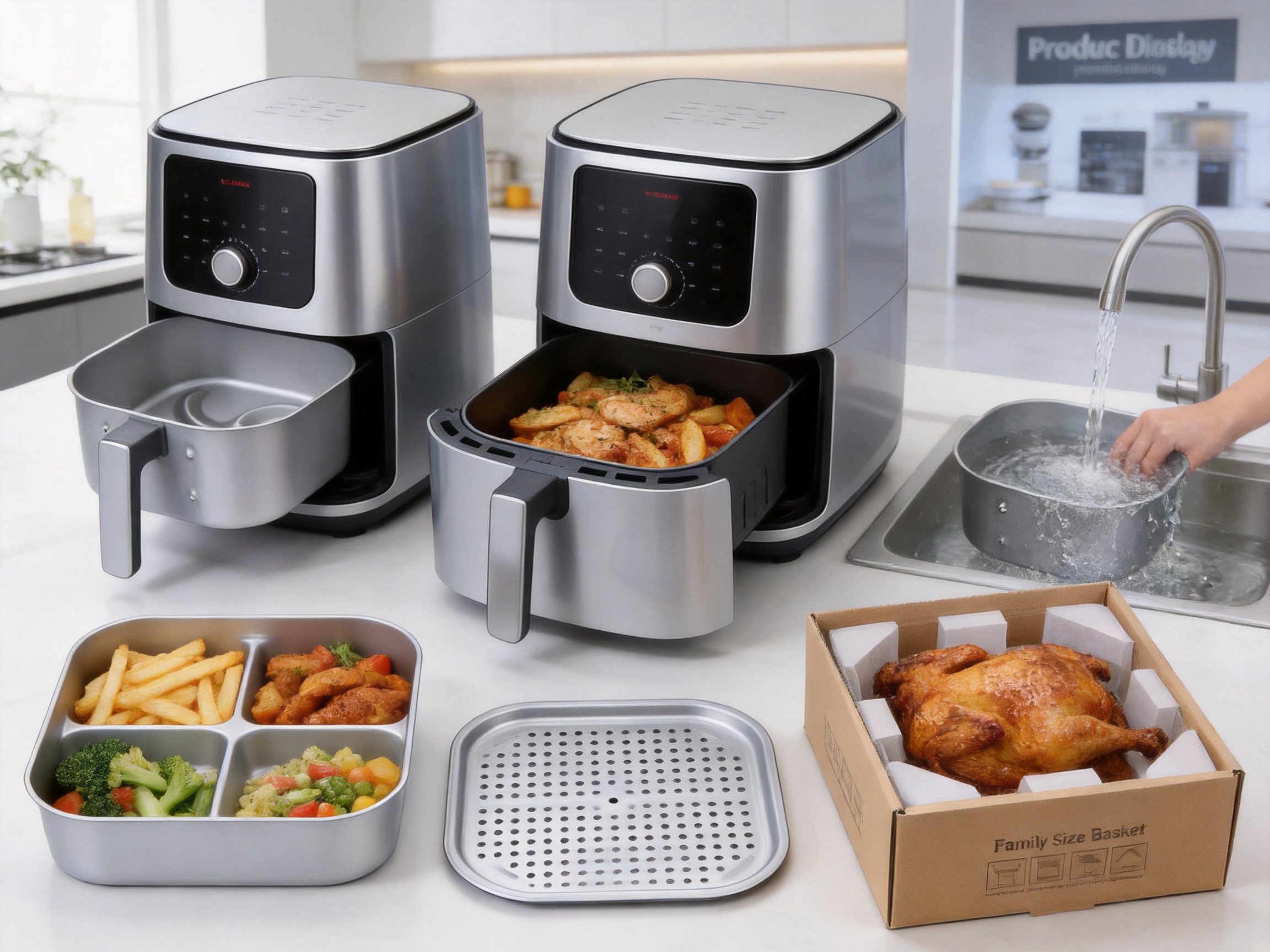
Containers can be designed for compact household fryers, larger family-size models, dual-compartment appliances, or specialized equipment. The shape may be rectangular, square, circular, oval, or based on another proprietary geometry. Corner radii and wall angles can be adapted to match the appliance housing.
Capacity requirements affect the depth and footprint of the container. However, increasing capacity must be balanced against the available airflow space and the physical limits of the fryer drawer. Engineering review is needed to ensure that the container remains practical to form and use.
Hole Patterns
The perforation pattern may be customized for different foods and cooking methods. Larger openings can support increased airflow, while smaller openings may provide better support for smaller ingredients. A solid perimeter can strengthen the rim and help retain food within the cooking area.
The design should also consider cleaning. Openings should be shaped and positioned so that they do not create unnecessary sharp edges or difficult-to-clean recesses. Rounded or carefully finished perforations improve handling and maintenance.
Rim and Handling Features
The rim may be formed with a rolled, reinforced, or returned edge to improve rigidity and handling comfort. Additional features may be included to connect a handle, support a removable rack, or align the container within the drawer.
These features should be integrated into the tooling plan from the beginning. Adding them late in development may require design changes or additional operations.
Material and Surface Treatment
Customers may specify a material based on temperature requirements, corrosion resistance, appearance, forming behavior, and target cost. Surface treatment may also vary depending on the product design and approved application requirements.
Any material or coating decision should be evaluated for compatibility with the cooking environment, cleaning method, and customer’s regulatory or quality expectations. Documentation and sample approval are important before mass production.
Packaging and Identification
Air fryer containers should be protected from scratches, dents, moisture, and contamination during storage and transport. Packaging may include separators, protective film, molded supports, cartons, pallets, labels, and customer-specific instructions.
Identification can include part numbers, batch information, quantities, production dates, or other traceability details. Clear labeling helps customers manage inventory and match the container with the correct appliance model.
8. Product Applications
The primary application is as an inner cooking container for household air fryers. It may be supplied as an original component installed during appliance assembly or as a replacement part for after-sales service. Replacement demand can arise from wear, accidental damage, loss of accessories, or the desire to obtain an additional container for different foods.
The product can also be adapted for related hot-air cooking equipment. Depending on its geometry and specifications, a similar formed metal component may serve as a cooking tray, perforated insert, food-support basket, or internal accessory for compact kitchen appliances.
Manufacturers of small household appliances may use customized containers to differentiate their models. A unique hole pattern, branded interface, special capacity, or improved surface appearance can support a distinct product offering. Distributors may also request several sizes or designs for multiple appliance models.
Because Yuyao Hongli Optoelectronics manufactures a broad range of metal products, the company can support customers whose product lines include more than air fryer accessories. Related deep-drawn parts, bending parts, stamped hardware, heater components, optical instrument parts, and automotive stamping components may be developed through the same general manufacturing network.
9. Benefits for OEM and ODM Customers
Working with a capable component manufacturer can provide advantages beyond the delivery of finished parts. It can help appliance companies reduce development time, improve product consistency, and simplify supplier management.
Design for Manufacturability
A design that looks suitable in a digital model may still create problems during forming. Experienced engineers can review wall thickness, corner transitions, drawing depth, hole placement, material flow, and trimming requirements before tooling begins. Design-for-manufacturability feedback can prevent avoidable tooling modifications.
Cost Control
Cost is influenced by material usage, production cycle time, tooling complexity, scrap rate, secondary operations, packaging, and order volume. An optimized forming sequence can reduce waste and improve press utilization. A reliable supplier can help customers evaluate the cost effect of design changes before approval.
Consistent Repeat Orders
After the initial project is approved, repeat orders should reproduce the same fit and performance. Stable tooling, documented processes, inspection records, and controlled material purchasing support consistency across production batches.
Flexible Order Support
Customers may require prototypes, pilot runs, small replacement-part quantities, or large OEM orders. A manufacturer with experience in both development and production can adapt its planning to different purchasing stages. This flexibility is useful for new product launches and market testing.
10. Selecting the Right Air Fryer Container Supplier
Purchasers should evaluate an air fryer container supplier according to more than quoted price. Important questions include whether the supplier understands deep drawing, can maintain perforation accuracy, has suitable inspection resources, supports customized tooling, and can provide dependable delivery.
Customers should ask for information about material options, sample approval procedures, production capacity, quality documentation, packaging methods, and handling of nonconforming products. It is also helpful to confirm whether the supplier has experience serving household appliance manufacturers and can communicate clearly in technical and commercial matters.
Factory capability is another consideration. A supplier with multiple stamping workshops, established production processes, and experienced employees may be better prepared to handle tooling adjustments, capacity changes, and repeated orders than a trading company with limited direct manufacturing control.
Location and supply-chain organization can influence delivery efficiency. A manufacturer located in a developed industrial area may have access to supporting suppliers for tooling, materials, finishing, packaging, and logistics. However, the most important factor remains the supplier’s ability to coordinate these resources while maintaining quality.
Long-term cooperation is usually built on transparency. Clear drawings, agreed samples, realistic lead times, defined acceptance standards, and prompt technical communication help both sides avoid unnecessary disputes. A professional supplier should be willing to discuss practical details before confirming a project.
11. Recommended Project Development Process
Step One: Requirement Collection
The customer provides the intended appliance model, container dimensions, expected capacity, material preference, perforation requirements, surface expectations, estimated order quantity, and packaging needs. Photos, drawings, physical samples, and three-dimensional files can all assist technical review.
Step Two: Technical Evaluation
The manufacturer reviews the design for forming feasibility, material flow, tooling complexity, critical dimensions, potential deformation, and secondary operations. If improvements are necessary, the supplier discusses them with the customer before tooling is started.
Step Three: Prototype and Sample Approval
Initial samples are produced for fit, appearance, function, and dimensional verification. The customer evaluates the sample in the intended air fryer or approved fixture. Any required revisions are recorded and incorporated into the next sample or tooling adjustment.
Step Four: Tooling Confirmation
Once the design is approved, the production tooling is finalized. Die components, piercing features, forming stages, and inspection fixtures are checked before mass production. Tool maintenance procedures should also be established for continued repeatability.
Step Five: Pilot Production
A pilot batch confirms that the approved design can be produced consistently under normal manufacturing conditions. The supplier evaluates cycle time, material usage, defect rates, inspection results, and packaging effectiveness.
Step Six: Mass Production and Inspection
Production proceeds according to the agreed schedule. Incoming, in-process, and final inspections are performed according to the customer’s requirements. Any deviations should be reviewed and corrected before shipment.
Step Seven: Packaging and Delivery
Finished containers are packed to prevent contact damage and contamination. Labels and shipping documents are checked before dispatch. For repeat orders, production and delivery information can be reviewed periodically to improve future planning.
12. Practical Use and Maintenance Considerations
Although the container is designed for repeated kitchen use, correct handling can further extend its service life. Users should avoid dropping the container, striking it against hard surfaces, or using tools that may scratch the cooking surface. Food residue should be removed according to the appliance manufacturer’s cleaning instructions.
After washing, the container should be dried thoroughly, especially around the rim, perforations, joints, and underside. Removing moisture helps preserve the surface and reduces the possibility of corrosion over time.
If the container includes a surface treatment, users should follow the recommended cleaning method. Abrasive pads, aggressive chemicals, or unsuitable automatic washing cycles may damage a finish even when the underlying metal remains structurally sound.
Manufacturers can support users by providing clear instructions and by designing the container with accessible surfaces and smooth transitions. Good design and responsible maintenance work together to preserve performance.
13. Sustainability and Resource Efficiency
Metal components can contribute to a more durable appliance product when they are designed for long service life and manufactured with controlled material usage. A durable air fryer container may reduce the need for frequent replacement and help extend the useful life of the complete appliance.
Deep drawing and precision stamping can also support efficient production by forming multiple features from sheet material with relatively limited waste compared with more complex subtractive manufacturing methods. Tool layout, blank optimization, nesting, and scrap management influence the overall material efficiency of the project.
Repair and replacement are additional sustainability considerations. If a container can be replaced separately, users may not need to discard the entire appliance because of damage to one internal accessory. Supplying replacement parts can therefore support a more serviceable product model.
Manufacturers should still evaluate material sourcing, process energy, finishing chemicals, packaging, and transportation. Sustainable manufacturing is a continuous improvement goal that involves the complete product life cycle rather than one isolated operation.
14. Frequently Asked Questions
Q1: What is an air fryer container?
An air fryer container is the internal cooking insert, basket, tray, or inner pot that holds food inside an air fryer. It is designed to fit the appliance and may include perforations or mesh-like openings to support hot-air circulation.
Q2: Why are perforations important?
Perforations allow heated air to reach more sides of the food. This supports more even heating and helps produce a crisp surface. The opening size and pattern must be balanced with food support, strength, safety, and cleanability.
Q3: Can the container be customized for a specific air fryer?
Yes. A container can be customized according to the appliance’s internal dimensions, drawer structure, capacity, mounting points, rim design, and airflow requirements. OEM and ODM development is appropriate when a standard component does not provide the required fit.
Q4: Which manufacturing processes are used?
Common processes include deep drawing, precision stamping, piercing, trimming, bending, deburring, cleaning, surface treatment, inspection, and protective packaging. The exact sequence depends on the product design and material.
Q5: What should customers provide for a quotation?
Useful information includes a two-dimensional drawing or three-dimensional file, material preference, dimensions, surface requirements, perforation pattern, estimated order quantity, sample requirements, packaging expectations, and delivery destination. A physical sample or appliance model can also help with compatibility review.
Q6: How does deep drawing improve the container?
Deep drawing can form the container body as an integrated three-dimensional part with a continuous base and side wall. This may improve structural consistency and reduce the number of separate joints compared with an assembled construction.
Q7: How is quality controlled?
Quality control may include material verification, tooling checks, first-piece approval, in-process dimensional inspection, visual inspection, burr and edge checks, fit testing, final quantity verification, and packaging inspection.
Q8: Can the supplier provide prototypes?
Prototype and sample development can be arranged according to the project requirements. Samples allow the customer to verify fit, appearance, handling, hole layout, and assembly before mass production.
Q9: What makes a container easy to clean?
Smooth surfaces, rounded transitions, appropriately finished perforations, controlled edges, and a suitable surface treatment all help reduce the accumulation of grease and food residue. Proper user cleaning practices are also important.
Q10: Is the container suitable for replacement-part sales?
Yes. Air fryer containers can be manufactured as replacement accessories for specific appliance models. Accurate identification, packaging, labeling, and dimensional control are especially important in the replacement market.
Q11: What industries does the manufacturer serve?
The manufacturer serves applications including educational instruments, optical instruments, household electric heaters, small household appliances, auto parts, hardware products, plastic products, deep-drawn parts, stamped parts, bending parts, kitchen appliance accessories, and automotive stamping parts.
Q12: How can a customer begin a project?
The customer can submit product drawings, samples, photos, or an application description for technical review. The manufacturer can then discuss material, tooling, prototype, quality standards, quantity, packaging, and delivery requirements.
15. Why Manufacturing Experience Matters
The performance of an air fryer container is determined by the relationship between design, material, tooling, forming, finishing, and inspection. Focusing on only one of these factors may not produce a dependable result. A strong manufacturer understands how each stage affects the next.
More than two decades of industry experience provide practical knowledge about metal behavior, press operation, tooling maintenance, production scheduling, and customer support. This experience can help identify potential problems earlier and make the development process more efficient.
Yuyao Hongli Optoelectronics combines manufacturing experience with a broad product range and a dedicated factory environment. Its capabilities in deep drawing, stamping, bending, and customized metal-part production are relevant to air fryer containers and other kitchen appliance accessories. The company also supports OEM and ODM projects, rapid prototyping, production conversion, wholesale, retail, import, and export services.
For customers seeking a long-term supply partner, these capabilities offer a practical foundation. The objective is not simply to produce a metal container, but to deliver a component that fits correctly, performs consistently, withstands repeated use, and supports the quality image of the finished appliance.
Conclusion
A high-quality air fryer container contributes directly to cooking performance, appliance reliability, cleaning convenience, and customer satisfaction. Its high-temperature resistance, rust resistance, corrosion resistance, mechanical strength, dimensional accuracy, and airflow-supporting perforations make it a critical component rather than an ordinary accessory.
Compared with lower-quality alternatives, a precision-manufactured container can provide more consistent fit, cleaner edges, improved airflow uniformity, better surface appearance, and longer service life. Deep drawing and precision stamping make it possible to produce complex three-dimensional forms efficiently while maintaining repeatable dimensions across production batches.
Yuyao Hongli Optoelectronics Co., Ltd. offers relevant manufacturing strengths for customers requiring customized air fryer containers and other metal components. With more than 20 years of experience, a 5,000-square-meter factory, multiple stamping workshops, more than 60 employees, OEM and ODM support, rapid prototyping, quality control, and international supply capabilities, the company is equipped to support projects from initial concept through mass production.
For appliance manufacturers, distributors, and replacement-parts suppliers, selecting the right production partner can improve product quality and reduce long-term supply risks. A carefully designed and professionally manufactured air fryer container provides a stable foundation for efficient cooking and a dependable user experience.
References
1. General principles of sheet-metal forming, deep drawing, piercing, bending, and stamping-process control.
2. General engineering guidance for dimensional inspection, burr control, surface-quality assessment, and production-part approval.
3. General design considerations for hot-air cooking appliances, internal airflow, food-support surfaces, and removable kitchen accessories.
4. General manufacturing practices for OEM and ODM product development, prototype validation, tooling confirmation, pilot production, and mass production.
5. Product and company information supplied for the air fryer container manufactured by Yuyao Hongli Optoelectronics Co., Ltd.
Product: Air Fryer Container
Previous Post
Deep-Drawn Containers with Cutouts for Precision Industrial Applications
Next Post
Deep-Drawn Square Containers with One-Sided Cutouts: Precision, Flexibility, and Reliable Industrial Performance
News
-
-
If you have ever asked yourself, “How do I find a reputable metal fabricator?” you are not alone. As a manufacturer with more than 20 years...
READ MORE -
Steel is the backbone of modern manufacturing, yet it is never a single, uniform material. When engineers and buyers ask, "How can you clas...
READ MORE -
Sheet metal bending is one of the most fundamental processes in metal fabrication. It turns a flat sheet of steel, aluminum, or copper into...
READ MORE
Get Fresh Updates Via Email
We promise we will never disclose your email address, and you can opt out at any time.
-
Quick Links
Home About Us Products Service News Contact Us -
Product list
Deep-drawn parts Stamped parts Bending parts Kitchen appliance accessories Automotive stamping parts -
About Us
Factory Honour FAQ -
News
Company News Industry News -
Contact Us
Address: South side of Shunke Road, Yangming Science and Technology Industrial Park, Yuyao City, Zhejiang Province, China Tel: +86-13905842349/+86-13738485724 Email: hongli@hl-stamping.com
Copyright © Yuyao Hongli Optoelectronics Co., Ltd. All Rights Reserved.
Custom Precision-Sheet/Sheet Metal Stamping Manufacturers
