


 English
 русский
 Español
 عربى


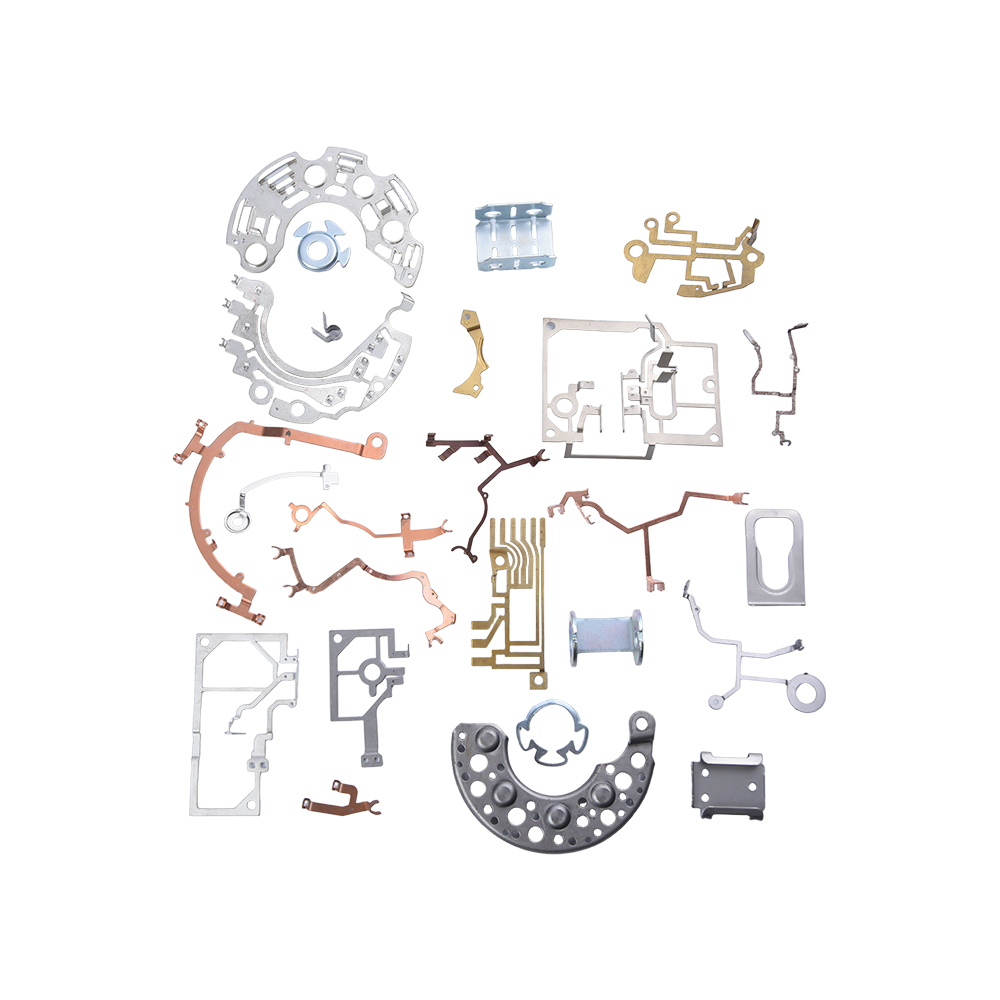
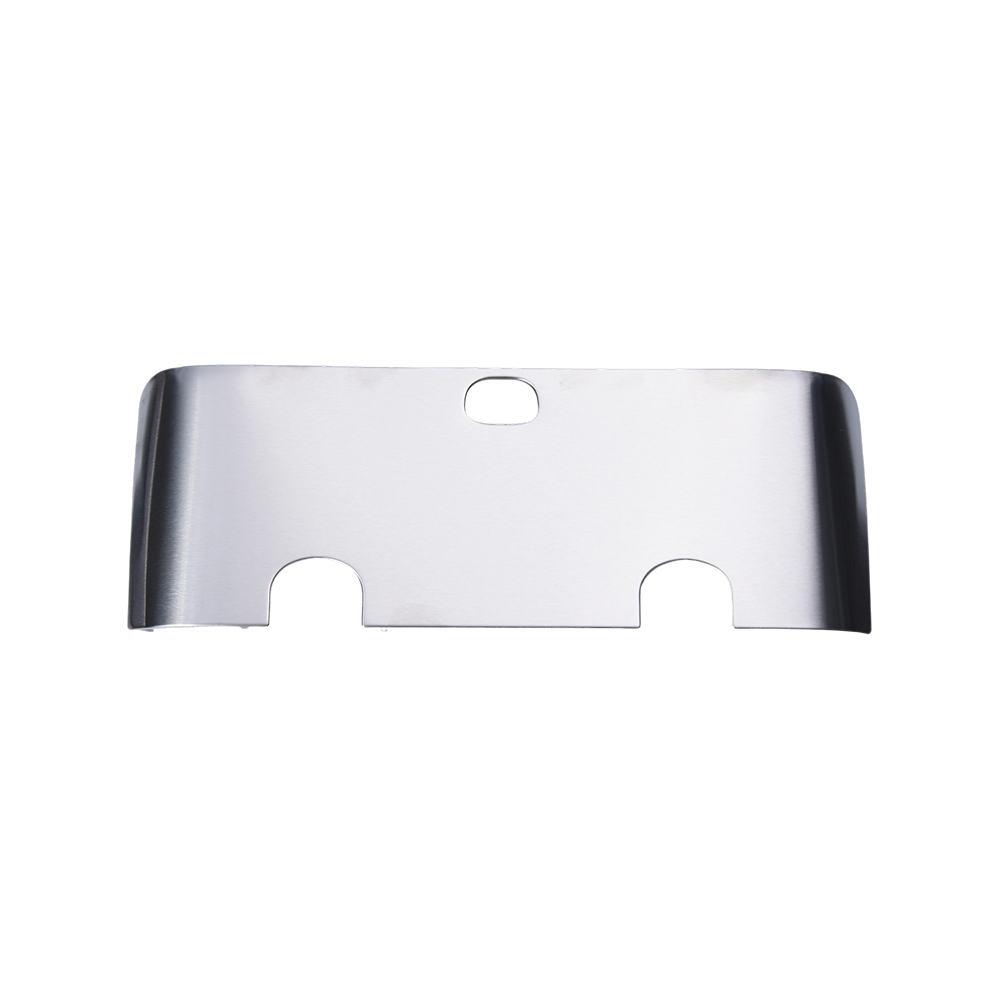
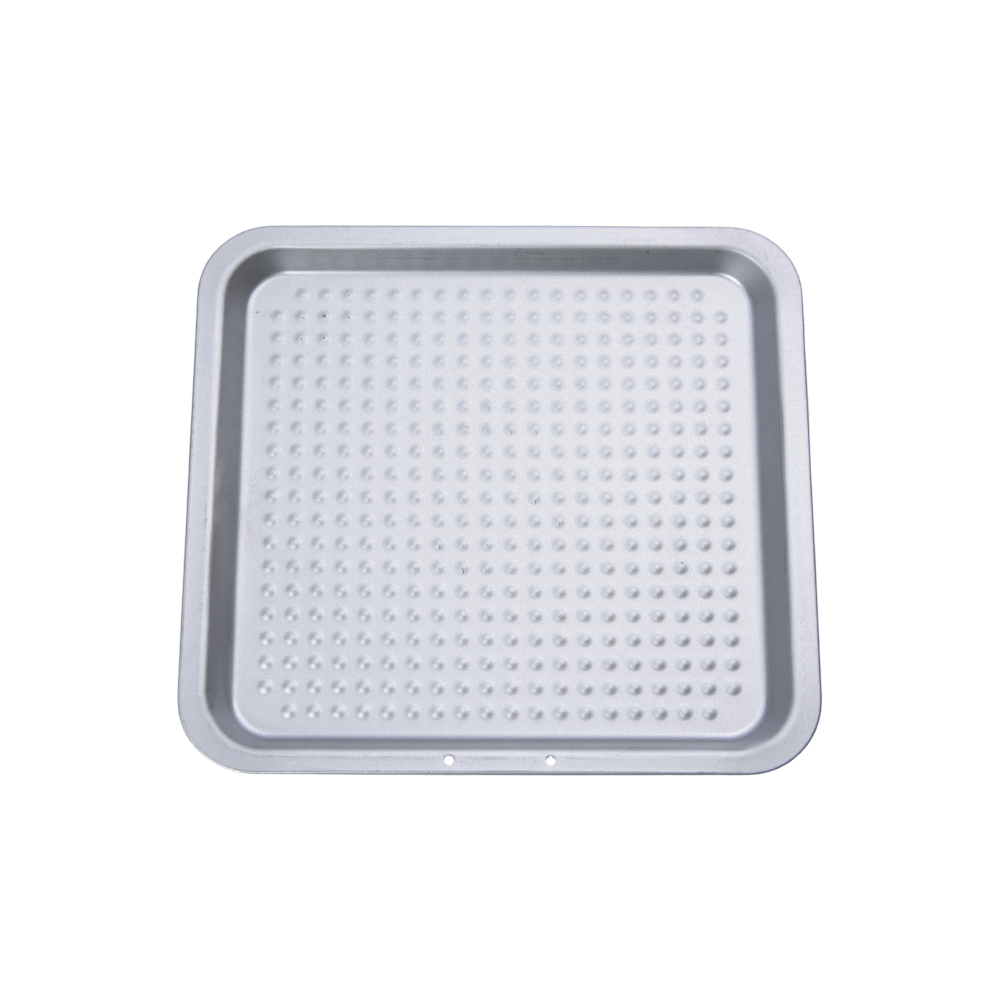
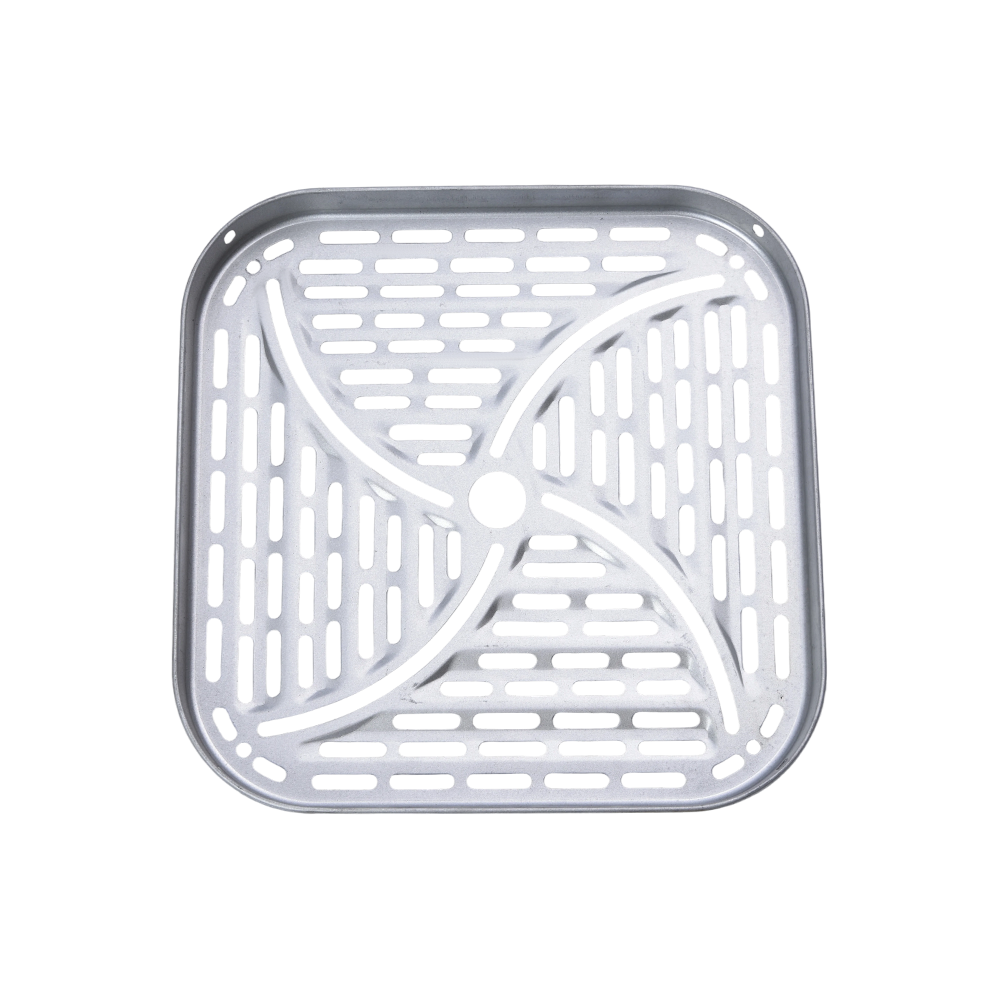
What Are Stamped Parts? Stamped parts are metal components produced by pressing flat sheet metal between a die and a punch to cut, bend, or...
READ MORE

News
Home / Author / Wang Xinyi — Senior After-Sales Coordinator / Precision Stamped Chassis Parts for Structural and Industrial Applications
Precision Stamped Chassis Parts for Structural and Industrial Applications
2026-09-28
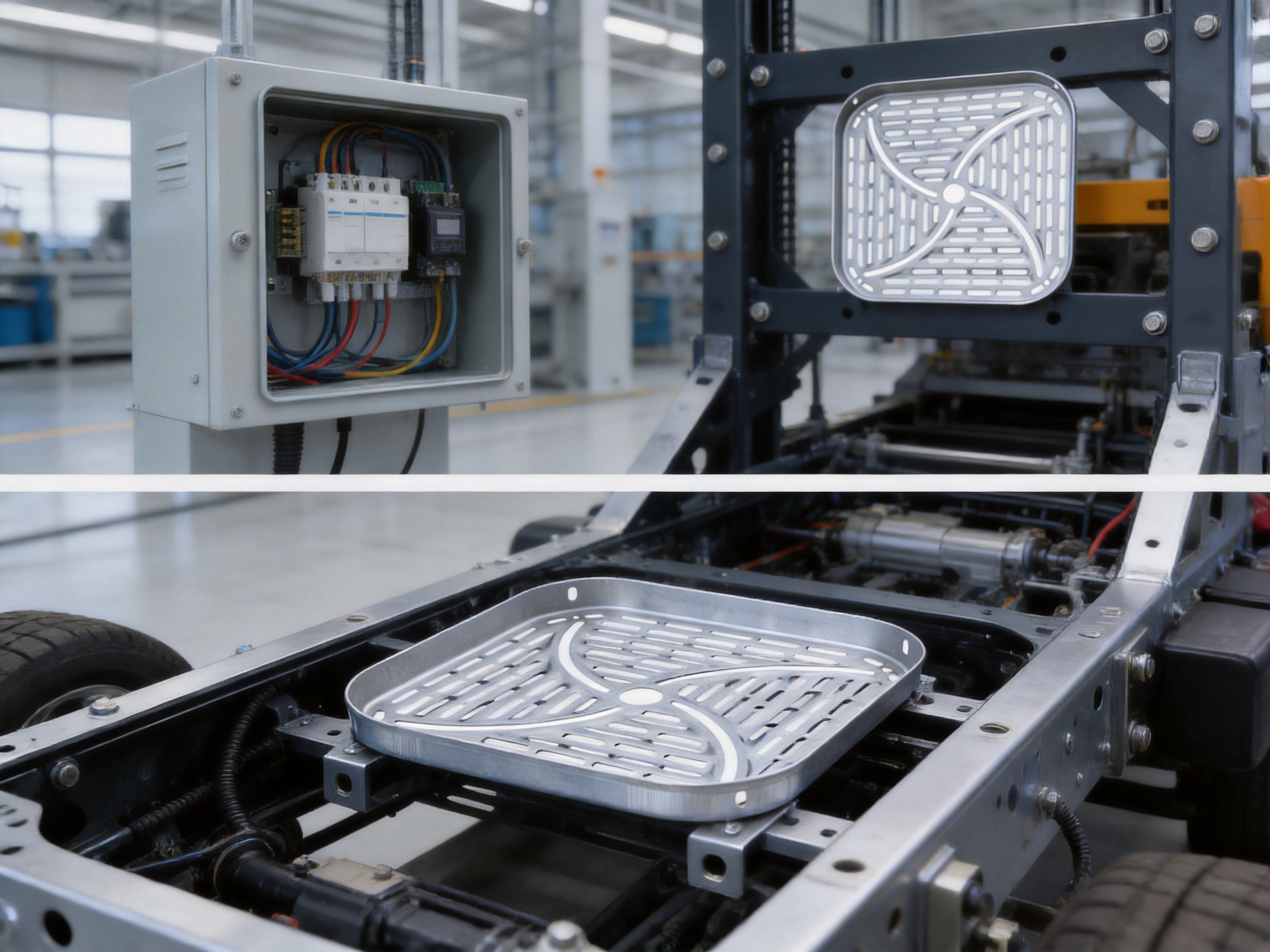
Stamped chassis parts are essential structural components used to support, protect, align, and connect equipment in demanding operating environments. Although many chassis components appear simple at first glance, their performance depends on accurate geometry, consistent material thickness, reliable forming, clean edges, and stable dimensional control. A small deviation in a mounting hole, flange, bend, or locating feature can affect assembly efficiency, structural strength, vibration behavior, and the service life of the finished product.
Precision stamped chassis parts combine the advantages of sheet metal forming with the efficiency of repeatable industrial production. Through advanced stamping technology, flat metal sheets can be transformed into components with bends, flanges, ribs, apertures, mounting points, reinforcing features, and other complex shapes. This makes stamping suitable for automotive chassis systems, electrical enclosures, machine frames, heavy equipment, household appliances, and other products that require dependable structural support.
Yuyao Hongli Optoelectronics Co., Ltd. manufactures customized stamped chassis parts for customers requiring stable quality, accurate dimensions, efficient production, and flexible design support. With more than 20 years of industry experience, a modern factory covering approximately 5,000 square meters, multiple stamping workshops, and a workforce of more than 60 employees, the company provides a practical manufacturing resource for both standard and customized metal components.
What Are Stamped Chassis Parts?
Stamped chassis parts are structural metal components produced by pressing sheet metal between specially designed dies. The stamping operation may include blanking, piercing, bending, forming, drawing, embossing, or a combination of several processes. Each process contributes to the final shape and function of the part.
A chassis part may serve as a supporting frame, mounting bracket, reinforcement plate, protective shell, connection component, or internal structural member. Depending on its intended use, the part may include a combination of flat surfaces and formed features. These features can improve rigidity, provide accurate assembly references, create clearance for other components, or distribute mechanical loads across a larger area.
Unlike a simple flat bracket, a stamped chassis component can be designed with multiple bends and integrated functional details. This reduces the need for additional welding, machining, or assembly operations. In many applications, one accurately formed stamped part can replace several individual pieces, reducing component count and simplifying production.
Stamped chassis parts are commonly manufactured from steel, stainless steel, aluminum, or other suitable sheet materials. The selection depends on strength requirements, corrosion resistance, weight limitations, electrical properties, appearance, operating temperature, and the intended surface treatment. Material selection and tooling design must be considered together because different materials behave differently during forming.
Structural Functions of Chassis Components
The primary function of a chassis component is to provide a stable structural foundation. In automotive applications, chassis parts may help support body systems, suspension-related structures, brackets, shields, or other assemblies. In electrical equipment, they may hold circuit assemblies, protect internal components, and maintain the position of enclosure elements. In industrial machinery, they may connect frames, support motors, or reinforce areas exposed to vibration and repeated loading.
A well-designed stamped chassis part can improve the overall rigidity of a product without adding excessive weight. Formed ribs, return flanges, offset sections, and boxed bends increase resistance to deflection and twisting. These features can be produced directly during the stamping process, allowing the component to deliver greater structural performance than a flat sheet with the same material thickness.
Chassis parts also help maintain positional accuracy between related components. Mounting holes, slots, locating tabs, and formed reference surfaces can be incorporated into the design. When these features are produced consistently, final assembly becomes faster and less dependent on manual adjustment.
In equipment exposed to vibration, the geometry of the stamped part is especially important. Properly positioned bends and reinforcing features can reduce movement and improve connection stability. A precise part can also help prevent fasteners from loosening because the mating surfaces remain correctly aligned during operation.
Precision and Dimensional Consistency
Dimensional consistency is one of the most important advantages of industrial stamping. Once the tooling has been properly designed, tested, and adjusted, the same forming sequence can be repeated for large quantities of parts. This repeatability helps control dimensions across production batches and supports consistent assembly at the customer’s facility.
Hongli’s stamped chassis parts are manufactured with tight tolerances, typically reaching approximately ±0.1 mm where the product design and material conditions permit. The actual tolerance capability depends on factors such as material type, thickness, part size, geometry, tooling condition, and measurement requirements. During product development, critical dimensions can be identified so that inspection and process controls are focused on the features most important to fit and function.
Important control points may include overall length and width, hole diameter, hole-to-hole distance, bend angle, flange height, flatness, corner position, and the relationship between formed surfaces. Controlling these features helps prevent problems such as difficult assembly, uneven mounting, interference with neighboring components, or inaccurate final positioning.
Precision does not depend only on the stamping press. It also depends on accurate tooling, correct material preparation, appropriate process parameters, careful die maintenance, and effective inspection procedures. A stable manufacturing system addresses each of these areas rather than relying on a single production step.
Advanced Stamping and Forming Processes
Modern stamping production can combine several operations in a coordinated process. Blanking separates the initial outline from the sheet. Piercing creates holes or slots. Bending forms angular features. Embossing creates raised or recessed details. Drawing produces deeper three-dimensional shapes. Forming operations establish the final structural profile of the part.
The correct sequence is important because each operation affects the material and the geometry of later operations. For example, a hole may need to be pierced before a bend is created if access becomes difficult after forming. In other cases, a hole may be formed later to maintain better positional accuracy relative to a finished surface.
Progressive stamping may be considered for suitable high-volume products. In this method, a coil or strip of sheet material moves through several stations, with each station completing a specific operation. The finished component is separated after a controlled sequence of forming steps. This approach can provide high productivity and consistent output when the design, material, and production volume are appropriate.
For products with lower volumes, larger dimensions, or more flexible production requirements, individual operations or transfer-based processes may be more suitable. The manufacturing route is selected according to the customer’s design, production quantity, tolerance requirements, material characteristics, and expected delivery schedule.
Deep forming and bending capabilities can also be combined with stamping expertise. This is useful when a chassis component includes both flat structural zones and deeper formed sections. Combining related operations can reduce handling, minimize alignment errors, and simplify the supply chain.
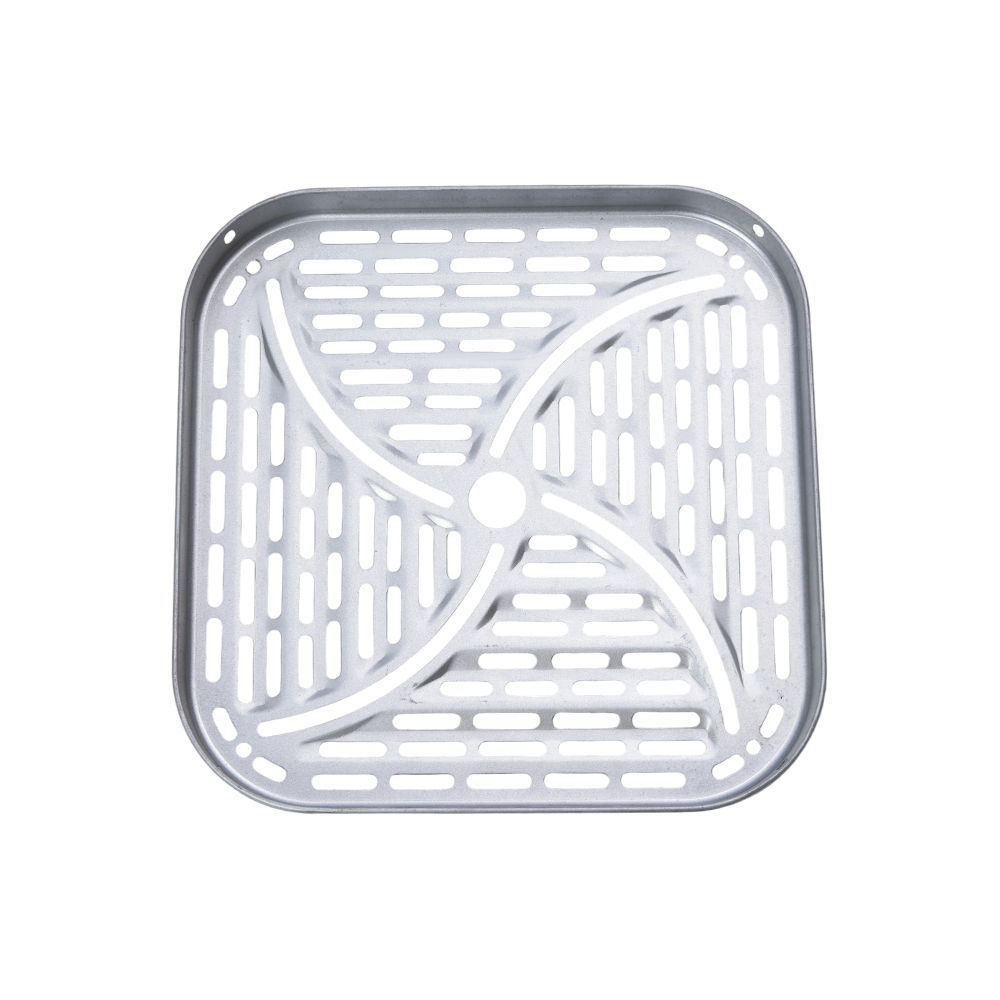
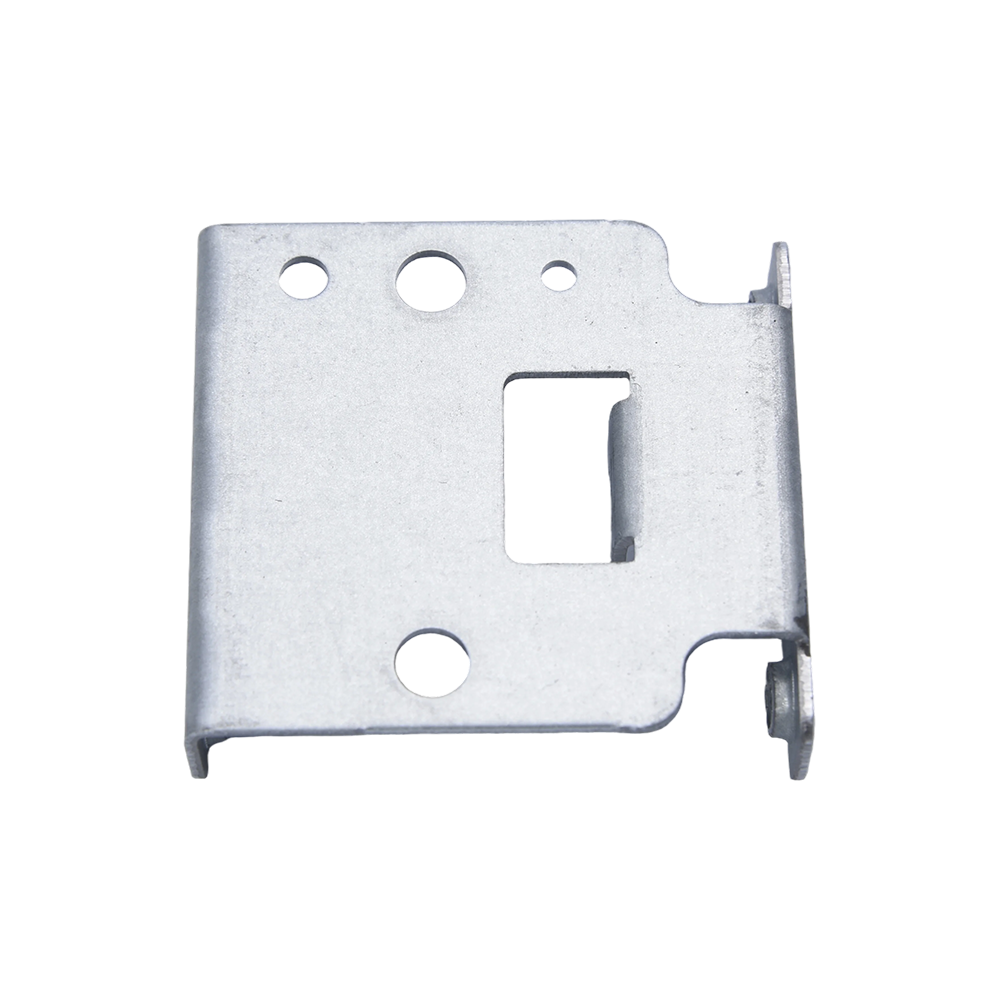
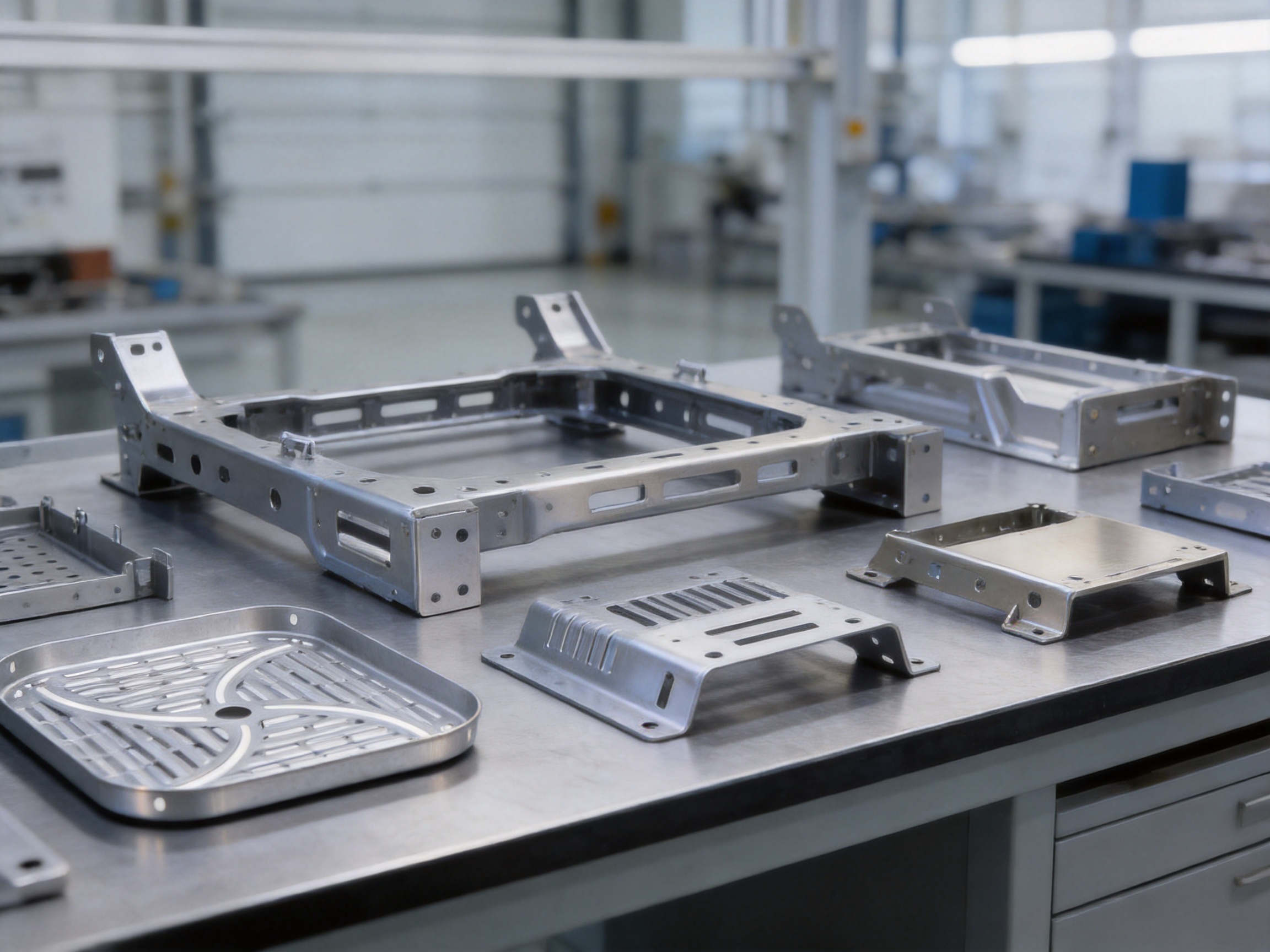
Stamped chassis parts
Design Features That Improve Chassis Performance
Stamped chassis parts can include many design details that improve strength and usability without significantly increasing material consumption. Ribs and beads increase stiffness by changing the cross-sectional profile of the sheet. Flanges provide additional support along an edge. Return bends can improve safety and reduce sharp exposed edges. Embossed areas can create clearance or reinforce a fastener location.
Mounting holes are often positioned to correspond with screws, bolts, rivets, studs, or other fasteners. Slots may be used when adjustment is required during assembly. Locating tabs can help guide a component into position, while notches can provide clearance for wiring, pipes, connectors, or adjacent parts.
Corner design also affects product quality. Excessively sharp corners may increase stress concentration, make forming more difficult, or create handling risks. Appropriate radii can support smoother material flow and reduce the risk of cracking or deformation during forming.
Part geometry should be designed with the stamping process in mind. Even a technically attractive shape may be difficult or expensive to manufacture if it requires unnecessary operations, inaccessible features, extreme bends, or inconsistent material flow. Early communication between the customer’s engineering team and the manufacturer can improve manufacturability before tooling begins.
A good design balances structural performance, material use, tooling cost, production efficiency, and inspection requirements. Hongli supports OEM and ODM customization, allowing the manufacturing process to be developed around the customer’s drawings, samples, functional requirements, or product concepts.
Applications Across Multiple Industries
Automotive Chassis and Structural Systems
Automotive applications require parts that can withstand vibration, repeated loading, environmental exposure, and demanding assembly conditions. Stamped chassis components may be used as brackets, supports, reinforcement plates, shields, mounting structures, or connecting elements. Their repeatable dimensions help maintain alignment during vehicle assembly.
Automotive production also benefits from the speed and scalability of stamping. When a component is produced in large quantities, stamping can provide a practical alternative to extensive machining or fabrication. Integrated formed features can reduce the number of separate pieces required in an assembly, supporting lower handling and assembly costs.
Because automotive components may be exposed to water, road contaminants, temperature changes, and corrosive conditions, material selection and surface protection are important. Depending on the application, customers may specify stainless steel, coated steel, plated material, or another corrosion-resistant solution.
Electrical Enclosures and Equipment Frames
Electrical enclosures often require internal brackets, mounting plates, partitions, support rails, and reinforcement components. These parts must hold equipment securely while preserving clearance for wiring, ventilation, connectors, and service access.
Stamped components are suitable for enclosure applications because they can include accurate holes, slots, tabs, and flanges in a single part. The final design can support faster installation and more reliable positioning of electrical assemblies. Where the equipment operates in humid or corrosive environments, appropriate material and finishing choices can help extend service life.
Industrial Machinery and Machine Frames
Machine frames and industrial equipment frequently experience vibration, impact, and continuous mechanical operation. Stamped chassis parts can reinforce frame sections, support motors and actuators, protect moving or sensitive components, and connect different structural elements.
Formed sheet metal can offer a favorable balance between strength and weight. Rather than using thick solid plates for every structural requirement, designers can use bends, ribs, and flanges to achieve the required rigidity with a more efficient material profile.
Heavy Equipment
Heavy equipment applications place high demands on component durability. Stamped chassis parts may be used in protective covers, brackets, support assemblies, control cabinets, and frame-related structures. The manufacturing process can be adapted to produce robust shapes with reinforced edges and secure mounting points.
Where components are exposed to moisture, high temperatures, dust, chemicals, or outdoor conditions, the production plan should include suitable material selection, surface treatment, and quality verification. A carefully designed stamped part can contribute to dependable operation even in challenging environments.
Household Appliances and Kitchen Equipment
Household electric heaters, small appliances, kitchen equipment, and related products often contain internal structural components that must be accurate, compact, and economical to produce. Stamped parts can support heating elements, motors, covers, control systems, wiring, and other assemblies.
Kitchen appliance accessories may require a combination of appearance, corrosion resistance, clean edges, and dimensional accuracy. Depending on the visible or hidden position of the part, the customer may specify different requirements for surface quality, finishing, and cosmetic consistency.
Advantages Compared with Alternative Manufacturing Methods
Advantages over Extensive Machining
Machining removes material from a solid block or plate to create the desired shape. It can provide excellent accuracy, but it may produce considerable material waste and require longer processing times for large quantities. Stamping forms sheet material more directly, making it efficient for components with repeated shapes and moderate wall thickness.
Stamped chassis parts can also include several functional features in one forming sequence. This may reduce the need for secondary machining of holes, edges, or bends. Machining remains valuable for certain complex or extremely precise features, but stamping can be more competitive for high-volume structural sheet metal components.
Advantages over Welding Multiple Pieces
Fabricating a chassis assembly from several cut and welded pieces can provide design flexibility, but it also introduces weld variation, heat distortion, additional labor, and more inspection points. A stamped part may combine several structural surfaces into one integrated component.
Reducing the number of welded joints can improve consistency and simplify assembly. It may also reduce the risk of weld spatter, incomplete welds, dimensional distortion, or corrosion around improperly treated weld areas. Where welding remains necessary, stamped components can still be designed to provide accurate mating surfaces and convenient joining locations.
Advantages over Manual Bending
Manual or semi-automatic bending can be suitable for prototypes and low-volume work, but repeated manual operations may create variation in bend angle, flange position, and part orientation. Stamping tooling provides a controlled forming reference, improving repeatability across the production batch.
For customers requiring stable dimensions and efficient delivery, a dedicated stamping process can provide a stronger long-term production solution than relying on multiple manual adjustments.
Advantages over Plastic Structural Components
Plastic can be lightweight and versatile, but metal stamping may be preferred when the application requires higher mechanical strength, better heat resistance, greater dimensional stability, or improved resistance to certain industrial conditions. Metal chassis parts can also provide reliable fastening performance and structural support in applications where loads, vibration, or temperature exceed the practical range of plastic components.
The choice between metal and plastic should always reflect the product’s operating environment and engineering requirements. In many assemblies, metal stamped parts and plastic molded parts work together, with each material used where its properties provide the greatest benefit.
Material Selection and Environmental Performance
Material selection is a central part of stamped chassis design. The chosen sheet must support the required strength, formability, corrosion resistance, appearance, and service temperature. A material that is strong but difficult to form may require a different tooling approach from a softer material with greater elongation.
Steel is widely used for structural components because of its strength, availability, and cost efficiency. Stainless steel may be selected where corrosion resistance, cleanliness, or heat resistance is important. Aluminum can reduce weight and provide useful corrosion resistance, although its forming behavior and springback characteristics require careful process control.
Material thickness affects stiffness, weight, forming force, and the final dimensions of the part. A thicker sheet may improve load capacity but increase tooling requirements and material cost. A thinner sheet may reduce weight but require additional ribs, beads, or flanges to achieve the desired rigidity.
Surface treatment may be used to improve corrosion resistance, appearance, wear resistance, or compatibility with other components. The appropriate treatment depends on the base material and operating environment. Customers should specify whether the component will be exposed to humidity, salt spray, chemicals, outdoor weather, elevated temperatures, or repeated cleaning.
For applications where corrosion is a concern, design details also matter. Drainage openings, appropriate bend radii, accessible coating surfaces, and the avoidance of trapped moisture can help improve long-term performance. Material and finish requirements should be agreed before production so that tooling, inspection, and packaging can be planned correctly.
Tooling Development and Production Preparation
Tooling is the foundation of repeatable stamping production. A die must control the sheet during cutting and forming while allowing the finished part to be released without damage. Tool design includes consideration of material flow, clearance, bend sequence, springback, locating methods, part ejection, and maintenance access.
Before production begins, the customer’s drawings or samples are reviewed for manufacturability. Critical dimensions, tolerance requirements, material specifications, hole patterns, bend directions, and surface requirements should be clarified. If a design creates unnecessary forming difficulty, adjustments may be recommended to improve reliability and control cost.
Rapid prototyping can help confirm the general shape and assembly relationship before full-scale production tooling is finalized. A prototype or trial part provides an opportunity to evaluate fit, clearance, mounting access, edge conditions, and structural behavior.
Tool trials are used to identify forming issues and establish appropriate process parameters. Depending on the product, trial evaluation may include checking dimensional accuracy, bend angles, hole locations, flatness, surface marks, edge quality, and the interaction between multiple formed features.
Tool maintenance is equally important after production begins. Wear, damage, inadequate lubrication, or accumulated material residue can affect dimensions and surface quality. A disciplined maintenance approach supports stable production and helps prevent unexpected interruptions.
Quality Control for Stamped Chassis Parts
Quality control begins with incoming material verification. Material grade, thickness, surface condition, and general conformity should be checked against the agreed specification. Using consistent material helps reduce variation in forming behavior and finished dimensions.
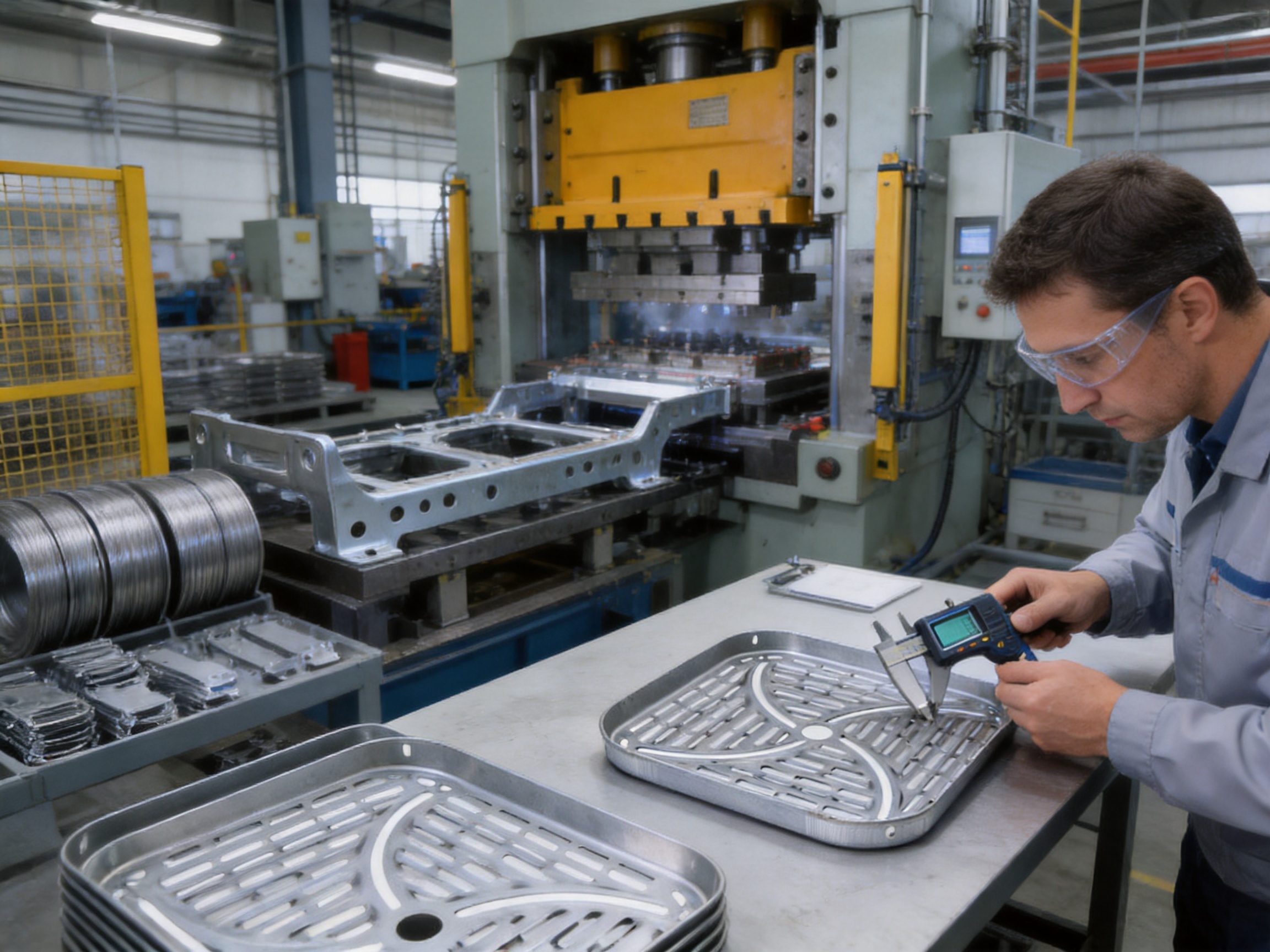
During production, operators and quality personnel may monitor part appearance, critical dimensions, hole positions, bend angles, and structural features. First-piece inspection is particularly important after tooling changes, material changes, or equipment adjustments. The purpose is to confirm that the process is producing acceptable parts before larger quantities are released.
Dimensional inspection may be performed using calipers, micrometers, gauges, height measurement equipment, templates, or other suitable tools. The inspection method should reflect the feature being measured and the required tolerance. For more complex parts, multiple reference points may be used to verify the relationship between surfaces and holes.
Visual inspection can identify scratches, cracks, burrs, dents, deformation, discoloration, or other surface problems. Edge quality is important because excessive burrs can create safety risks, interfere with assembly, or damage wiring and adjacent components.
Process inspection and final inspection work together. Process inspection detects variation early, while final inspection confirms that completed products meet the agreed requirements before shipment. Packaging should also protect the parts from impact, contamination, moisture, and unnecessary deformation during transportation.
Manufacturing Strengths and Service Capabilities
Yuyao Hongli Optoelectronics Co., Ltd. has more than two decades of experience in manufacturing and processing metal components. Founded in 2000, the company developed from its former identity as Yuyao Hongli Optoelectronics Educational Instruments Co., Ltd. and expanded into a broader manufacturing enterprise serving multiple product sectors.
The company operates from Yangming Science and Technology Industrial Park in Yuyao, Zhejiang Province, China. Its approximately 5,000-square-meter modern factory includes multiple stamping workshops and supports production for domestic and international customers.
With more than 60 employees, the company combines production experience with practical engineering coordination. Its product and service scope includes educational instruments, optical instruments, household electric heaters, small household appliances, automotive parts, hardware products, plastic products, deep-drawn parts, stamped parts, bending parts, kitchen appliance accessories, and automotive stamping parts.
This range of experience is valuable because stamped chassis components often require knowledge of several related processes. A product may include stamping, deep drawing, bending, secondary processing, surface treatment, assembly, or coordination with plastic and electrical components. Experience across different product categories can support more effective problem-solving during development.
The company provides OEM and ODM customization, rapid prototyping, production conversion, wholesale, retail, import, and export services. These capabilities allow customers to work with one manufacturing partner from initial concept through repeat production. The service model is designed to support customized solutions rather than limiting customers to fixed catalog products.
Stable delivery and after-sales service are also important for industrial customers. A component that is technically correct but delivered inconsistently can interrupt assembly schedules and increase inventory pressure. Hongli’s manufacturing approach emphasizes quality control, production organization, delivery coordination, and long-term customer cooperation.
OEM and ODM Customization Process
The customization process normally begins with the customer providing a drawing, three-dimensional model, physical sample, or functional description. Relevant information may include material, thickness, quantity, tolerance, surface treatment, application environment, packaging, and expected delivery schedule.
Engineering personnel review the design and identify important production considerations. These may include bend radii, hole-to-edge distances, material flow, forming direction, tool access, part release, flatness, and potential interference between features.
After the design review, the production route and tooling concept can be established. The customer may receive recommendations intended to improve manufacturability, reduce unnecessary operations, control cost, or improve repeatability. Any design changes should be confirmed before tooling is completed.
Prototype or trial samples can then be produced for evaluation. The customer may check the sample against its assembly, functional, and appearance requirements. Once the design is approved, the manufacturing process can be transferred into regular production.
For repeat orders, production data and quality requirements can support more consistent reordering. Clear communication regarding revisions is essential because even a small change to material thickness, hole position, or surface treatment can affect tooling and process conditions.
Cost Efficiency and Production Value
Cost efficiency is not limited to the lowest piece price. A complete evaluation should consider tooling investment, material utilization, production speed, labor, secondary processing, inspection, packaging, logistics, and the cost of rejected or inconsistent parts.
Stamping can lower the cost per part when production quantities justify tooling and process preparation. Once the process is established, repeat production can be faster and more consistent than individually machining or fabricating each component.
Integrated features can also reduce assembly cost. If a stamped chassis part includes mounting tabs, reinforcing ribs, and accurately positioned holes, fewer separate components may be required. This can reduce the number of fastening operations and simplify inventory management.
Material utilization should be considered during blank layout and tooling development. Efficient nesting and appropriate strip design can reduce scrap while maintaining part quality. The best design is not always the one that uses the thinnest material; it is the one that achieves the required performance with an efficient combination of geometry, material, and process.
| Evaluation Area | Value of Precision Stamping | Customer Benefit |
|---|---|---|
| Dimensional consistency | Repeatable tooling and controlled forming | More reliable assembly and reduced adjustment |
| Structural performance | Ribs, flanges, beads, and formed profiles | Improved rigidity without unnecessary weight |
| Production efficiency | Multiple operations combined in a planned process | Shorter processing time and stable output |
| Design flexibility | Customized holes, bends, tabs, slots, and profiles | Better integration with the customer’s product |
| Material efficiency | Controlled blanking and forming of sheet material | Lower waste and more predictable production cost |
| Environmental suitability | Material and finishing options for demanding conditions | Improved resistance to moisture, heat, and corrosion |
| Supply support | OEM, ODM, prototyping, and repeat production services | A single source for development and manufacturing |
Why Precision Matters in Competitive Applications
Customers comparing stamped chassis part suppliers should evaluate more than equipment lists or quoted prices. The supplier’s ability to interpret drawings, maintain tooling, control dimensions, respond to design changes, and manage delivery has a direct effect on the customer’s total production result.
A low-cost component may create additional expenses if it requires manual correction, sorting, rework, replacement, or delayed assembly. By contrast, a consistently manufactured component can reduce disruption and support smoother production planning.
Precision also affects the customer’s finished product. When chassis parts align correctly, panels fit more evenly, fasteners engage properly, vibration is better controlled, and the overall assembly appears more professional. These benefits are especially important for automotive, appliance, electrical, and industrial equipment manufacturers.
Hongli’s combination of long-term experience, stamping workshops, customization support, prototype capability, and broad product knowledge creates an advantage for customers seeking more than a basic part-forming service. The company’s approach is oriented toward practical manufacturing cooperation, from product development to delivery and after-sales communication.
Design Recommendations for Customers
Customers can improve the efficiency of a stamped chassis project by providing complete and accurate technical information at the beginning. Drawings should identify material, thickness, critical dimensions, tolerances, surface treatment, and inspection requirements wherever possible.
It is helpful to distinguish critical dimensions from general dimensions. Not every feature needs the same tolerance. Identifying the dimensions that directly affect assembly or function allows the manufacturer to focus tooling and inspection resources where they provide the greatest value.
Designers should allow suitable bend radii and avoid placing holes too close to bend lines or edges unless the application specifically requires it. Adequate spacing can reduce deformation and improve material stability during forming.
For parts exposed to corrosion, the operating environment should be described clearly. Information about humidity, chemicals, salt, temperature, outdoor exposure, and cleaning methods can guide material and surface treatment recommendations.
Customers should also explain how the part will be assembled. Information about fasteners, welding, riveting, press fitting, adhesive bonding, or manual installation can influence hole design, edge treatment, flatness, and access requirements.
Finally, expected annual or monthly volume should be communicated early. Production quantity affects tooling selection, automation opportunities, material purchasing, process planning, and the most economical manufacturing route.
Packaging, Delivery, and Long-Term Supply
Stamped chassis parts must be packaged according to their shape, surface condition, weight, and vulnerability to deformation. Small parts may be separated in cartons or trays, while larger structural components may require protective layers, dividers, or reinforced containers.
Proper packaging helps prevent scratches, dents, tangling, edge damage, and corrosion during storage and transportation. Parts with treated or visible surfaces may require additional protection to preserve their appearance.
Delivery planning should account for tooling preparation, material availability, trial production, inspection, finishing, packaging, and transportation. Early communication allows the production schedule to be aligned with the customer’s assembly plan.
For long-term projects, consistent documentation is useful. Approved drawings, material specifications, inspection requirements, packaging instructions, and revision records help ensure that future orders remain aligned with the original expectations.
A reliable supplier should also respond promptly when a customer needs a design revision, replacement batch, new size, or related component. Hongli’s broader capabilities in deep-drawn parts, bending parts, kitchen appliance accessories, hardware products, and automotive stamping parts can support customers whose product lines include several related metal components.
Frequently Asked Questions
What are stamped chassis parts used for?
Stamped chassis parts are used to support, reinforce, connect, protect, and align components in automotive systems, electrical enclosures, machine frames, heavy equipment, household appliances, and other structural products.
Can stamped chassis parts be customized?
Yes. The dimensions, material, thickness, hole pattern, bend configuration, mounting features, surface treatment, and packaging can be developed according to the customer’s drawings, samples, or functional requirements.
What tolerance can stamped chassis parts achieve?
The typical tolerance may reach approximately ±0.1 mm for suitable features and production conditions. The achievable tolerance depends on material, thickness, part size, geometry, tooling, and the specific dimension being controlled.
Which materials can be used?
Common options include steel, stainless steel, aluminum, and other suitable sheet metals. The final selection should consider strength, formability, corrosion resistance, weight, temperature, appearance, and the operating environment.
Can the parts be used in corrosive environments?
They can be designed for applications involving moisture, heat, or corrosive conditions when the material, surface treatment, geometry, and packaging are selected appropriately. The customer should provide details about the actual environment so that the correct solution can be evaluated.
What industries does the manufacturer serve?
The company serves automotive, electrical equipment, industrial machinery, heavy equipment, household appliance, kitchen appliance, educational instrument, optical instrument, hardware, and related manufacturing sectors.
Does the company support prototypes?
Yes. The company supports rapid prototyping and production conversion. Prototype or trial parts can help customers verify dimensions, fit, clearance, appearance, and functional requirements before regular production.
Can one part combine stamping and bending features?
Yes. Stamping production can combine blanking, piercing, bending, forming, embossing, and other operations when the design and material are suitable. Combining features may reduce secondary processing and simplify assembly.
How should a customer begin a project?
The customer should provide a drawing, three-dimensional model, sample, or detailed description, together with information about material, thickness, quantity, tolerance, surface treatment, application environment, and delivery requirements. The manufacturer can then review the design and recommend a suitable process.
What makes a supplier suitable for long-term cooperation?
Important factors include manufacturing experience, stable quality, effective tooling support, dimensional control, responsive communication, reliable delivery, customization capability, and after-sales service. A supplier with experience across related metal processes can also help customers manage a broader product range.
Conclusion
Precision stamped chassis parts provide an efficient and adaptable solution for structural applications that require strength, repeatability, accurate assembly, and dependable service performance. Through controlled blanking, piercing, bending, forming, and inspection, sheet metal can be converted into integrated components with complex functional features.
Compared with extensive machining, manual bending, or multi-piece welded fabrication, stamping can offer strong production efficiency, consistent dimensions, reduced component count, and competitive long-term value. Formed ribs, flanges, tabs, slots, and mounting features allow designers to achieve useful structural performance without unnecessary weight or complexity.
Yuyao Hongli Optoelectronics Co., Ltd. combines more than 20 years of industry experience with a modern 5,000-square-meter factory, multiple stamping workshops, more than 60 employees, OEM and ODM capabilities, rapid prototyping, and broad manufacturing experience. Its services cover stamped parts, deep-drawn parts, bending parts, kitchen appliance accessories, automotive stamping parts, and related customized products.
For customers seeking a dependable source for automotive chassis components, electrical enclosure parts, machine frame supports, heavy equipment structures, or household appliance accessories, a carefully developed stamped solution can improve product consistency and manufacturing efficiency. By combining sound design, appropriate materials, accurate tooling, disciplined quality control, and coordinated delivery, stamped chassis parts can support reliable products across demanding industries.
References
1. ASM International. ASM Handbook: Sheet Metal Forming. Materials and forming principles for industrial sheet metal production.
2. American Society of Mechanical Engineers. Dimensioning and Tolerancing Principles for Mechanical Components. General guidance for interpreting and controlling engineering dimensions.
3. Society of Automotive Engineers. Automotive Body and Chassis Engineering Practices. Structural considerations for stamped automotive components.
4. American Iron and Steel Institute. Sheet Steel Design and Forming Guidelines. Material behavior, forming considerations, and structural design practices.
5. International Organization for Standardization. Geometrical Product Specifications and Quality Management Principles. General reference for dimensional control and manufacturing quality.
6. Manufacturer-provided product and company information for customized stamped chassis parts, metal stamping, deep drawing, bending, OEM/ODM production, and related industrial applications.
Product: Stamped chassis parts
Previous Post
Deep-Drawn Rectangular Containers with Lids: Strength, Hygiene, and Precision for Demanding Applications
Next Post
Precision Stamped Base Plates with Multiple Holes for Reliable Industrial Assembly
News
-
-
When you need a metal component whose depth clearly exceeds its width, such as a one-piece battery enclosure, an air-fryer inner container,...
READ MORE -
What Is Deep Drawing Process and What Are Deep-Drawn Parts The deep drawing process is a sheet metal forming operation in which a flat meta...
READ MORE -
Steel is the backbone of modern manufacturing, yet it is never a single, uniform material. When engineers and buyers ask, "How can you clas...
READ MORE
Get Fresh Updates Via Email
We promise we will never disclose your email address, and you can opt out at any time.
-
Quick Links
Home About Us Products Service News Contact Us -
Product list
Deep-drawn parts Stamped parts Bending parts Kitchen appliance accessories Automotive stamping parts -
About Us
Factory Honour FAQ -
News
Company News Industry News -
Contact Us
Address: South side of Shunke Road, Yangming Science and Technology Industrial Park, Yuyao City, Zhejiang Province, China Tel: +86-13905842349/+86-13738485724 Email: hongli@hl-stamping.com
Copyright © Yuyao Hongli Optoelectronics Co., Ltd. All Rights Reserved.
Custom Precision-Sheet/Sheet Metal Stamping Manufacturers
