


 English
 русский
 Español
 عربى
عربى

Steel is the backbone of modern manufacturing, yet it is never a single, uniform material. When engineers and buyers ask, "How can you clas...
READ MORE

News
Home / Author / Wang Xinyi — Senior After-Sales Coordinator / Precision Stamped Circular Parts with Holes for Durable Industrial Assemblies
Precision Stamped Circular Parts with Holes for Durable Industrial Assemblies
2026-06-02
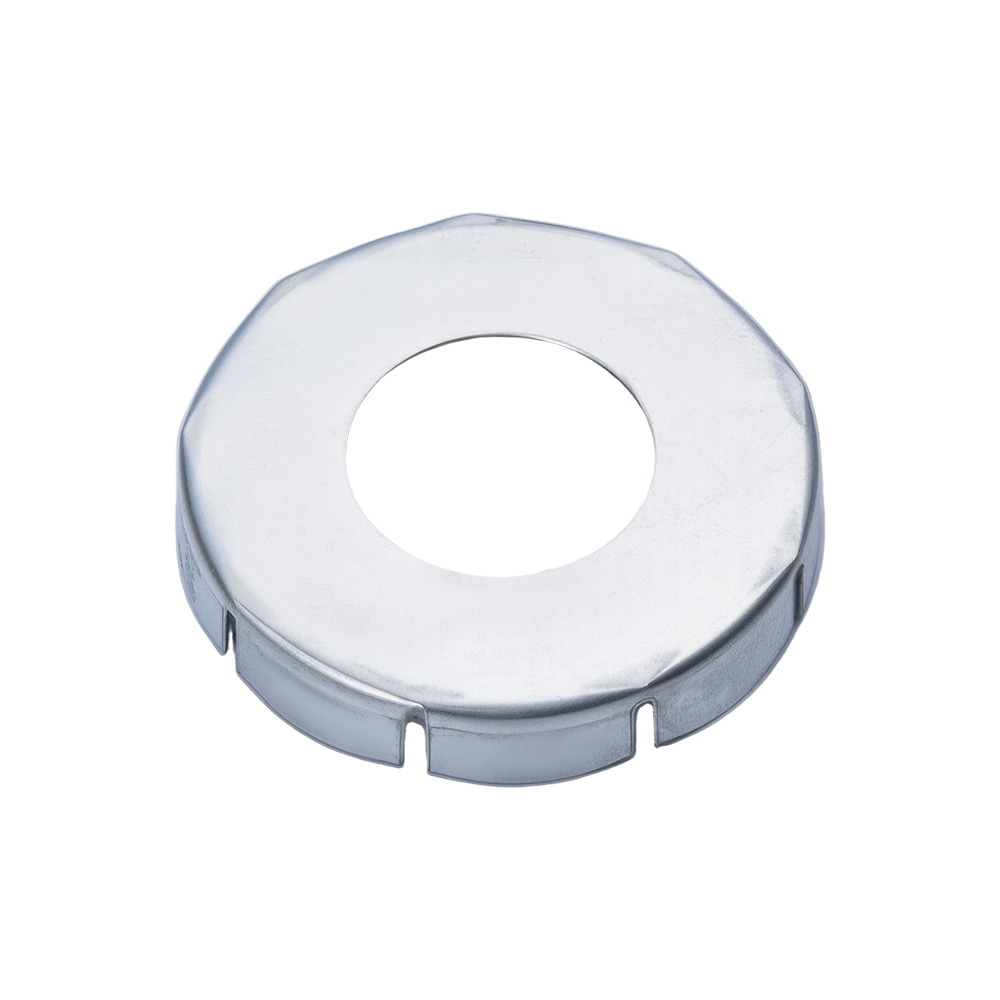
Stamped circular parts with holes are essential components in modern industrial production, mechanical assembly, appliance manufacturing, automotive systems, and customized hardware solutions. Although their appearance may seem simple, their performance depends on carefully controlled material selection, tooling accuracy, stamping stability, hole positioning, surface quality, corrosion resistance, and dimensional consistency. A circular stamped component with one or more holes can serve as a mounting plate, spacing element, reinforcement washer, protective cover, structural interface, rotating support part, fixture component, or customized functional part in a larger assembly.
This article introduces the value, design flexibility, manufacturing advantages, application potential, and quality considerations of stamped circular parts with holes. It also explains how experienced production capability, advanced stamping processes, OEM/ODM customization, rapid prototyping, stable delivery, and strict quality control create a stronger competitive position for customers who require reliable metal components. The focus is not only on the product itself, but also on the manufacturing system behind it: a system that transforms flat metal material into precise, durable, and application-ready parts.
Stamped circular parts with holes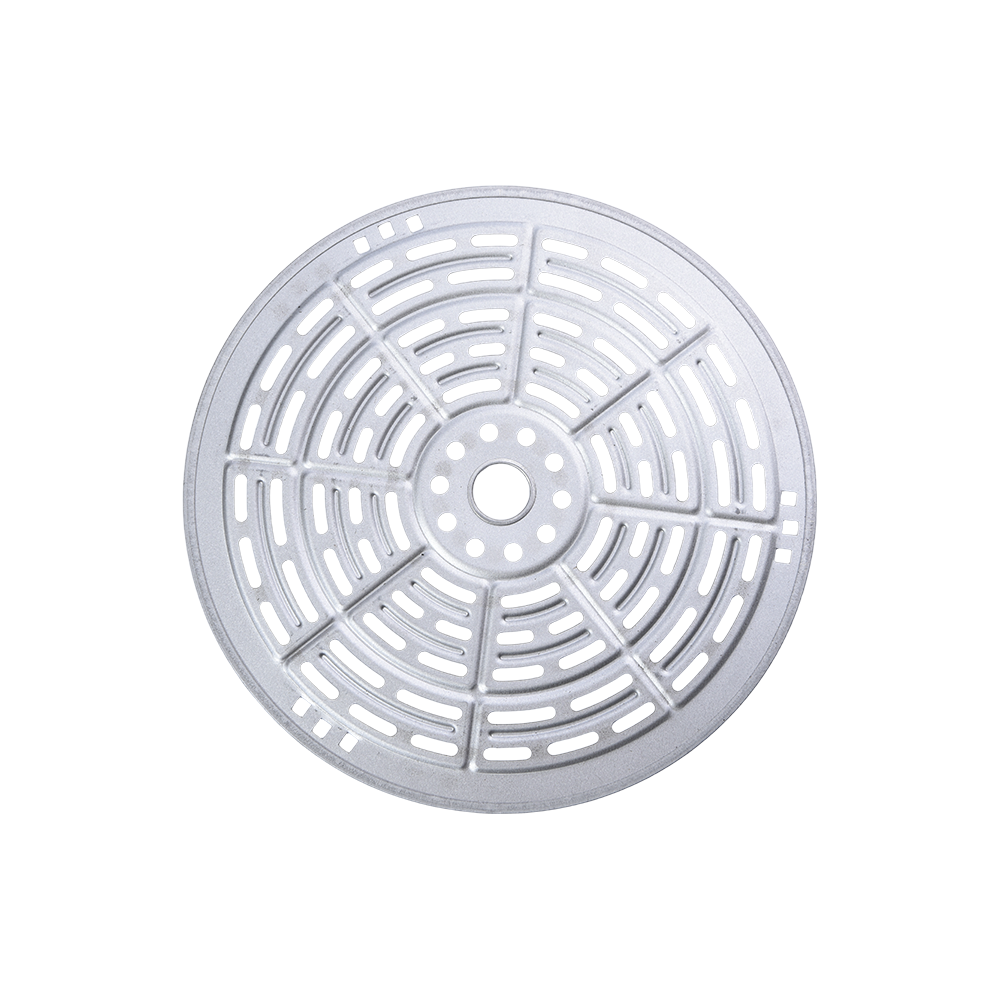
Product Overview
Stamped circular parts with holes are produced by using stamping dies and press equipment to form flat or shallow-profile circular metal pieces with accurately located holes. The holes may be located at the center, distributed around the circumference, arranged according to a bolt circle, placed asymmetrically for positioning, or customized for ventilation, drainage, weight reduction, fastening, alignment, or functional assembly.
The product is typically manufactured from sheet metal materials selected according to the application environment. Depending on customer requirements, materials may include carbon steel, stainless steel, galvanized steel, aluminum, copper, or other suitable alloys. The finished component may be plain, deburred, polished, plated, coated, passivated, oiled, or treated with other surface processes to improve appearance and resistance to corrosion, rust, high temperature, or mechanical wear.
The most important feature of these components is the balance between simplicity and functional versatility. A circular shape naturally distributes stress more evenly than many irregular geometries, while the inclusion of holes allows easy assembly and integration into machinery or equipment. For manufacturers, the stamping process offers high repeatability, efficient production, economical unit cost at scale, and the ability to produce large batches with consistent dimensions.
Why Circular Stamped Parts with Holes Matter
In mechanical design, small components often determine the reliability of the entire product. A washer-like circular stamping may help distribute fastening force. A perforated circular plate may provide airflow or drainage. A custom stamped disc may become a key interface between an electrical appliance housing and an internal structure. An automotive stamped circular component may support, shield, reinforce, or locate another part in a vehicle assembly.
When such components are poorly made, common problems may appear: hole misalignment, burrs, deformation, cracking, inconsistent thickness, poor corrosion resistance, unstable fit, and assembly delays. In contrast, a well-manufactured stamped circular part supports faster assembly, better product reliability, lower maintenance risk, and improved production efficiency for the customer.
For this reason, the product should not be evaluated only by appearance. Buyers should consider tooling precision, press capability, process planning, material traceability, tolerance control, surface finishing, packaging protection, and the manufacturer’s ability to support customization. A dependable supplier can help customers avoid hidden production costs caused by rework, scrap, unstable assembly, or inconsistent batch quality.
Core Product Advantages
High Dimensional Accuracy
Precision is one of the defining advantages of stamped circular parts with holes. The circular outer diameter, hole diameter, hole spacing, concentricity, flatness, and edge condition all influence final assembly performance. Advanced stamping technology allows these factors to be controlled with repeatable accuracy, especially when the tooling is designed and maintained correctly.
High dimensional accuracy is especially important for parts that must match bolts, shafts, pins, housings, brackets, frames, or other stamped components. If holes are slightly out of position, assembly may become difficult or impossible. If the circular shape is distorted, the part may not seat properly. If burrs are excessive, the component may damage adjacent parts or create safety concerns. Precision stamping reduces these risks and supports stable downstream production.
Customization of Hole Size, Number, and Location
One of the strongest benefits of this product type is flexible hole customization. A customer may require a single center hole, multiple mounting holes, slotted holes, countersunk holes, ventilation holes, drainage holes, or special patterns. The holes can be placed according to drawings, samples, application needs, or assembly constraints.
Customization also includes the relationship between holes and the part’s outer diameter. For example, a circular part may need a central hole for shaft clearance and four outer holes for fastening. Another part may require a pattern of small holes for airflow while keeping enough material for strength. A custom industrial part may need non-standard hole spacing to match legacy equipment. Stamping technology can support these requirements when the design is reviewed carefully and proper tooling is developed.
Lightweight Structure with Functional Strength
Holes reduce weight and can improve functionality without sacrificing necessary strength when they are properly designed. In many industrial systems, every gram matters, especially in automotive components, moving mechanisms, handheld equipment, or appliance assemblies. By removing unnecessary material through controlled hole placement, the component can become lighter while maintaining adequate load-bearing capacity.
The circular geometry also supports efficient stress distribution. Compared with sharp-cornered designs, circular shapes can reduce stress concentration. When combined with rounded hole edges, proper material thickness, and controlled forming, the final part can provide excellent mechanical stability for its intended use.
Durability in Demanding Environments
Stamped circular parts with holes can be designed for harsh operating conditions. Depending on material and finishing, they may provide resistance to rust, corrosion, heat, moisture, vibration, and chemical exposure. Stainless steel may be selected for corrosion-sensitive environments. Galvanized or coated steel may be selected for economical rust resistance. Aluminum may be used when lightweight performance is required. Surface treatment can further improve durability and product life.
This durability makes the component suitable for demanding applications in machinery, household appliances, kitchen appliance accessories, automotive assemblies, heaters, optical equipment, educational instruments, and general industrial hardware. The product can be engineered for long-term reliability rather than short-term use.
Efficient Production and Cost Control
Stamping is highly efficient for repeated production. Once the die is developed and validated, the press can produce parts quickly and consistently. Compared with machining each piece individually, stamping can reduce cycle time and unit cost, especially for medium and high-volume production. Material utilization can also be optimized through nesting and strip layout planning.
For customers, this means a strong combination of precision, repeatability, and economic value. The process is especially attractive when the part geometry is suitable for stamping and when stable batch delivery is required. A manufacturer with multiple stamping workshops and experienced technicians can help customers move from prototype to mass production efficiently.
Manufacturing Process and Technical Strength
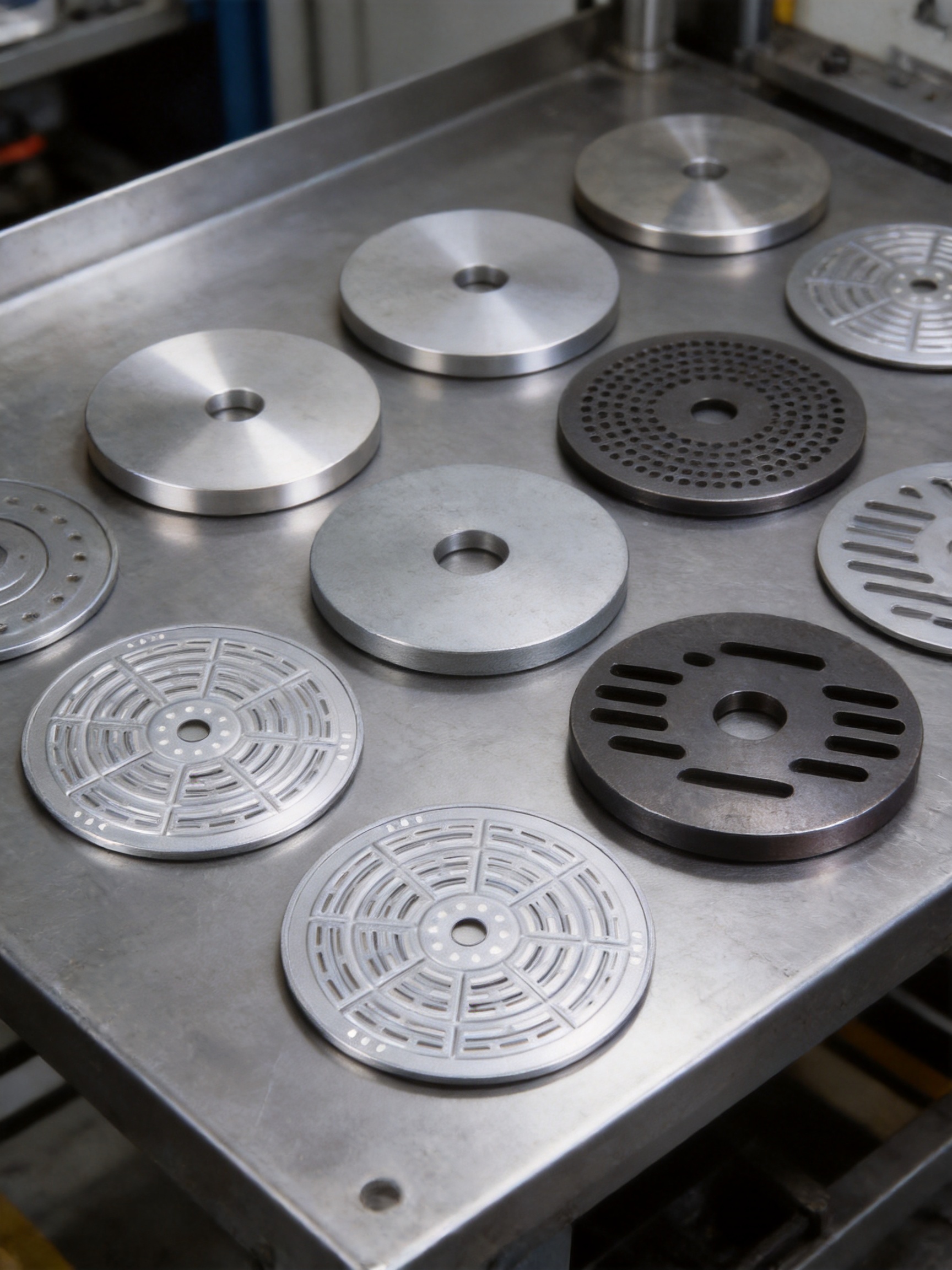
The production of a stamped circular part with holes begins long before the press starts running. A reliable manufacturing process includes design review, material selection, tooling design, die fabrication, trial production, inspection, process optimization, batch production, finishing, quality control, packaging, and delivery. Each step influences the final quality.
Design Review and Engineering Communication
A successful stamped component begins with clear technical communication. Drawings, samples, 3D models, material requirements, tolerance specifications, surface finish expectations, application conditions, and annual demand should be reviewed at the beginning of the project. If the customer does not yet have a complete drawing, an experienced manufacturer can help refine the design according to stamping feasibility.
Design review helps identify potential problems early. For example, holes placed too close to the edge may cause deformation or tearing. Very tight tolerances may require special tooling or secondary operations. Certain materials may crack during forming if the radius is too small. Surface finishing may affect thickness or hole fit. By discussing these issues before production, the manufacturer can reduce development time and prevent avoidable cost increases.
Material Selection
Material selection determines strength, corrosion resistance, forming behavior, cost, appearance, and long-term durability. Carbon steel may be suitable for general industrial use where strength and cost efficiency are important. Stainless steel may be preferred for kitchen appliance accessories, environments with moisture, or components requiring superior corrosion resistance. Aluminum may be used for lightweight applications. Copper or brass may be considered where conductivity or specific appearance is required.
The material thickness must also be selected carefully. Too thin, and the part may deform during assembly. Too thick, and it may increase cost, weight, and stamping force requirements. The correct thickness depends on load conditions, hole pattern, outer diameter, assembly method, and environmental exposure.
Tooling Design and Die Accuracy
Tooling is the heart of the stamping process. The die controls the shape, hole location, edge quality, and repeatability of the part. For circular stamped parts with holes, tooling must account for blanking clearance, punching clearance, material springback, burr direction, flatness, die wear, pilot positioning, and part ejection.
Well-designed tooling improves product consistency and reduces scrap. It also increases production efficiency by allowing stable operation at appropriate press speeds. For complex hole patterns or high-volume orders, progressive dies may be considered. For smaller batches or specialized designs, single-operation dies or compound dies may be suitable. The right tooling strategy depends on quantity, tolerance, geometry, and budget.
Stamping and Punching
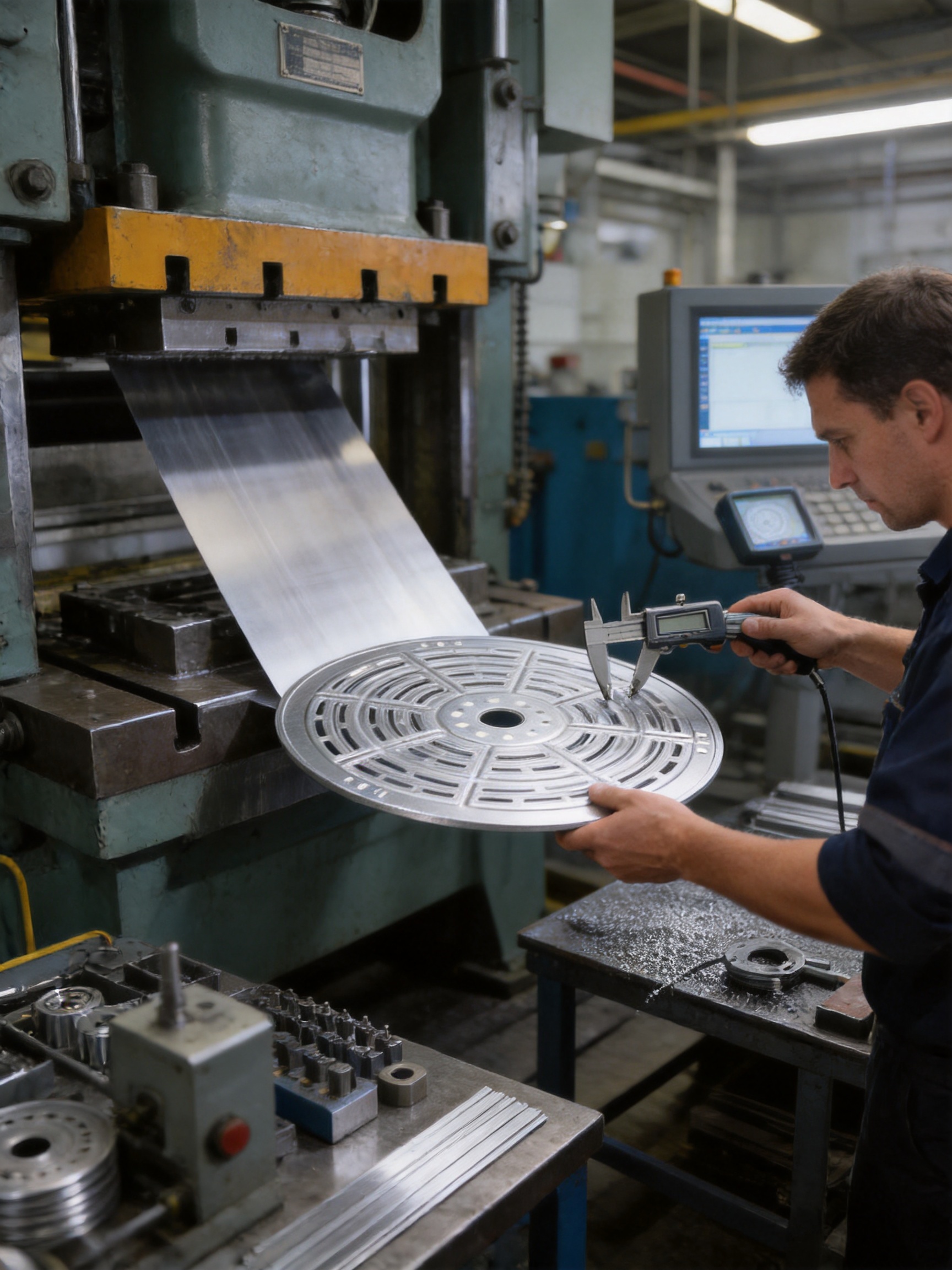
During stamping, sheet metal is cut, punched, or formed by the force of the press and die. For circular parts with holes, operations may include blanking the outer diameter, punching holes, forming slight profiles, embossing, flattening, or trimming. In some designs, these steps are combined in one die. In others, they are performed in sequence.
Stable press operation is important. Press tonnage, speed, die alignment, lubrication, feed accuracy, and operator skill all affect quality. If the clearance is incorrect, burrs may be excessive. If alignment is poor, holes may shift. If lubrication is inadequate, surface scratches or galling may occur. A controlled production environment reduces these issues.
Deburring and Edge Treatment
After stamping, edges and holes may have burrs depending on material, thickness, and die condition. Burr control is critical because sharp edges can interfere with assembly, reduce safety, or create stress concentration. Deburring methods may include mechanical tumbling, brushing, grinding, polishing, or other finishing processes.
Edge treatment also improves appearance and handling. For parts used in visible assemblies, the surface and edge quality may be especially important. For parts used in mechanical interiors, burr removal still matters because it can prevent damage to wires, seals, gaskets, plastic parts, or adjacent metal components.
Surface Treatment
Surface treatment improves corrosion resistance, wear resistance, appearance, and functional performance. Depending on customer requirements, stamped circular parts with holes may receive zinc plating, nickel plating, blackening, powder coating, painting, passivation, polishing, oiling, or other finishes.
For kitchen appliance accessories and household appliance components, surface finish may be closely related to product safety, appearance, and cleaning performance. For automotive stamping parts, corrosion resistance and durability are critical. For industrial machinery, the finish may need to resist oil, heat, dust, or outdoor exposure. The best surface treatment is selected according to the application environment and cost target.
Inspection and Quality Control
Quality control should be present throughout production, not only at final inspection. Incoming materials may be checked for thickness, surface condition, and material grade. First-piece inspection confirms that tooling setup is correct. In-process inspection monitors dimensions and surface quality during production. Final inspection verifies that the batch meets drawing requirements before shipment.
Common inspection items for stamped circular parts with holes include outer diameter, hole diameter, hole position, pitch circle diameter, flatness, thickness, burr height, surface condition, coating quality, corrosion resistance, and packaging condition. Measurement tools may include calipers, micrometers, height gauges, gauges, optical measuring equipment, and customized fixtures.
Manufacturing Strengths Behind Reliable Supply
A product is only as strong as the production system that supports it. With more than 20 years of industry experience, a modern factory of approximately 5,000 square meters, multiple stamping workshops, and more than 60 employees, the manufacturer behind these stamped circular parts has the practical foundation needed to support stable production and customized projects.
The company has developed from a long-established manufacturing background into a professional producer of metal stamping parts and related products. Its business scope includes manufacturing, processing, wholesale, retail, import, and export. Product capabilities cover educational instruments, optical instruments, household electric heaters, small household appliances, auto parts, hardware products, plastic products, deep-drawn parts, stamped parts, bending parts, kitchen appliance accessories, and automotive stamping parts.
This broad manufacturing experience is valuable because stamped circular parts with holes may be used across many industries. A supplier familiar with different applications can better understand customer needs, such as appliance assembly requirements, automotive durability expectations, hardware cost control, or industrial equipment tolerance demands. Cross-industry experience helps improve problem-solving and project communication.
OEM and ODM Customization
OEM and ODM support allows customers to obtain parts tailored to their own products. Some customers provide complete drawings and require strict production according to specifications. Others provide samples or application descriptions and need assistance in developing a manufacturable design. The ability to support both models is an important advantage.
For stamped circular parts with holes, customization may involve diameter, thickness, hole pattern, material, surface treatment, edge finish, packaging, labeling, and production quantity. The manufacturer can help translate a customer’s functional requirement into a practical stamping solution. This is especially useful for customers developing new products or replacing an existing component that is expensive, inconsistent, or difficult to source.
Rapid Prototyping and Production Conversion
Rapid prototyping shortens product development cycles. Before investing in mass production tooling, customers may need samples to test fit, function, strength, appearance, and assembly performance. A responsive manufacturer can support sample development, feedback adjustments, and design optimization.
Efficient conversion from prototype to production is equally important. Once a sample is approved, the process must be stabilized for repeatable batch manufacturing. This includes finalizing tooling, confirming inspection standards, planning material procurement, preparing production schedules, and establishing packaging requirements. A smooth transition reduces delays and helps customers launch products on time.
Stable Delivery and Production Capacity
Stable delivery depends on workshop organization, equipment availability, skilled workers, material planning, and quality management. Multiple stamping workshops and experienced production teams help support consistent output. For customers managing their own production lines, supplier delivery stability can be as important as part price.
A late or inconsistent supply of small stamped parts can stop an entire assembly line. Therefore, dependable scheduling, clear communication, and reliable packaging are major supplier advantages. Customers benefit when a manufacturer can handle repeated orders, urgent requirements, and batch consistency without compromising quality.
Comprehensive After-Sales Service
After-sales service is essential for long-term cooperation. Even with careful production, customers may need technical clarification, packaging adjustments, dimensional reports, material documentation, or improvement support after receiving parts. A manufacturer committed to long-term cooperation should respond quickly and work with customers to solve practical issues.
Good after-sales support also helps with continuous improvement. Customer feedback from assembly lines, field use, or product testing can be used to refine tolerances, improve surface treatment, adjust hole patterns, or optimize packaging. This creates a stronger supply relationship over time.
Comparison with Common Alternative Manufacturing Methods
Stamped circular parts with holes can sometimes be made by machining, laser cutting, waterjet cutting, or casting. Each method has value in specific situations, but stamping offers distinct advantages when the design and volume are suitable.
| Manufacturing Method | Typical Strengths | Limitations | Best Use Scenario |
|---|---|---|---|
| Metal Stamping | High speed, repeatable accuracy, economical for volume production, good material utilization, suitable for hole patterns and flat circular forms | Requires tooling investment; design must be stamping-feasible | Medium to high-volume circular parts with holes requiring consistent quality |
| CNC Machining | High precision, flexible for complex thick parts, no stamping die required for small quantities | Higher unit cost for simple sheet parts; slower for mass production | Low-volume prototypes, thick components, or very tight machined features |
| Laser Cutting | Flexible geometry, fast setup, good for prototypes and varied shapes | May have heat-affected edges; less economical for very large repeated batches | Small to medium batches or designs not yet ready for hard tooling |
| Waterjet Cutting | No heat-affected zone, can cut many materials | Slower and often costlier than stamping for high-volume thin metal parts | Special materials or low-volume parts requiring cold cutting |
| Casting | Suitable for three-dimensional shapes and thicker parts | Less efficient for thin, flat, precise sheet metal discs; may require secondary machining | Complex three-dimensional parts not suitable for sheet stamping |
This comparison shows why stamping is often the preferred method for circular sheet metal components with holes. Once tooling is established, the process delivers speed, consistency, and cost effectiveness that are difficult for many alternative methods to match in volume production.
Design Considerations for Better Performance
Outer Diameter and Tolerance
The outer diameter determines how the part fits into its assembly. If the part is used as a cover, washer, spacer, retainer, or mounting disc, the diameter must be controlled to prevent looseness or interference. Tolerance requirements should reflect actual functional needs. Overly tight tolerances may increase tooling cost, while overly loose tolerances may reduce assembly reliability.
Hole Diameter and Hole Position
Hole accuracy is often more critical than the outer contour. Mounting holes must align with screws, rivets, pins, or mating components. Center holes may need to fit shafts, bushings, or fasteners. Hole position should be defined clearly in the drawing, including reference datums and allowable tolerances.
When multiple holes are distributed around a circular part, pitch circle diameter and angular spacing are important. If the pattern is not accurate, the component may rotate incorrectly or fail to align with the assembly. Proper die design and inspection methods help maintain hole pattern accuracy.
Material Thickness
Material thickness affects strength, weight, stamping force, burr formation, and cost. Thicker material may provide better rigidity but requires more press force and may produce larger burrs if tooling is not optimized. Thinner material reduces weight but may bend or warp more easily. The ideal thickness should be based on application load, handling requirements, and assembly method.
Flatness
Flatness is important when the part must seat against another surface. Stamping can introduce stress, especially near punched holes or edges. Good tooling, proper clearance, stress control, and post-stamping flattening can improve flatness. If flatness is critical, it should be specified in the drawing and confirmed during inspection.
Burr Direction
Blanking and punching usually create a burr on one side of the part. In assembly, burr direction can matter. For example, the burr side may need to face away from a sealing surface or plastic component. Customers should identify functional surfaces when possible. The manufacturer can then plan die orientation and finishing accordingly.
Surface Finish and Appearance
Surface finish requirements depend on the final use. Internal mechanical components may only require rust prevention and burr removal. Visible appliance parts may require a cleaner finish. Automotive parts may require coating performance and corrosion resistance. Clear finish expectations help avoid misunderstandings and ensure the correct process is selected.
Applications Across Industries
Industrial Machinery
In industrial machinery, stamped circular parts with holes may be used as spacers, guards, retainers, mounting plates, adjustment discs, reinforcement elements, or protective covers. Their durability and dimensional stability support reliable machine operation. Custom hole patterns allow the parts to fit specific equipment layouts.
Kitchen Appliance Accessories
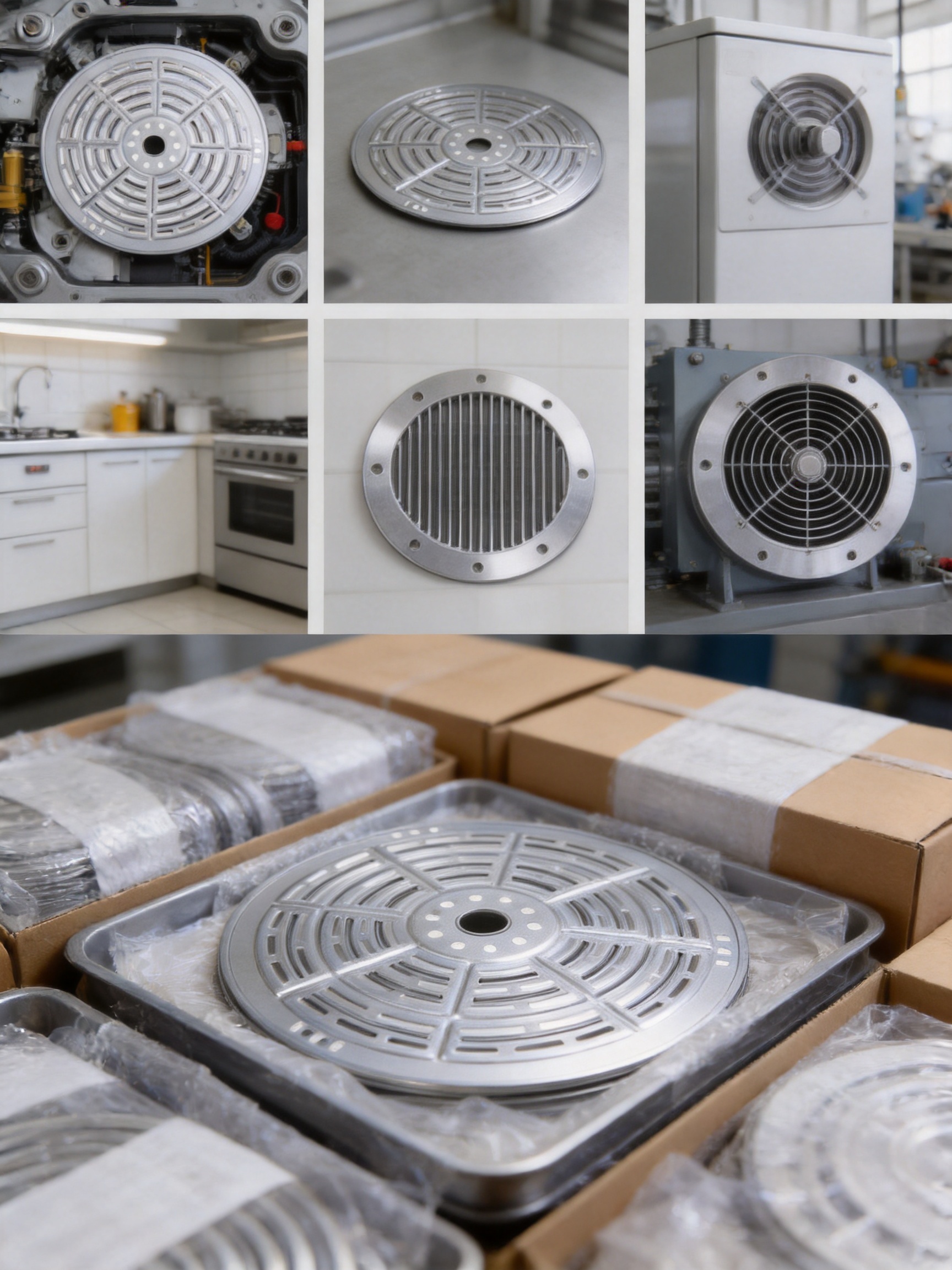
Kitchen appliances often require metal parts that can resist heat, moisture, cleaning agents, and repeated use. Stamped circular parts with holes may be used in heating elements, ventilation areas, mounting assemblies, support structures, filters, or protective internal components. Stainless steel or treated steel may be selected for corrosion resistance and appearance.
Household Electrical Appliances
Small household appliances and electric heaters often depend on precise stamped metal parts for structural support, airflow, heat shielding, and safe assembly. Circular stamped parts can provide reliable positioning and fastening in compact appliance designs. Hole customization can support ventilation, screw mounting, or component alignment.
Automotive Stamping Parts
Automotive applications demand stable quality, durability, and resistance to vibration, temperature change, and corrosion. Stamped circular parts with holes may serve as brackets, washers, covers, spacers, reinforcement discs, or mounting interfaces in vehicle systems. The ability to produce consistent batches is important for automotive supply chains.
Optical and Educational Instruments
Precision stamped metal parts may also be used in optical instruments and educational equipment. In these applications, dimensional accuracy, clean edges, and stable assembly are important. Circular parts with holes can be used for mounting, alignment, protection, or mechanical support within instrument housings.
General Hardware and Custom Assemblies
Many hardware products use simple but precise metal discs and perforated circular parts. These components may be used in furniture, fixtures, tools, lighting products, enclosures, brackets, and custom mechanical assemblies. The combination of economical stamping and customization makes them practical for a wide range of designs.
Advantages Over Competitors
Experience-Based Manufacturing Judgment
More than 20 years of manufacturing experience provides practical knowledge that cannot be replaced by equipment alone. Experienced teams understand how materials behave, how tooling wears, how burrs develop, how flatness changes, and how to adjust processes for stable production. This experience helps prevent problems before they reach the customer.
Broad Product Capability
The manufacturer is not limited to one narrow product type. Capabilities include deep-drawn parts, stamped parts, bending parts, kitchen appliance accessories, automotive stamping parts, hardware products, plastic products, and appliance-related components. This broad capability supports integrated solutions when customers need more than one part type or when a project includes both stamping and forming challenges.
Customization Rather Than Generic Supply
Many suppliers can sell simple metal washers or standard stamped discs, but custom industrial projects often require more. The competitive advantage of these stamped circular parts with holes lies in the ability to customize geometry, material, surface treatment, and production approach according to specific requirements. This reduces the need for customers to compromise their product design around a standard part.
Quality Control from Prototype to Batch
Competitiveness also depends on repeatable quality. A sample may be acceptable, but batch production must remain consistent. The manufacturing process described here emphasizes inspection, tooling control, material selection, and process stability. This helps customers receive parts that match approved samples and drawings.
Strong Support for Long-Term Cooperation
Long-term cooperation requires more than a one-time shipment. It requires communication, responsiveness, stable delivery, and continuous improvement. The company’s business philosophy of integrity, excellence, innovation, and sharing supports a partnership approach. For customers, this means working with a supplier that values reliability and mutual success.
Quality Standards Customers Should Expect
When purchasing stamped circular parts with holes, customers should expect clear documentation and consistent standards. Important items may include drawings, material specifications, tolerance requirements, surface treatment standards, inspection reports, packaging requirements, and sample approval records.
A practical quality process begins with confirming the drawing. The drawing should define the outer diameter, hole dimensions, hole positions, thickness, material, surface treatment, burr requirements, flatness, and any special notes. If the part is safety-related or used in a demanding environment, additional requirements may be needed.
During production, first-piece inspection confirms that the equipment and die setup are correct. Regular in-process inspection helps detect drift caused by die wear, material variation, or press conditions. Final inspection confirms that the batch is ready for delivery. Packaging inspection helps ensure the parts are protected from scratches, deformation, moisture, or mixing.
For customers with strict assembly requirements, customized gauges can improve inspection speed and reliability. For example, a go/no-go gauge may verify hole pattern alignment quickly. A flatness fixture may confirm seating performance. A visual standard may define acceptable surface marks. These tools help align supplier and customer expectations.
Packaging, Handling, and Delivery Considerations
Even a well-made stamped part can be damaged by poor packaging. Circular parts with holes may be scratched, bent, corroded, or mixed if packaging is not properly planned. Packaging should consider part size, material, surface finish, quantity per carton, weight, transportation distance, and customer handling method.
For corrosion-sensitive parts, protective oil, moisture-resistant packaging, or sealed bags may be used. For visible parts, separators or layered packaging may help prevent scratches. For thin parts, rigid cartons or trays may reduce deformation. Clear labeling supports warehouse management and production line efficiency.
Delivery stability is especially important for customers using these parts in ongoing assembly. A good supplier should communicate production schedules, confirm lead times, and support repeat orders. When demand changes, the ability to adjust production planning can help customers avoid shortages or excessive inventory.
Sustainability and Material Efficiency
Metal stamping can support sustainability goals through efficient material utilization and long service life. During tooling design, strip layout and nesting can reduce scrap. Metal offcuts may be collected for recycling. Durable surface treatment can extend product life and reduce replacement frequency.
Lightweight hole design can also contribute to material efficiency. By removing unnecessary material while maintaining strength, the part can reduce weight and resource consumption. In automotive or moving equipment applications, weight reduction may also contribute to energy efficiency.
Sustainability is not only about materials. Stable quality reduces waste caused by defective parts. Accurate production reduces rework. Reliable delivery reduces emergency shipping and production disruption. In this way, a well-managed stamping process contributes to more efficient industrial supply chains.
How to Specify a Custom Stamped Circular Part with Holes
Customers can improve quotation accuracy and development speed by preparing clear information before contacting the manufacturer. The most useful details include part drawings, material grade, thickness, outer diameter, hole diameter, hole quantity, hole position, tolerance requirements, surface treatment, application environment, estimated order quantity, packaging expectations, and sample needs.
If a drawing is not available, a physical sample or sketch may be used as a starting point. The manufacturer can help create or refine technical details based on the intended function. However, final confirmation should always be made through sample approval or drawing approval before mass production begins.
Recommended Specification Checklist
1. Outer diameter and tolerance.
2. Material type and thickness.
3. Hole diameter, number, and pattern.
4. Required flatness and burr direction.
5. Surface treatment and corrosion resistance requirements.
6. Application environment, including heat, moisture, vibration, chemicals, or outdoor exposure.
7. Annual usage or batch quantity.
8. Packaging and labeling requirements.
9. Inspection standards and documentation needs.
10. Sample testing requirements before mass production.
Typical Project Workflow
A typical customized project begins with inquiry and technical communication. The customer provides drawings, samples, or requirements. The manufacturer reviews feasibility, suggests improvements if needed, and provides quotation details. After commercial confirmation, prototype or tooling development begins.
Samples are then produced and inspected. The customer tests fit, function, appearance, and assembly performance. If changes are needed, the design or tooling is adjusted. Once samples are approved, mass production planning begins. The manufacturer prepares materials, schedules equipment, confirms inspection methods, and proceeds with batch production.
After production, parts are inspected, packaged, and shipped. Feedback from the customer is collected for future improvement. For repeat orders, the approved process can be reused, making future production faster and more predictable.
Q&A Section
Q1: What are stamped circular parts with holes used for?
They are used for mounting, spacing, reinforcement, protection, alignment, ventilation, drainage, fastening, and structural support in machinery, appliances, automotive systems, instruments, hardware products, and custom assemblies.
Q2: Can the hole pattern be customized?
Yes. The size, number, location, and arrangement of holes can be customized according to drawings, samples, or application requirements. Hole patterns may include center holes, bolt circles, ventilation holes, slotted holes, or special layouts.
Q3: What materials are available?
Common materials may include carbon steel, stainless steel, galvanized steel, aluminum, copper, brass, and other suitable sheet metals. The best material depends on strength, corrosion resistance, weight, appearance, and cost requirements.
Q4: Are these parts suitable for harsh environments?
Yes, they can be designed for demanding conditions by selecting appropriate materials and surface treatments. Options such as stainless steel, galvanizing, plating, coating, passivation, or protective oil can improve rust resistance, corrosion resistance, and durability.
Q5: How does stamping compare with machining?
Stamping is usually more efficient and economical for medium to high-volume production of sheet metal parts. Machining may be better for low-volume thick parts or complex features that cannot be stamped. For circular sheet parts with repeated hole patterns, stamping often provides the best balance of cost, speed, and consistency.
Q6: Can samples be produced before mass production?
Yes. Sample production and rapid prototyping can be supported so customers can test fit, function, and appearance before approving mass production. This reduces risk and helps optimize the design.
Q7: What information is needed for a quotation?
A drawing or sample is ideal. Useful details include material, thickness, outer diameter, hole pattern, tolerance, surface treatment, quantity, application environment, and packaging requirements.
Q8: How is quality controlled?
Quality control includes material inspection, tooling verification, first-piece inspection, in-process checks, final inspection, and packaging inspection. Key dimensions such as outer diameter, hole diameter, hole position, flatness, burr height, and surface condition can be checked according to customer requirements.
Q9: Can the parts be used in kitchen appliances or automotive applications?
Yes. These parts can be customized for kitchen appliance accessories, household electrical appliances, and automotive stamping applications. Material and surface treatment should be selected according to the specific environment and performance requirements.
Q10: Why choose an experienced stamping manufacturer?
An experienced manufacturer can provide better design feedback, stable tooling, consistent quality, efficient production, and reliable delivery. Experience helps reduce development risk, production defects, and hidden assembly costs.
Conclusion
Stamped circular parts with holes are practical, versatile, and highly valuable components for industrial and mechanical applications. Their circular shape provides balanced geometry, while customized holes enable fastening, positioning, ventilation, drainage, weight reduction, and integration into complex assemblies. When produced with advanced stamping technology, proper material selection, accurate tooling, and strict quality control, these parts deliver precision, durability, and long-term reliability.
The advantages of these parts are especially clear in medium and high-volume production, where stamping offers repeatable accuracy, efficient output, and cost-effective manufacturing. Compared with machining, laser cutting, waterjet cutting, or casting, stamping is often the best solution for thin or medium-thickness sheet metal circular parts requiring consistent hole patterns and stable batch quality.
Behind the product is a manufacturing system built on more than 20 years of experience, a modern factory, multiple stamping workshops, skilled employees, OEM/ODM customization, rapid prototyping, stable production conversion, strict inspection, and comprehensive after-sales support. This combination allows customers to obtain not only a metal part, but also a dependable manufacturing solution.
For buyers seeking stamped circular parts with holes, the key is to choose a supplier that understands both product function and production reality. With the right engineering communication, material selection, tooling strategy, and quality standards, these components can support reliable performance in appliances, automotive systems, industrial machinery, instruments, hardware products, and many other applications.
References
1. Kalpakjian, S., and Schmid, S. R. Manufacturing Engineering and Technology. Pearson Education.
2. Lange, K. Handbook of Metal Forming. Society of Manufacturing Engineers.
3. Altan, T., and Tekkaya, A. E. Sheet Metal Forming: Processes and Applications. ASM International.
4. ASM International. ASM Handbook, Volume 14B: Metalworking: Sheet Forming. ASM International.
5. Boljanovic, V. Sheet Metal Forming Processes and Die Design. Industrial Press.
6. Society of Manufacturing Engineers. Tool and Manufacturing Engineers Handbook: Forming. SME.
Product: Stamped circular parts with holes
Previous Post
Precision Stamped Parts with a Polka Dot Pattern Base for Functional and Decorative Applications
Next Post
Precision Red Bent Parts with Integrated Fabric Straps for Reliable Industrial and Commercial Use
News
-
-
What Are Stamped Parts? Stamped parts are metal components produced by pressing flat sheet metal between a die and a punch to cut, bend, or...
READ MORE -
Sheet metal is one of those materials that quietly holds everyday life together. The tray inside your air fryer, the bracket behind a car b...
READ MORE -
Sheet metal bending is one of the most fundamental processes in metal fabrication. It turns a flat sheet of steel, aluminum, or copper into...
READ MORE
Get Fresh Updates Via Email
We promise we will never disclose your email address, and you can opt out at any time.
-
Quick Links
Home About Us Products Service News Contact Us -
Product list
Deep-drawn parts Stamped parts Bending parts Kitchen appliance accessories Automotive stamping parts -
About Us
Factory Honour FAQ -
News
Company News Industry News -
Contact Us
Address: South side of Shunke Road, Yangming Science and Technology Industrial Park, Yuyao City, Zhejiang Province, China Tel: +86-13905842349/+86-13738485724 Email: hongli@hl-stamping.com
Copyright © Yuyao Hongli Optoelectronics Co., Ltd. All Rights Reserved.
Custom Precision-Sheet/Sheet Metal Stamping Manufacturers
