


 English
 русский
 Español
 عربى
عربى

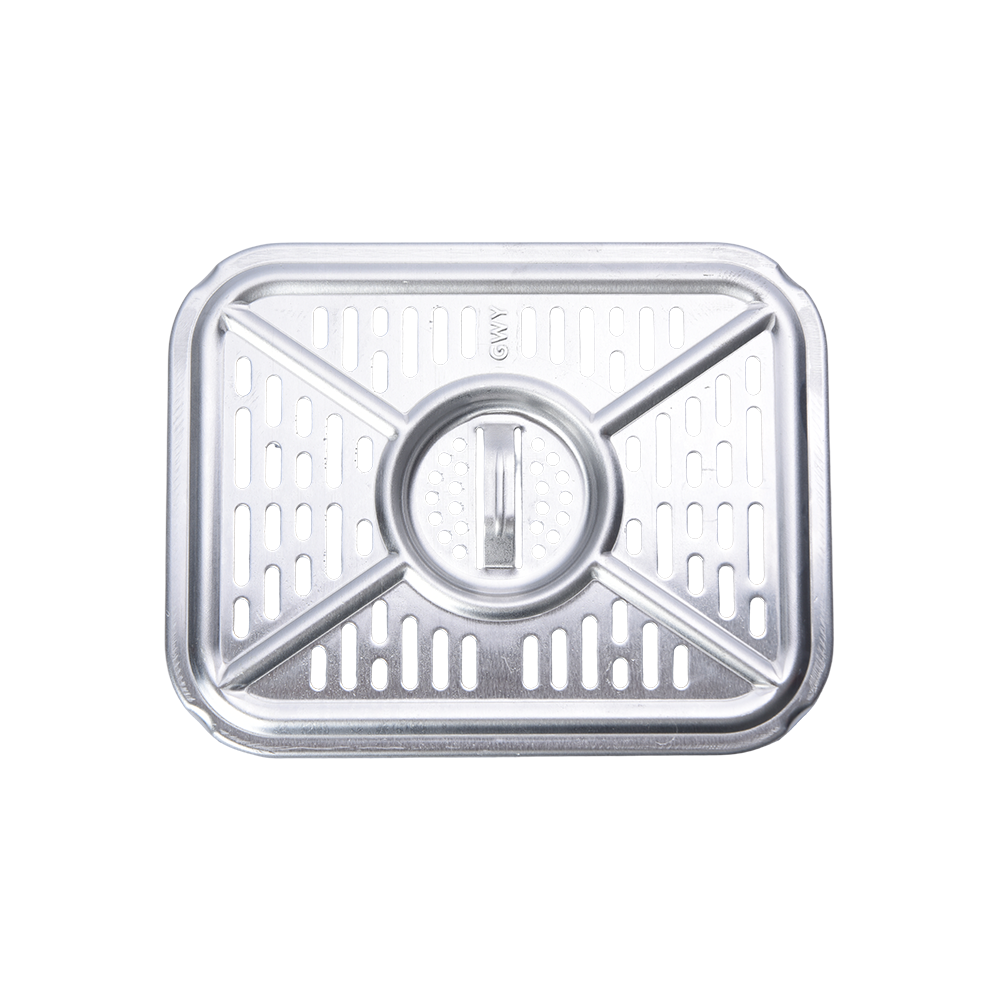
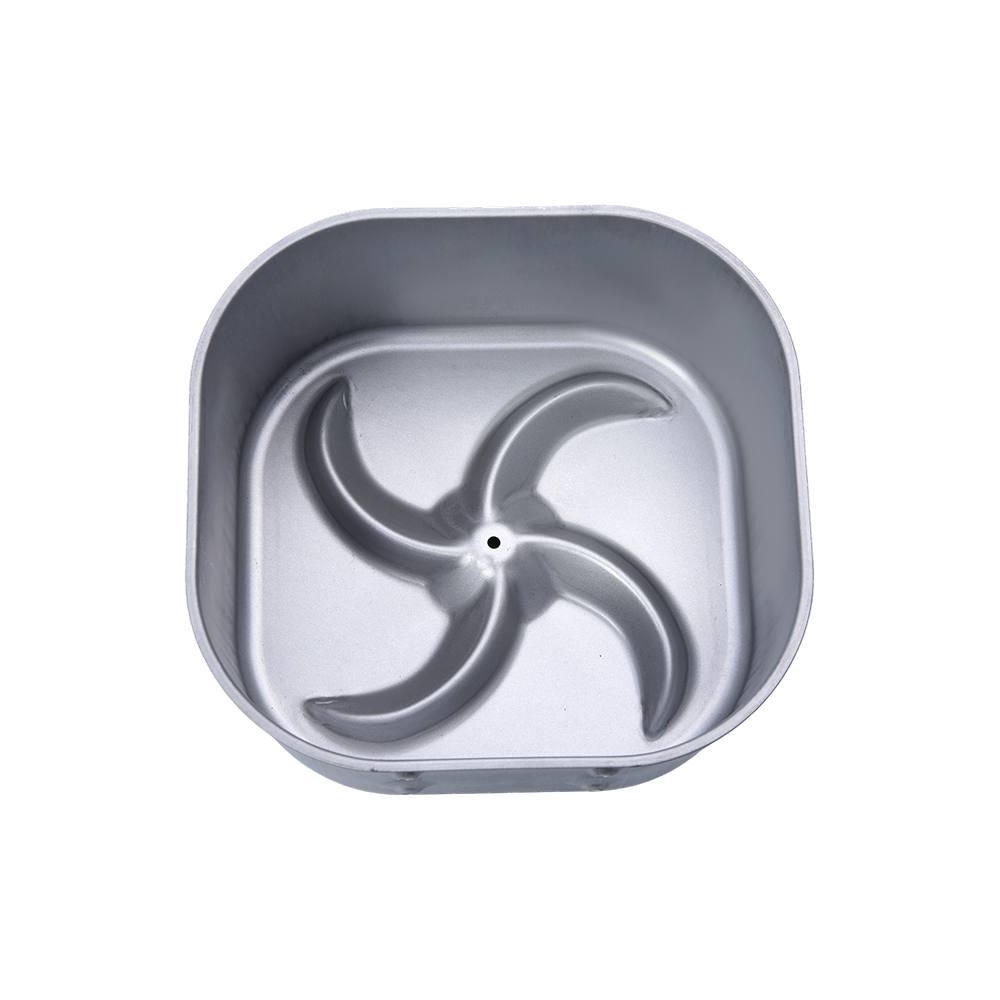
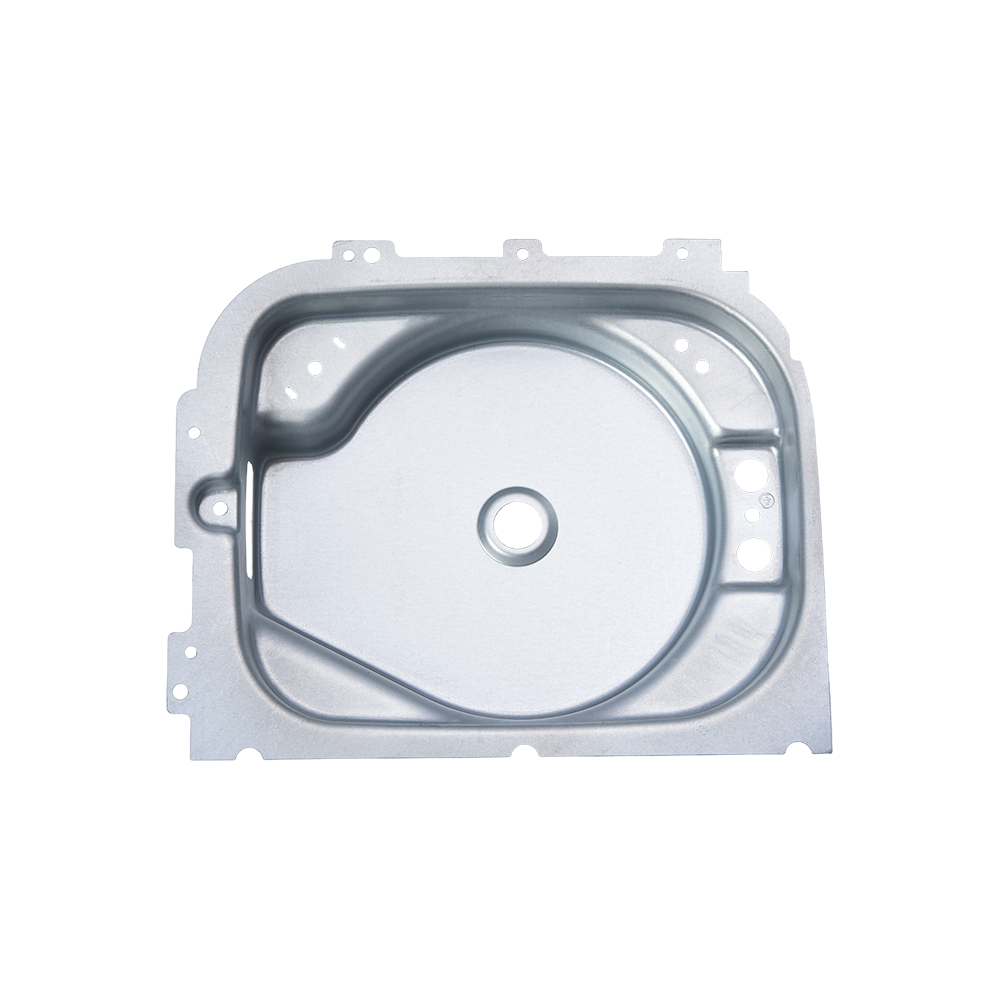
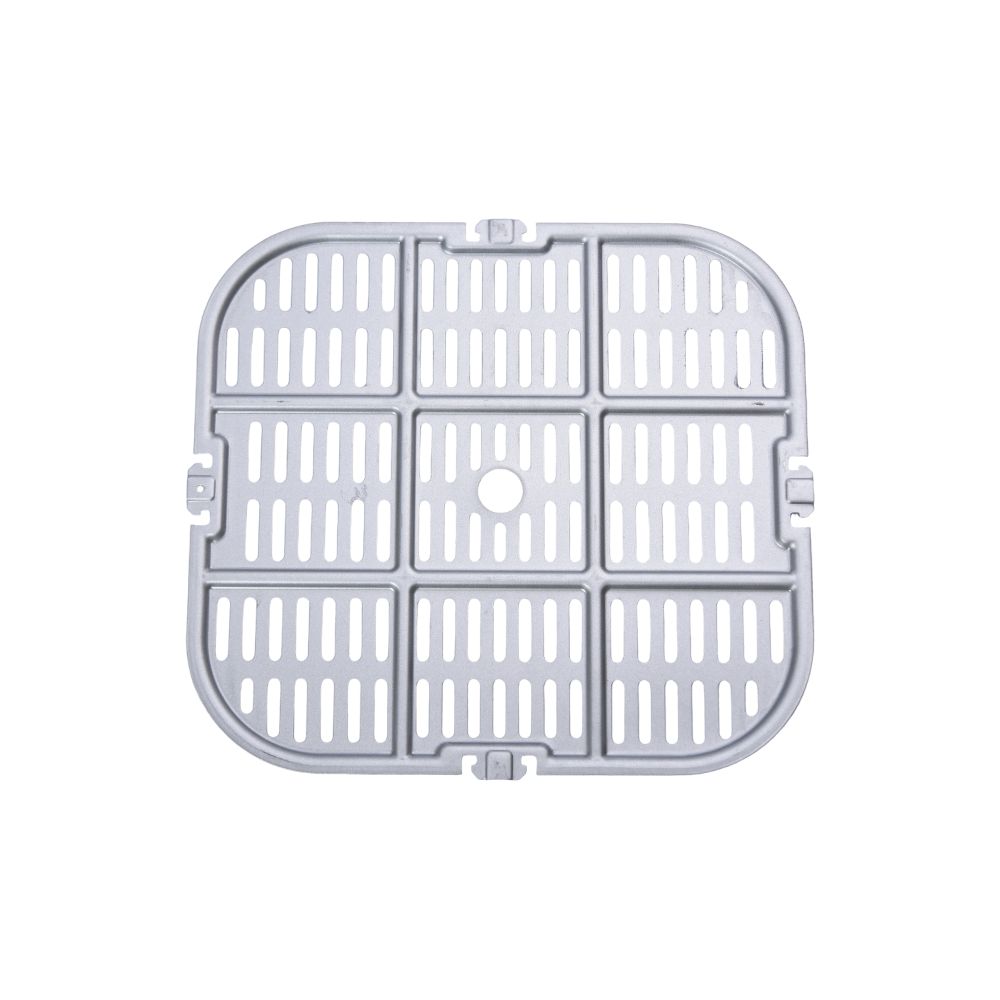
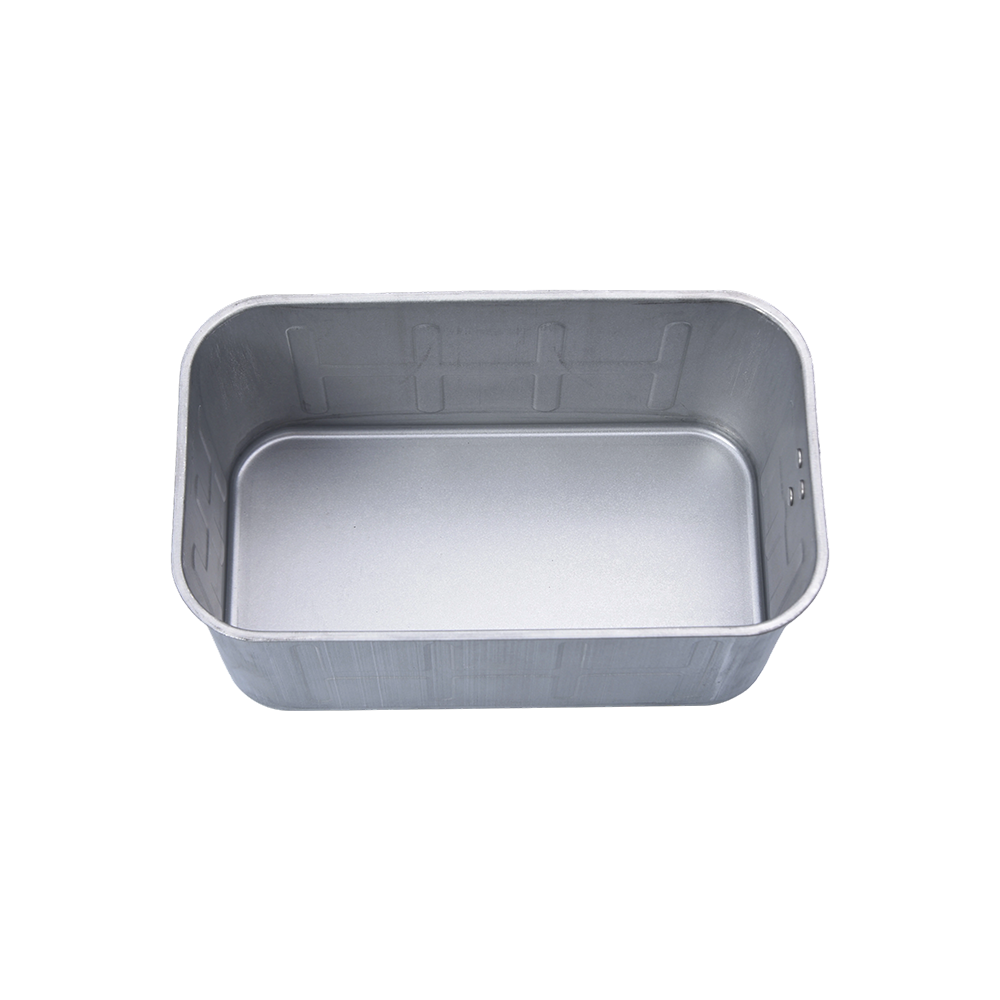
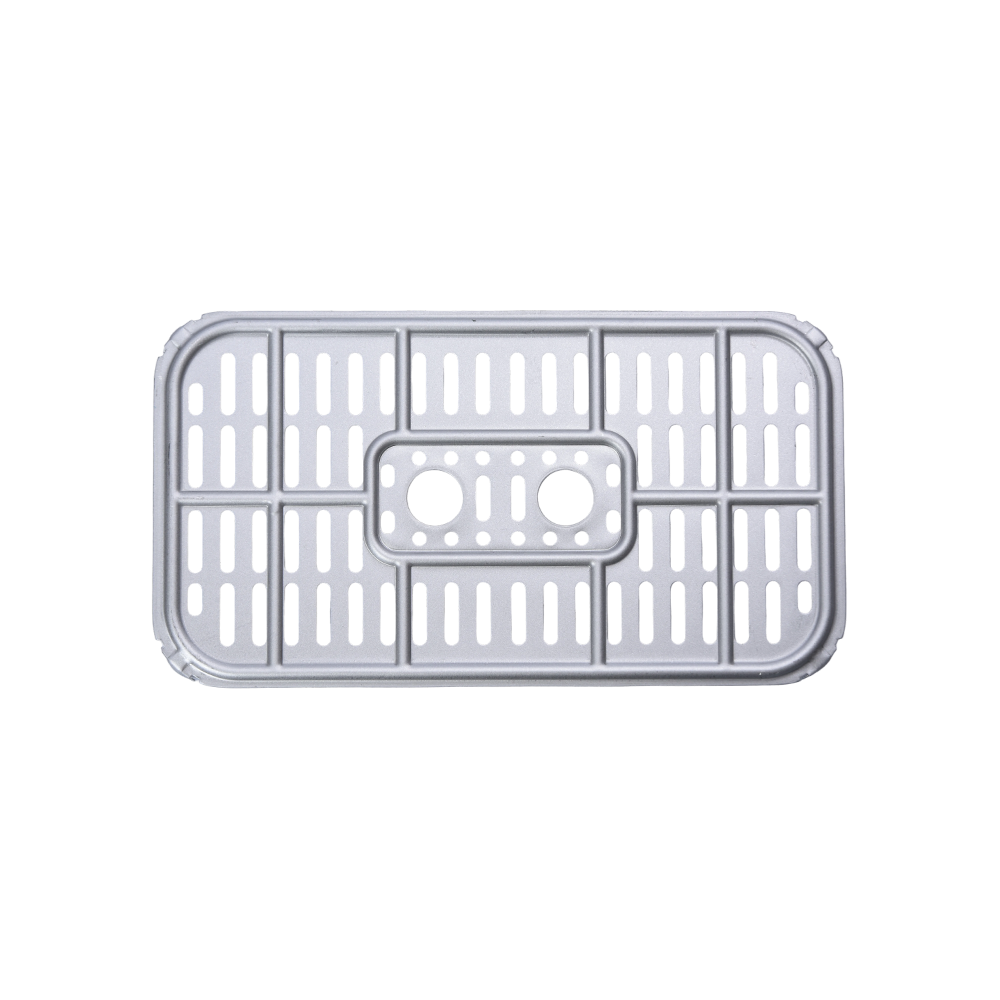
What Are Stamped Parts? Stamped parts are metal components produced by pressing flat sheet metal between a die and a punch to cut, bend, or...
READ MORE

News
Home / Author / Zhang Meilin — Product Sales Consultant / Air Fryer Containers: Performance, Manufacturing Excellence, and Reliable OEM Solutions
Air Fryer Containers: Performance, Manufacturing Excellence, and Reliable OEM Solutions
2026-08-04
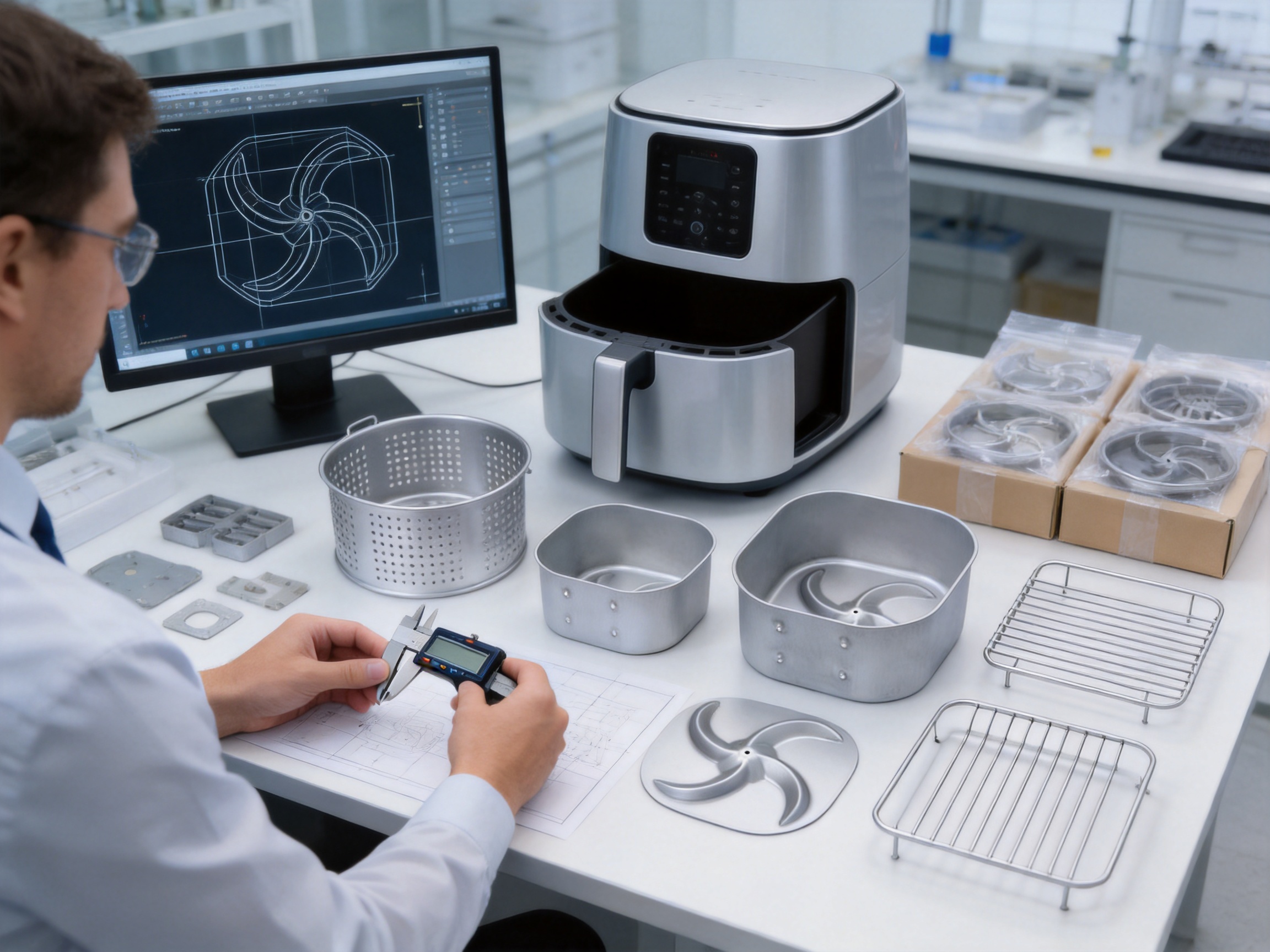
The air fryer container is one of the most important internal components in a modern air fryer. Although it may appear to be a simple metal insert, its design, material quality, dimensional accuracy, surface condition, and airflow performance all directly influence cooking results, user safety, cleaning convenience, and the service life of the appliance.
A well-designed air fryer container creates a stable cooking space inside the appliance. It supports food during cooking, permits hot air to circulate around the ingredients, withstands repeated heating and cooling cycles, and remains easy to clean after exposure to oil, moisture, seasoning, and food residue. For appliance manufacturers, distributors, and product developers, selecting the right container is therefore a technical and commercial decision rather than a basic component purchase.
Yuyao Hongli Optoelectronics Co., Ltd. manufactures air fryer containers as part of its broader portfolio of kitchen appliance accessories, deep-drawn parts, stamped parts, bending parts, and automotive stamping parts. With more than 20 years of manufacturing experience, a modern factory in Yuyao, Zhejiang Province, and capabilities covering tooling, metal forming, processing, customization, and quality control, the company provides practical solutions for customers seeking dependable metal components for air fryers and other small household appliances.
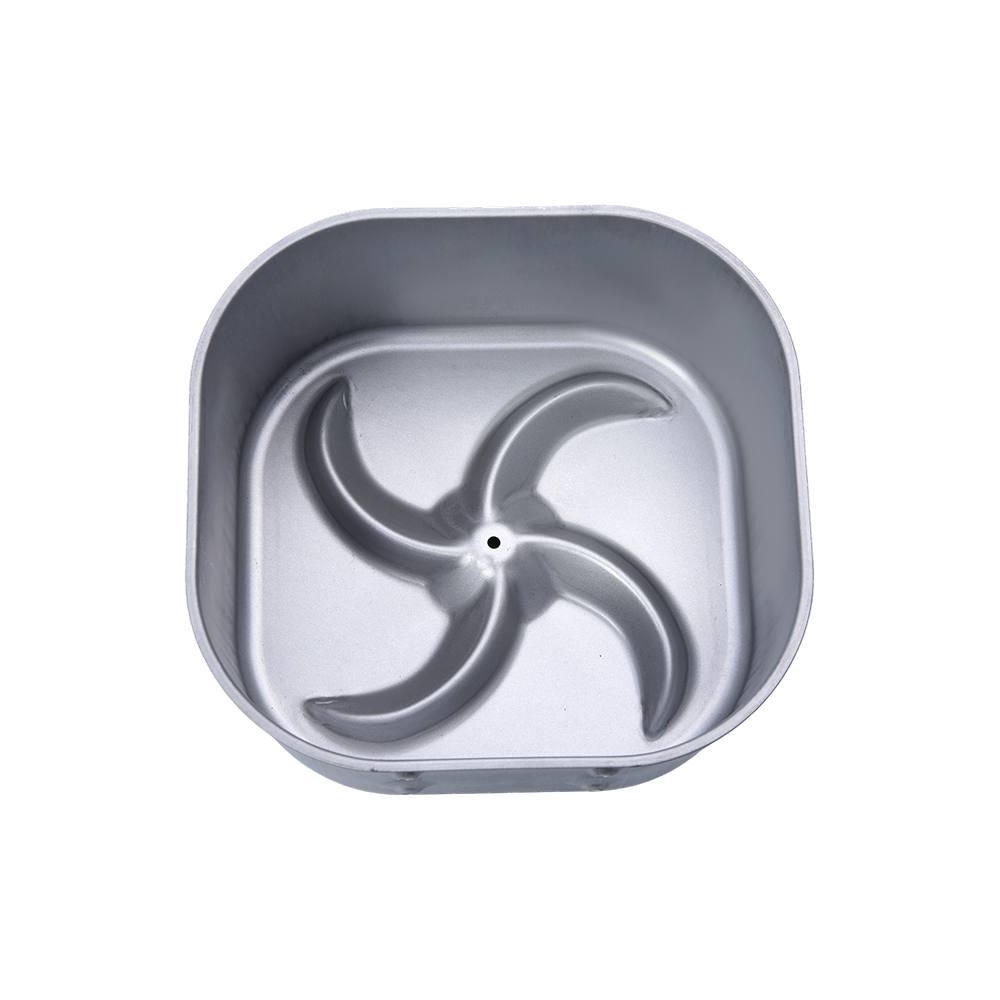
Air Fryer Container
Why the Air Fryer Container Matters
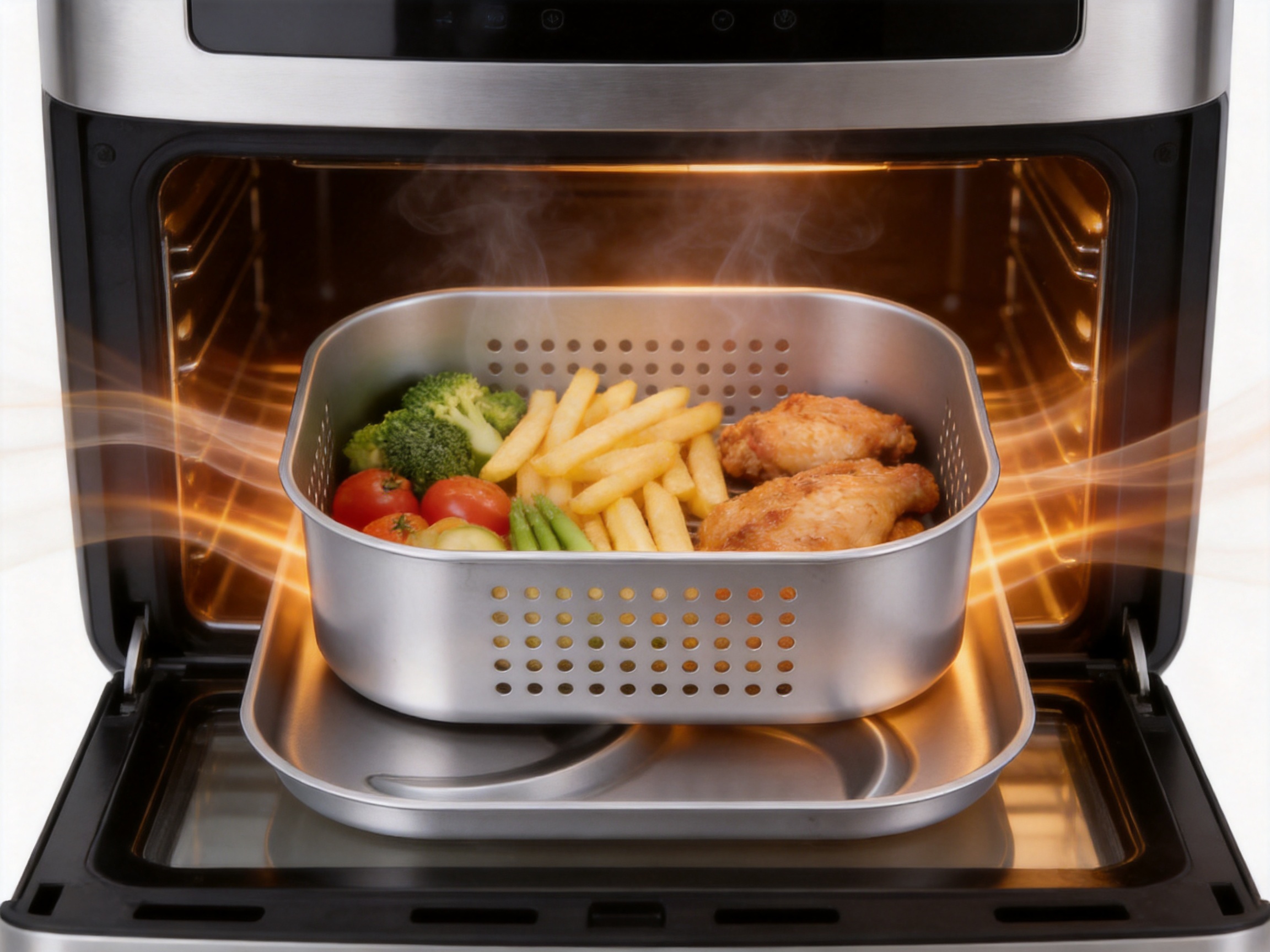
An air fryer depends on the controlled movement of heated air. Unlike conventional frying, the cooking process uses circulating hot air to transfer heat to the surface of food while reducing the need for large quantities of cooking oil. The container placed inside the appliance must support this airflow while also holding the food securely and protecting the outer appliance structure from grease and heat.
The inner container typically has a perforated, mesh, or specially formed design. Openings in the base or side walls allow hot air to move around the food. When the opening pattern is properly engineered, it helps reduce stagnant areas and encourages more uniform cooking. This can contribute to a crisp surface, balanced browning, and a more consistent result across different types of food.
Dimensional accuracy is equally important. If an inner pot is too large, it may interfere with the heating element, fan, basket, or outer drawer. If it is too small, it may move during use, reduce usable capacity, or create an unstable cooking environment. Correct geometry ensures that the container sits securely and works smoothly with the appliance body, handle assembly, rack, and surrounding components.
The container also experiences demanding operating conditions. It can be exposed to high temperatures, repeated thermal expansion and contraction, water, salt, acidic ingredients, cooking oil, detergents, and mechanical contact during loading and cleaning. Inferior materials or poor surface treatment may result in discoloration, rust, corrosion, deformation, flaking, or difficult-to-remove residue.
For these reasons, the container should be evaluated as a functional engineered part. Its performance depends on the relationship between material selection, sheet thickness, forming method, hole design, edge treatment, surface finish, dimensional control, and final inspection.
Core Advantages of a High-Quality Air Fryer Container
High-Temperature Resistance
Air fryer containers must operate reliably in a heated chamber. The selected material and manufacturing process should enable the component to retain its shape during normal cooking cycles. A stable container reduces the risk of warping, interference with nearby components, or changes in the cooking position.
High-temperature resistance is not limited to the maximum temperature reached during a single use. Repeated heating and cooling cycles can create stress within the metal. Over time, poor-quality components may lose their dimensional stability. A properly formed and finished container is designed to maintain its functional shape through frequent household use.
Yuyao Hongli Optoelectronics applies metal forming and stamping expertise to produce components with controlled geometry. This experience is valuable because the forming process influences the distribution of material, the shape of corners, the flatness of the base, and the consistency of the finished part.
Rust and Corrosion Resistance
Food preparation environments are naturally exposed to moisture and corrosive substances. Water, salt, marinades, acidic sauces, and cleaning agents may remain on the container if it is not cleaned immediately after use. A corrosion-resistant surface helps preserve both appearance and performance.
Rust resistance also contributes to consumer confidence. Users expect an internal cooking component to remain clean-looking and hygienic through repeated use. A surface that resists corrosion is easier to maintain and less likely to develop rough areas where grease and food residue can accumulate.
Material selection, surface treatment, and post-forming handling all affect corrosion performance. Scratches, burrs, unclean edges, or damaged coatings can create vulnerable areas. For that reason, manufacturing quality must be managed throughout the process rather than assessed only at the final packaging stage.
Efficient Hot-Air Circulation
The perforated or mesh structure is a defining feature of many air fryer containers. It allows hot air to contact more of the food surface, supporting the cooking principle of the appliance. A suitable opening size and distribution can improve ventilation while retaining smaller food pieces and preventing excessive contact with the heating system.
Hole placement must be considered together with the container shape. The base, side wall, corners, and raised sections may require different patterns. If openings are too concentrated in one area, airflow may become uneven. If they are too large or poorly positioned, food may fall through or the container may lose structural strength.
Precision stamping and forming help create repeatable opening patterns. Consistency is particularly important for OEM production because every container in a batch must work with the same appliance design. Stable tooling and controlled processing reduce variation between parts and support predictable assembly.
Easy Cleaning and Maintenance
Air fryer users value convenience. A container that resists grease, stains, and food residue can significantly reduce cleaning time. Smooth surfaces, properly finished edges, and an appropriate surface treatment help prevent residue from becoming trapped in scratches, burrs, or irregular corners.
Cleanability is also connected to product longevity. When a container is easy to wash, users are more likely to clean it regularly. This helps limit the buildup of oil and burned food particles, preserving the appearance and functional condition of the component.
The design should avoid unnecessary grooves or inaccessible recesses. Where forming requires corners or transitions, those areas should be shaped and finished carefully. A well-controlled manufacturing process can improve the consistency of these details across the entire production run.
Mechanical Strength and Stability
The container must support food and withstand normal handling. Users may place frozen products, cookware-safe accessories, or heavy portions inside the basket. They may also remove the container repeatedly, wash it, stack it, or place it on a countertop.
A strong structure helps prevent denting and deformation. The base should remain stable, while the walls and rim should resist accidental impact during ordinary use. Reinforcing features, formed ribs, rolled edges, or carefully selected material thickness may be used where necessary to balance strength and weight.
Strength must be achieved without making the component unnecessarily heavy or expensive. This is one area where engineering experience and forming knowledge provide a practical advantage. The goal is a container that feels durable while remaining suitable for efficient mass production and convenient appliance handling.
Reliable Compatibility
Compatibility is more than matching an overall length and width. An air fryer container must work with the appliance drawer, handle, rack, heating system, fan airflow, and safety clearances. Small dimensional differences can affect insertion, removal, cooking capacity, and user experience.
A reliable supplier should be able to work from drawings, samples, three-dimensional models, or detailed customer requirements. The supplier should also understand how tolerances, forming angles, hole patterns, and edge conditions influence final assembly.
Yuyao Hongli Optoelectronics supports OEM and ODM customization, allowing customers to develop containers according to their own appliance structures. This is useful for brands that require a proprietary capacity, a special perforation pattern, a specific rim design, or a customized surface treatment.
Comparison with Inferior or Generic Alternatives
Low-cost generic containers may appear attractive during initial purchasing, but the lowest unit price does not always represent the lowest total cost. A component with poor dimensional consistency can create assembly problems, increase inspection requirements, and lead to customer complaints.
Inferior materials may discolor or corrode more quickly. Inconsistent forming can produce uneven walls, unstable bases, sharp edges, or incorrect fit. Poorly controlled holes may contain burrs or vary in size, affecting airflow and food retention. These problems may not be obvious during a visual review of a single sample, but they can become significant during long-term use or large-volume production.
A higher-quality air fryer container offers advantages in several areas:
| Evaluation Area | High-Quality Container | Generic or Poorly Controlled Alternative |
|---|---|---|
| Dimensional accuracy | Consistent geometry designed for secure appliance fit | Variation may cause loose, tight, or unstable installation |
| Airflow performance | Controlled perforation pattern supports even circulation | Irregular openings may reduce ventilation or retain food poorly |
| Surface condition | Smooth, clean, and carefully finished surfaces | Burrs, rough areas, scratches, or inconsistent treatment |
| Heat-cycle durability | Designed for repeated heating and cooling | Greater risk of warping or premature deterioration |
| Corrosion resistance | Suitable material and finish for food-contact conditions | Potential for rust, staining, or surface degradation |
| Cleaning convenience | Fewer residue-trapping areas and easier maintenance | Grease and food particles may collect in defects |
| OEM flexibility | Can be developed according to drawings and samples | Limited sizes, patterns, and structural options |
| Production consistency | Controlled tooling and inspection support repeatability | Batch-to-batch differences may be more common |
These differences influence the appliance brand’s reputation. A container that fits accurately, cleans easily, and remains attractive after repeated use contributes to a better overall product experience. It can also reduce after-sales issues related to rust, deformation, poor assembly, or dissatisfaction with cooking performance.
Manufacturing Processes Used for Air Fryer Containers
The performance of an air fryer container begins with the manufacturing process. Metal forming is a sequence of carefully controlled operations rather than a single action. Each stage affects the final appearance, strength, accuracy, and cost of the part.
Product Design and Engineering Review
Before production begins, the supplier reviews the customer’s drawings, samples, capacity requirements, material specifications, opening pattern, assembly interfaces, and expected annual volume. This stage identifies potential forming difficulties and helps determine whether the part should be produced by deep drawing, stamping, bending, progressive operations, or a combination of methods.
The engineering review may examine wall height, corner radii, base flatness, rim design, hole spacing, material flow, and tolerance requirements. It may also consider how the container will be cleaned, packaged, installed, and removed by the end user.
Early technical communication helps avoid preventable tooling changes. When the design, forming method, and inspection requirements are considered together, customers can achieve a better balance between product performance and production efficiency.
Material Preparation
Suitable sheet metal is selected according to the intended application and customer requirements. Important considerations may include heat resistance, corrosion resistance, formability, strength, surface appearance, thickness, and compatibility with the required finishing process.
Material preparation includes checking the incoming sheet or coil for thickness, flatness, surface quality, and visible defects. Clean and consistent material supports stable forming and reduces the risk of scratches, cracks, or uneven surfaces in the finished container.
For high-volume production, controlled material sourcing is especially important. Consistency in the raw material helps maintain repeatable forming behavior and reduces adjustments during stamping or deep drawing.
Blanking and Stamping
Blanking cuts the basic shape from sheet material, while stamping may create holes, edges, ribs, mounting points, or other features. The tooling must be designed to control cutting clearance, prevent excessive burrs, and preserve the required shape.
Stamping is particularly useful for producing repeated perforation patterns. Accurate dies can create a large number of openings efficiently while maintaining consistent spacing. The process also supports scalable production for customers that require substantial quantities of identical containers.
Yuyao Hongli Optoelectronics has extensive experience in metal stamping parts and related products. Its stamping workshops and production resources provide a foundation for manufacturing components that require repeatable cutting and forming operations.
Deep Drawing and Container Forming
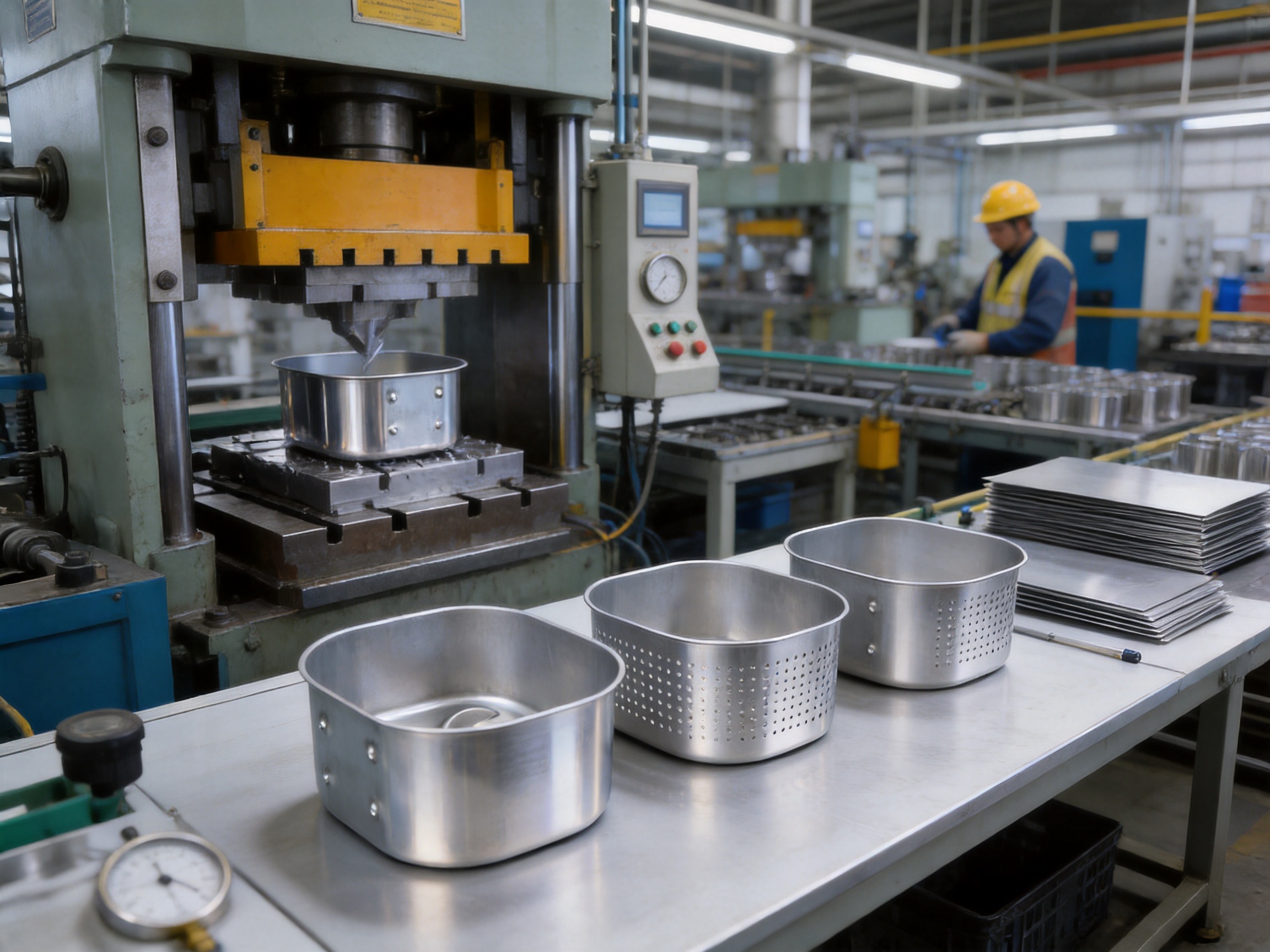
Deep drawing is commonly used when a flat sheet must be transformed into a container-like shape with a defined depth. The process uses a punch and die to draw the material into the required form. Depending on the geometry, multiple forming operations may be used to achieve the final depth without excessive thinning, wrinkling, or cracking.
Deep drawing requires careful control of material flow. The tooling design, blank holder pressure, lubrication, punch radius, die radius, and forming speed can all influence the result. A well-planned process helps maintain wall uniformity and reduces distortion.
The company’s experience with deep-drawn parts is directly relevant to air fryer containers. This capability enables the production of inner pots and related metal components with controlled depth, consistent corners, and reliable integration into the appliance structure.
Bending and Edge Formation
Bending operations may be used to create rims, flanges, support sections, side features, or reinforcing elements. Correct bend angles and radii are important for both structural performance and user safety.
Edges should be designed and processed to minimize sharp areas. Depending on the product design, the rim may be folded, rolled, or otherwise finished to create a more comfortable handling surface. Edge formation can also improve rigidity and help the container maintain its shape.
Because bending follows or interacts with other forming steps, the sequence of operations must be carefully planned. Incorrect sequencing may cause springback, misalignment, surface marks, or interference with subsequent stamping operations.
Surface Treatment and Finishing
Surface finishing helps protect the container and contributes to its appearance and cleanability. The exact treatment depends on the material, design, customer requirements, food-contact expectations, and intended market.
Finishing operations may include cleaning, deburring, polishing, passivation, coating, or other specified treatments. The objective is to provide a clean, even surface while maintaining the dimensional requirements of the container.
Quality control at this stage is important because surface defects can affect both appearance and performance. The finished component should be checked for scratches, stains, unprocessed burrs, uneven treatment, and other visible abnormalities.
Assembly and Final Inspection
Some air fryer containers are supplied as standalone inner pots, while others may be integrated with racks, handles, supports, or additional accessories. Where assembly is required, each connection should be checked for alignment, strength, and safe handling.
Final inspection may include visual inspection, dimensional measurement, fit testing, hole-pattern verification, edge inspection, and functional checks based on the customer’s specifications. Inspection standards should be agreed upon before mass production so that both supplier and customer share the same acceptance criteria.
Manufacturing Strengths of Yuyao Hongli Optoelectronics
Yuyao Hongli Optoelectronics Co., Ltd. was founded in 2000 and has developed from its former name, Yuyao Hongli Optoelectronics Educational Instruments Co., Ltd., into a comprehensive manufacturing enterprise. The company is located in Yangming Science and Technology Industrial Park, Yuyao City, Zhejiang Province, China, a region with a strong industrial base and extensive manufacturing supply chains.
The company operates a modern factory of approximately 5,000 square meters and has more than 60 employees. Its production organization includes multiple stamping workshops and capabilities covering manufacturing, processing, wholesale, retail, import, and export. This combination supports both component production and broader customer service requirements.
Although the company supplies many product categories, its metal-processing experience is particularly valuable for air fryer container development. Deep-drawn parts, stamped parts, bending parts, household electric heater components, small household appliance parts, hardware products, and automotive stamping parts all require attention to material behavior, tooling, dimensional control, and production stability.
Experience Across Multiple Industries
Experience across industries can strengthen product development because different applications require different types of precision. Automotive stamping parts demand repeatability and structural reliability. Household appliance parts require attention to appearance, safe handling, corrosion resistance, and practical assembly. Deep-drawn components require control over material flow and shape retention.
This combined experience gives the company a broad understanding of metal forming challenges. The same principles used to control a vehicle hardware component or a household heater part can be adapted to the geometry and functional demands of an air fryer container.
OEM and ODM Customization
Standard containers may not meet the requirements of every air fryer brand. Appliance manufacturers may need a special internal diameter, a different depth, a customized hole pattern, a particular rim, a unique support structure, or a proprietary appearance.
OEM production enables the customer to provide its own design and receive components manufactured according to that design. ODM cooperation can involve deeper support during product development, including recommendations related to forming, structure, materials, and production feasibility.
Customization is most effective when it begins early. Sharing drawings, product samples, three-dimensional files, target quantities, performance expectations, and packaging requirements allows the manufacturer to propose a more suitable process. The result can be a component that satisfies both technical and commercial goals.
Rapid Prototyping and Production Conversion
New appliance projects often move from concept to launch under strict time constraints. A supplier that can support rapid prototyping helps the customer verify dimensions, fit, appearance, handling, and cooking-related features before committing to full-scale production.
Prototype development may identify issues such as an overly tight fit, insufficient clearance, unstable support, unsuitable perforation spacing, or an edge that requires improvement. Correcting these matters at the prototype stage is generally more efficient than changing production tooling after a large order has begun.
After approval, an experienced manufacturer can convert the validated design into a stable production process. This transition requires the coordination of tooling, material procurement, stamping schedules, inspection procedures, packaging, and delivery planning.
Quality Control and Delivery Stability
Quality control is essential for components that are installed inside a heated food appliance. It should cover incoming materials, tooling condition, in-process forming, surface treatment, final dimensions, and packaging.
Stable delivery is also important. Appliance manufacturers often coordinate container production with the assembly of heating elements, electrical systems, plastic housings, baskets, handles, and packaging materials. Delayed metal components can interrupt the entire production schedule.
Yuyao Hongli Optoelectronics emphasizes strict quality control, stable delivery, and comprehensive after-sales service. These strengths support long-term cooperation by helping customers manage both product quality and supply continuity.
Integrated Customer Communication
Successful custom manufacturing depends on clear communication. Technical drawings should define critical dimensions, tolerances, materials, surfaces, hole patterns, inspection points, and packaging. Commercial discussions should clarify order quantities, lead times, sample approval, tooling ownership, and change-control procedures.
A responsive manufacturer can help identify practical improvements before they become production problems. For example, a small change to a corner radius may improve drawability, while a revised hole arrangement may preserve strength and improve airflow. A modified rim may make the container easier to remove and safer to handle.
The company’s business philosophy of integrity, excellence, innovation, and sharing reflects the importance of cooperation in customized manufacturing. These principles are particularly relevant when the supplier is expected to contribute engineering knowledge rather than simply produce a fixed catalog item.
Design Considerations for Air Fryer Container Development
Capacity and Internal Dimensions
The container should provide sufficient cooking capacity without reducing airflow or creating interference inside the appliance. The usable volume depends on the base area, wall height, corner shape, and position of the food relative to the heating element.
Designers should consider not only the nominal dimensions but also the actual usable area. A container with a deep but narrow shape may have a different cooking behavior from a wider, shallower design. The best geometry depends on the air fryer’s power, fan arrangement, intended food portions, and overall product positioning.
Perforation Pattern
The opening pattern should support air circulation while retaining the intended food sizes. Hole diameter, spacing, distribution, and edge distance all influence performance. The pattern should also avoid creating weak sections that may deform during use.
Perforations near corners may require special attention because the forming process can alter their shape or position. If holes are stamped before deep drawing, their deformation must be considered. If they are created after forming, tooling access and part stability must be evaluated.
Rim and User Handling
The rim is an important interface between the container and the user. It may provide stiffness, support the container in a drawer, or interact with a removable basket. It should be free of sharp burrs and suitable for repeated handling.
A carefully formed rim can improve the perceived quality of the appliance. Users often judge a product by how smoothly the basket inserts, how securely it rests, and how easy it is to lift after cooking. These details can distinguish a well-developed component from an inexpensive generic replacement.
Material Thickness and Weight
Thickness affects strength, forming behavior, heat response, weight, and cost. An overly thin container may be vulnerable to denting or deformation, while an unnecessarily thick container can increase material consumption and appliance weight.
The correct thickness should be determined through engineering review and prototype testing. It should account for the container’s dimensions, perforation percentage, support structure, expected load, thermal cycling, and handling conditions.
Surface Appearance
Many air fryer containers are visible when the drawer or basket is removed. A consistent surface appearance supports the appliance’s premium impression. Uniform finishing, clean edges, and the absence of obvious scratches or stains can increase customer satisfaction.
Appearance requirements should be defined clearly. Customers may specify a matte, polished, coated, or otherwise treated surface. The chosen finish should be compatible with the forming process and should not compromise dimensional accuracy or long-term durability.
Application Benefits for Appliance Brands
For air fryer brands, a reliable container supplier can provide benefits beyond the component itself. A well-engineered container may help improve the product’s cooking consistency, perceived quality, maintainability, and differentiation in a competitive market.
One important benefit is product reliability. When the container maintains its shape and resists corrosion, the appliance is more likely to perform consistently throughout its intended service life. This can reduce replacement requests and protect the brand’s reputation.
Another benefit is manufacturing efficiency. Accurate components require fewer assembly adjustments and reduce the likelihood of line stoppages. Consistent hole patterns, stable dimensions, and controlled edges simplify inspection and installation.
Customization also gives brands greater design freedom. Instead of adapting an appliance around an available generic container, the brand can develop the container together with the appliance. This supports distinctive capacities, basket designs, airflow concepts, and visual details.
For distributors and replacement-part suppliers, durable containers can create a stronger aftermarket offering. Customers are more likely to purchase a replacement part when it fits correctly, is easy to clean, and provides confidence in long-term use.
Quality Verification and Recommended Inspection Points
Every customer may define its own quality requirements, but several inspection points are generally important for air fryer containers.
Dimensional Inspection
Critical dimensions may include external diameter, internal diameter, overall height, base dimensions, rim position, support locations, and hole spacing. Measurement methods should be selected according to the required tolerance and production volume.
Dimensional inspection confirms that the container fits the appliance and maintains the intended cooking capacity. For custom orders, a first-article inspection can be used to verify the approved design before mass production.
Visual and Surface Inspection
Inspectors should check for dents, cracks, scratches, discoloration, stains, incomplete forming, unprocessed burrs, and other visible defects. The inspection should cover both the cooking surface and areas that may contact the appliance housing.
Surface inspection is especially important for food-related components. Clean handling and suitable packaging should be used after finishing to prevent contamination or damage before delivery.
Edge and Burr Inspection
Edges should be checked manually or with appropriate inspection methods to ensure they are safe to handle. Stamped openings should be examined for burrs, sharp projections, and deformation.
Proper die maintenance and deburring procedures help control these risks. Edge quality should be verified not only on the outer rim but also around perforations, slots, corners, and any cutout features.
Fit and Functional Inspection
A sample container may be placed into a representative appliance or checking fixture to confirm insertion, removal, stability, clearance, and interaction with adjacent parts. This type of inspection can reveal issues that dimensional measurements alone may not detect.
Where required, customers may also establish tests for load support, repeated insertion and removal, thermal cycling, cleaning exposure, or corrosion resistance. The specific test conditions should be agreed upon according to the intended product and market.
Why Yuyao Is a Strategic Manufacturing Location
Yuyao, Zhejiang Province, is an established manufacturing area with strong capabilities in hardware, plastic products, household appliances, electrical components, and related industrial supply chains. A supplier located within this environment can benefit from access to material providers, tooling resources, processing partners, packaging services, and logistics networks.
For international customers, location within a mature manufacturing region can support efficient coordination between different suppliers. It may be easier to integrate a metal container with plastic appliance housings, electrical assemblies, fasteners, handles, and packaging components produced nearby.
Yuyao Hongli Optoelectronics’ location in Yangming Science and Technology Industrial Park provides a practical base for serving domestic and international customers. The company supports import and export activities and has experience serving different product sectors with customized metal components.
From Prototype to Mass Production
A successful air fryer container project normally progresses through several stages. The first stage is requirement definition. The customer provides the appliance architecture, target capacity, design drawings or samples, material expectations, surface requirements, estimated quantity, and delivery schedule.
The second stage is technical evaluation. The manufacturer reviews whether the proposed geometry can be formed efficiently and whether changes are advisable. Potential improvements may relate to draw depth, corner radius, opening design, rim structure, material utilization, or inspection access.
The third stage is prototype production. Prototype samples allow the customer to check fit, appearance, handling, and overall integration. If the container is part of a new air fryer, the prototype can be evaluated together with the heating system and basket assembly.
The fourth stage is tooling preparation and process validation. Production dies, fixtures, inspection gauges, and work instructions are prepared. Initial production parts are checked against the approved specifications.
The final stage is regular production and continuous quality monitoring. Material batches, tooling condition, process settings, inspection results, packaging, and delivery records should be managed consistently. If the customer changes the appliance design, the change should be reviewed before implementation.
This structured approach helps reduce development risk and supports a smoother transition from an idea to a market-ready kitchen appliance component.
Sustainability and Efficient Material Use
Metal forming can support efficient material use when the blank size, nesting arrangement, forming sequence, and scrap management are carefully planned. Reducing unnecessary scrap can lower production costs and reduce the environmental impact associated with raw material consumption.
Durability also has a sustainability benefit. A container that remains functional for a longer period is less likely to require premature replacement. Resistance to rust, deformation, and surface deterioration supports longer product life and better resource efficiency.
Manufacturers can also improve efficiency by optimizing tooling, reducing rework, controlling defects, and organizing production schedules effectively. These practices benefit both the environment and the customer’s total cost of ownership.
Purchasing Guide for Air Fryer Containers
When selecting a supplier, buyers should first confirm whether the supplier has experience with the required manufacturing methods. Deep drawing, stamping, and bending capabilities are valuable when the container combines a formed body with perforations, a reinforced rim, or custom supports.
Buyers should then review the supplier’s ability to work with drawings and samples. A supplier that supports OEM and ODM projects is better positioned to manage custom dimensions and product-specific details.
Material and surface requirements should be stated clearly. The customer should define the intended use, temperature conditions, cleaning expectations, corrosion concerns, and appearance standards. If food-contact compliance or market-specific documentation is required, these expectations should be discussed before production.
Quality requirements should include critical dimensions, acceptable surface conditions, burr limits, hole-pattern tolerances, packaging specifications, and inspection procedures. Clear requirements reduce misunderstandings and make supplier performance easier to evaluate.
Production capacity and delivery should also be considered. The supplier should be able to explain its factory resources, workforce, production workshops, tooling arrangements, inspection process, and expected lead time. A good price is useful only when the supplier can maintain quality and deliver reliably.
Finally, after-sales communication matters. Product development may involve revisions, replacement orders, packaging changes, or technical questions. A responsive manufacturer can help maintain continuity throughout the life of the appliance program.
Applications Beyond Standard Air Fryers
The same metal-forming capabilities used for air fryer containers can support many other kitchen and household appliance components. Similar principles apply to inner pots, heating chambers, protective covers, trays, racks, shields, brackets, and other formed metal accessories.
Small household appliances often require compact components with precise dimensions and good surface quality. Products such as electric heaters, toaster ovens, cooking devices, and other countertop appliances may use stamped or deep-drawn metal parts that must tolerate heat and repeated handling.
The company also manufactures or processes parts for educational instruments, optical instruments, auto parts, hardware products, plastic products, household electric heaters, and other industrial applications. This broad portfolio demonstrates the adaptability of its manufacturing organization.
Frequently Asked Questions
What is an air fryer container?
An air fryer container is the inner pot, basket, tray, or formed metal insert located inside an air fryer. It holds food during cooking and is often perforated or designed with openings to support hot-air circulation.
Why should an air fryer container be perforated?
Perforations allow heated air to pass around the food. This supports more even cooking and helps create a crisp surface. The opening pattern must be balanced so that it provides ventilation while retaining the intended food pieces and maintaining structural strength.
What are the main advantages of a metal container?
A suitable metal container can provide high-temperature resistance, structural strength, dimensional stability, rust resistance, corrosion resistance, and long-term durability. It can also be formed into complex shapes using stamping, deep drawing, and bending processes.
Can the container be customized for a specific air fryer?
Yes. Customization may include the overall size, depth, capacity, perforation pattern, rim structure, support points, surface finish, and packaging. The design should be developed according to the air fryer’s internal structure and assembly requirements.
What information should a buyer provide for a quotation?
A buyer should provide drawings, samples, three-dimensional files, material requirements, dimensions, surface specifications, estimated order quantity, packaging expectations, and delivery requirements. Information about the appliance model and the container’s assembly position is also helpful.
Does deep drawing work for air fryer containers?
Deep drawing is suitable for producing container-shaped parts from sheet metal. It can create a controlled body depth and smooth formed walls. The exact process depends on the material, dimensions, draw ratio, corner geometry, and production volume.
How can burrs and sharp edges be controlled?
Burrs can be controlled through suitable die design, correct cutting clearance, regular tooling maintenance, deburring, edge finishing, and final inspection. The rim and perforations should both be checked because either area may affect safe handling.
How does a precise container improve the air fryer?
A precise container fits securely inside the appliance, maintains proper clearance, supports consistent airflow, and reduces movement during use. It can also simplify assembly and reduce the likelihood of interference with the heating element, fan, drawer, or basket.
What makes a supplier suitable for OEM projects?
An OEM supplier should have relevant forming capabilities, stable tooling resources, quality-control procedures, prototype support, production capacity, clear communication, and the ability to follow customer drawings. Experience with customized metal parts is also important.
Can the same supplier support prototype and mass production?
A manufacturer with rapid prototyping and production-conversion capabilities can support both stages. This arrangement helps maintain design continuity and allows lessons learned during prototype development to be applied to the mass-production process.
How should the container be maintained by users?
Users should follow the air fryer manufacturer’s cleaning instructions, remove food residue after use, avoid damaging the surface, and inspect the container periodically for corrosion, deformation, or other damage. Proper maintenance helps extend service life.
Why is surface quality important for a food appliance component?
Surface quality affects cleanability, appearance, corrosion resistance, and user safety. Smooth and properly finished surfaces are less likely to trap grease and food residue, while clean edges reduce the risk of cuts during handling.
Conclusion
The air fryer container is a functional component that influences airflow, cooking consistency, safety, maintenance, durability, and the overall perception of an appliance. Its success depends on more than a basic metal shape. Material selection, perforation design, deep drawing, stamping, bending, edge treatment, surface finishing, dimensional accuracy, and inspection must work together.
Compared with poorly controlled generic alternatives, a high-quality container offers better fit, stronger construction, improved resistance to heat and corrosion, easier cleaning, and more reliable long-term performance. For appliance brands, these advantages can reduce assembly problems, support product differentiation, and improve customer satisfaction.
Yuyao Hongli Optoelectronics Co., Ltd. combines more than two decades of industry experience with a 5,000-square-meter factory, multiple stamping workshops, more than 60 employees, and capabilities in deep drawing, stamping, bending, processing, OEM, ODM, rapid prototyping, and production conversion. Its experience across household appliances, hardware, automotive components, optical instruments, educational instruments, and other sectors provides a strong foundation for customized air fryer container projects.
For customers seeking a reliable manufacturing partner, the most valuable solution is one that combines practical engineering advice, controlled metal forming, consistent quality, stable delivery, and responsive after-sales support. With the right development process, an air fryer container can become more than an internal accessory: it can contribute directly to the performance, durability, and market success of the finished appliance.
References
1. General principles of sheet-metal stamping, blanking, bending, and deep-drawing technology.
2. General engineering guidance for corrosion-resistant metal components used in household appliances.
3. General design considerations for forced-air cooking appliances and perforated cooking containers.
4. General quality-control practices for dimensional inspection, surface inspection, burr control, and first-article approval.
5. Product and company information supplied for Yuyao Hongli Optoelectronics Co., Ltd.
Product: Air Fryer Container
Previous Post
Stamped Square Lid with Holes: Precision, Durability, and Customized Metal Protection
Next Post
Precision Stamped Square Parts with Holes for Reliable Industrial Assembly
News
-
-
What Is Deep Drawing Process and What Are Deep-Drawn Parts The deep drawing process is a sheet metal forming operation in which a flat meta...
READ MORE -
A flat mounting plate with three punched holes and a rectangular container with a fitted lid can come off presses in the same workshop, yet...
READ MORE -
When you need a metal component whose depth clearly exceeds its width, such as a one-piece battery enclosure, an air-fryer inner container,...
READ MORE
Get Fresh Updates Via Email
We promise we will never disclose your email address, and you can opt out at any time.
-
Quick Links
Home About Us Products Service News Contact Us -
Product list
Deep-drawn parts Stamped parts Bending parts Kitchen appliance accessories Automotive stamping parts -
About Us
Factory Honour FAQ -
News
Company News Industry News -
Contact Us
Address: South side of Shunke Road, Yangming Science and Technology Industrial Park, Yuyao City, Zhejiang Province, China Tel: +86-13905842349/+86-13738485724 Email: hongli@hl-stamping.com
Copyright © Yuyao Hongli Optoelectronics Co., Ltd. All Rights Reserved.
Custom Precision-Sheet/Sheet Metal Stamping Manufacturers
